
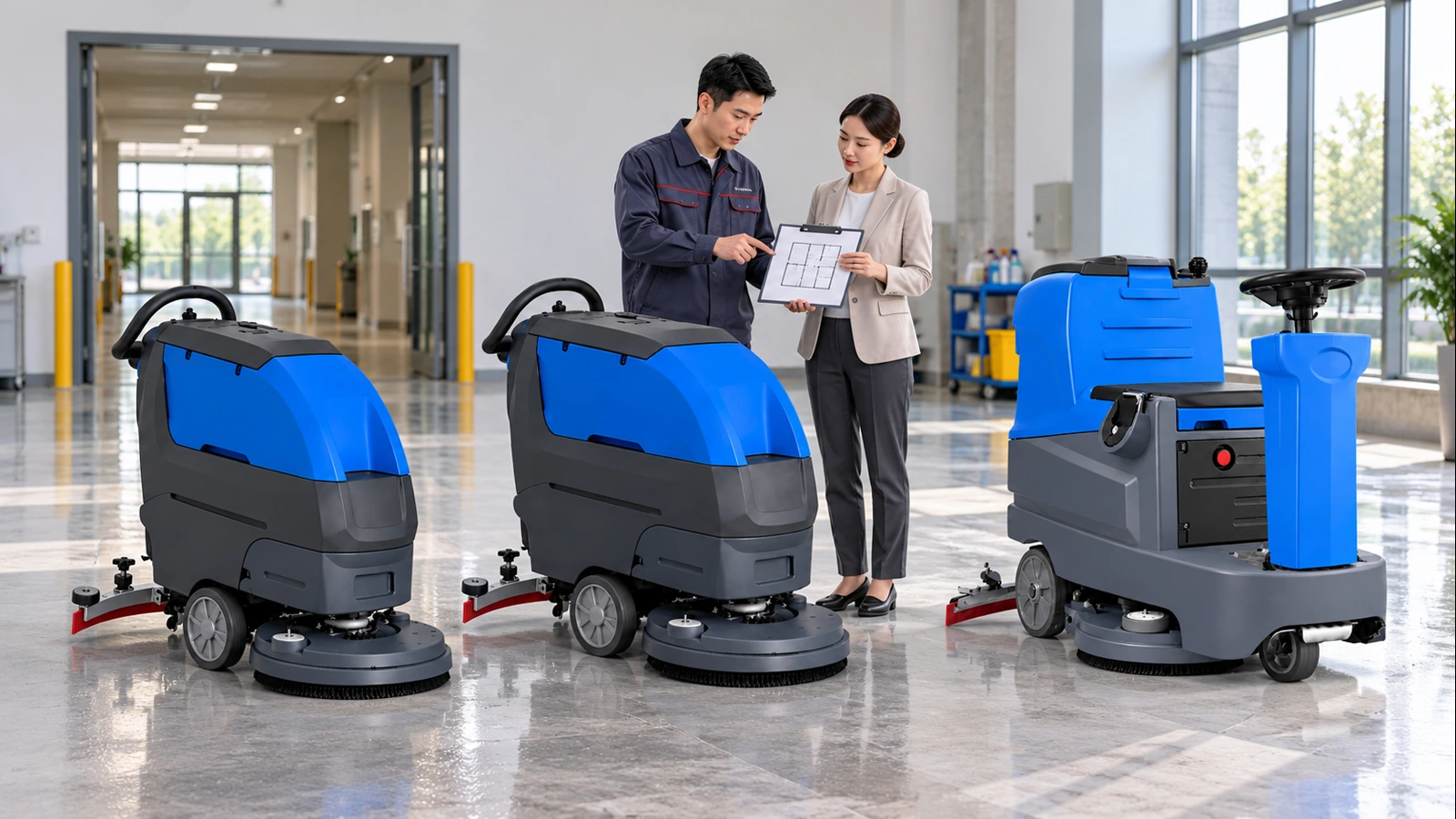
Define the daily cleaning task first. Floor area, access, turns and the time available all influence the choice of scrubber.
Put site conditions on one checklist
- Measure open floor, rack aisles and corners needing manual work separately.
- Measure the body, squeegee, doors, turns and passing places. Working width alone does not establish the required aisle width.
- Record flooring, loose particles, oil, standing water and changes in level. Select the process for each soil.
- Check water, wastewater disposal, charging, storage and transfers between floors.
Compare the operating method, then the configuration
For operator-propelled equipment, start withJ-D3C configuration、J-D3L configurationandJ-D3S configurationfor its specifications. For traction assistance, seeJ-D5SL configuration. Traction assistance still requires a walking operator.
For a move to seated operation, seeJ-56BF configurationfor access and operator requirements. Measure any labour savings for seated operation on the actual job.
Test the comparison on site
On the same floor and soil, record the pass, pickup, turns and finishing work. Compare against the same cleanliness requirement. Use measured working time alongside theoretical coverage.
Specify the battery, brush, recovery system, accessories and maintenance arrangements at purchase. Confirm missing details for the exact configuration.
Checks after reading
- Site area, routes and narrowest access
- Floor material, soil type and pre-cleaning
- Daily frequency and continuous working time
- Power, water, wastewater, consumables and service conditions
Explore products and selection information
Questions about this guide
Can floor area alone determine the model?
Measure the narrowest aisle, turning spaces, flooring, soil and available time. Area alone cannot determine model choice.
Is the cleaning width the minimum aisle width?
Check actual body and squeegee dimensions, turning clearance and space for passing traffic.
Why trial-clean when comparing machines?
A trial shows the floor finish, water pickup, handling and servicing arrangements. Compare these with theoretical coverage.