
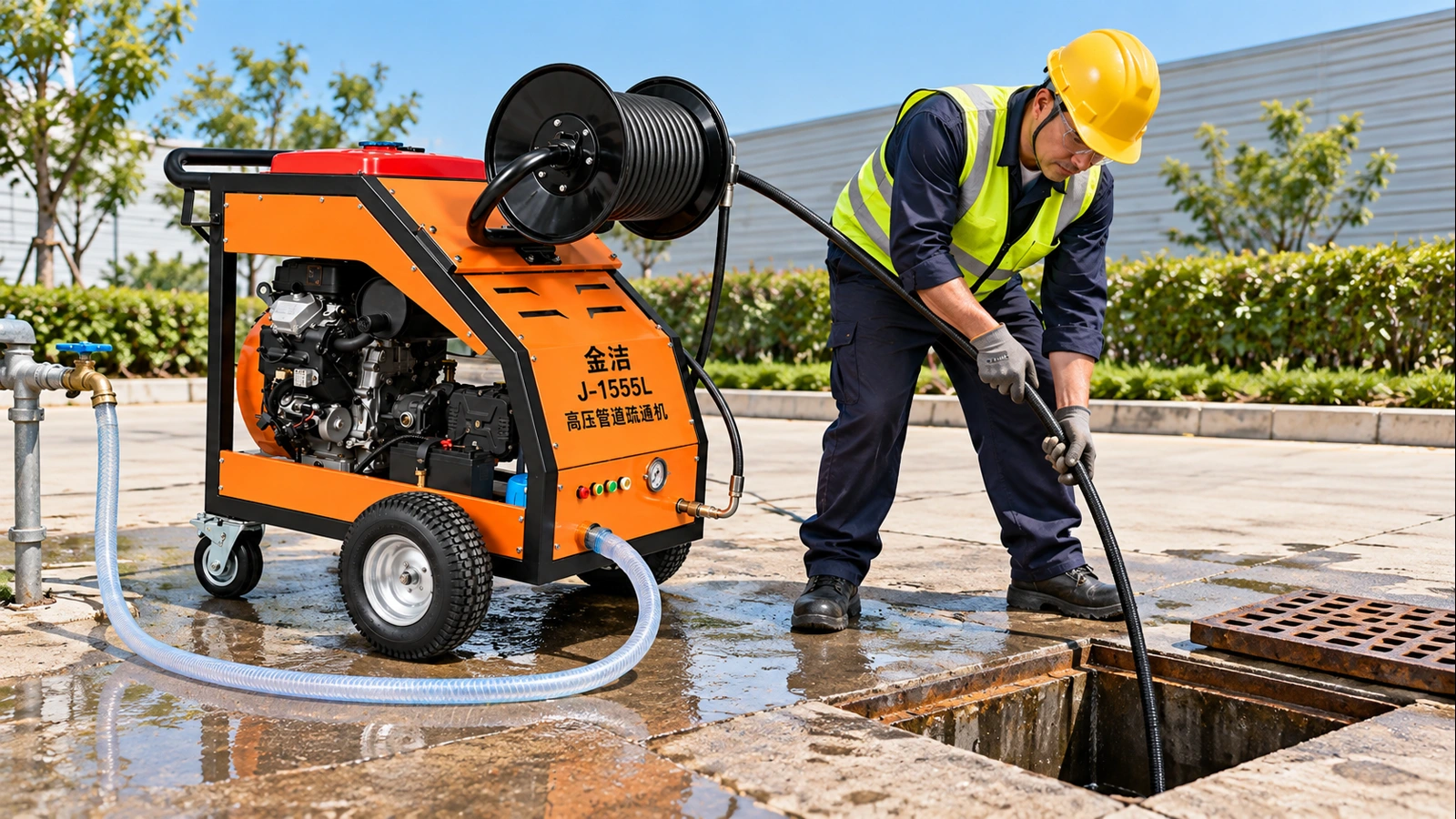
Assess sustained flushing requirements against deposits, length, bends, water and drainage.
Assess the need for sustained deposit transport
After loosening silt or sludge in factory and property drains, provide a discharge route. The J-1555L machine rating is 150 bar (15 MPa) and 55 L/min. Nozzle, pipe layout and drainage determine how much material is removed.
Plan water and wastewater handling alongside flushing
Record sustained water, access and wastewater routing/collection. Greater machine flow does not establish clearance of every blockage or sustained operation with inadequate water.
Interpret the base lance's flow separately
The earlier single-gun figure of 150 bar (15 MPa) and 35 L/min requires confirmation of nozzle, regulation and supply. The machine-level figure is 55 L/min. Check multi-gun capacity separately.
Conditions requiring another method
Assess collapsed pipes, lodged objects, roots and severe hardening separately. Provide pipe dimensions, bends, blockage, access and water/drainage; model names or hose length do not establish maximum diameter or effective distance.
Checks after reading
- Site area, routes and narrowest access
- Floor, dust, oil, debris or pipe-blockage type
- Daily frequency and continuous working time
- Power, water, wastewater, consumables and service conditions
Explore products and selection information
J-1555L at 150 bar (15 MPa) and 55 L/min for sediment: questions and answers
What does this article address?
Assess sustained flushing requirements against deposits, length, bends, water and drainage.
What site information is needed before equipment selection?
Provide area, aisle width, floor/pipe conditions, contamination, frequency, power/water, city and budget range.
Should we trial the 150 bar (15 MPa), 55 L/min J-1555L for sediment in our drains?
This article offers selection guidance. For complex sites, heavy contamination or continuous work, verify models and configurations through equipment information, video or a trial.