
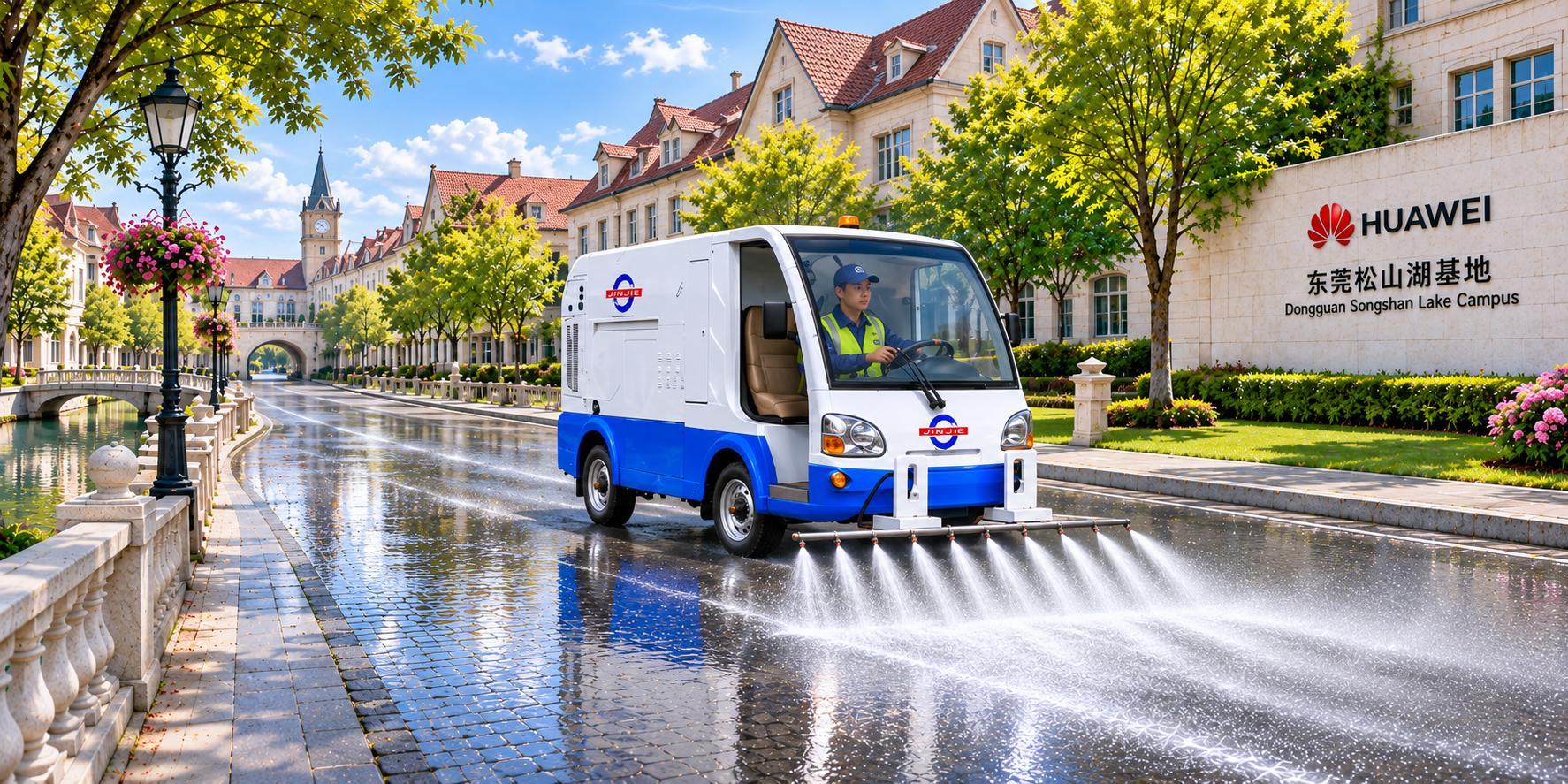
Sodexo (Hong Kong) Limited purchased a Jinjie JC-1800 four-wheel road washer for the Huawei campus at Songshan Lake in Dongguan. The site and the purchasing organisation had different roles.
Plan the working route
Record surface condition, traffic windows, stopping points and the location of water supplies. Follow the route from the first wash area to the refill point and back. A campus with the same road length may require a different schedule if traffic or drainage differs.
Assign tasks and check the equipment
Identify which sections need washing and where loose waste needs collecting first. Compare vehicle access, the water jet required at the surface, accessories, drainage and operator access. The campus illustration depicts the application. Use the actual proposed vehicle and accessories for the trial.
Accept the configuration on your own site
Run a representative section under the agreed site controls. Record the state of the surface, what remained after washing, water stops and the route back into service. Agree the equipment list, training and support arrangements against that record.
Applying the method to a site problem
To use this case as a reference, supply the road layout, cleaning objective, water supply and drainage. Confirm the equipment against the new site.
Sodexo’s road-washing application at Songshan Lake
Sodexo (Hong Kong) Limited purchased the Jinjie JC-1800 four-wheel washing vehicle for roads at Huawei’s Dongguan Songshan Lake site. Sodexo was the purchaser. For another campus, check road access, refill points, drainage and working windows before specifying a vehicle.
View Sodexo’s Songshan Lake road-washing application ↗
Applying a project example to a new task
Identify the purchasing organisation, operator, task and equipment in each project. Wanshenglong headquarters coordinates requirements and technical information, Guangzhou handles customer discussions, and Zhaoqing prepares equipment for delivery. Use the agreed specification for the current project.
What to record on site
Use the road project to identify access, refill, drainage and scheduling questions. Keep the purchasing organisation, model, site and reconstructed-image label with the reference. Assess new accessories and tasks against the new project.
How site conditions affect equipment performance
A road-washing vehicle coordinates movement, onboard supply and end tools for road work. A walk-behind washer has different operating requirements. Use the specification for the equipment in question.
Pressure washers · Jinjie JC-1800 four-wheel road-washing vehicle · Shenzhen headquarters and technical support · Guangzhou demonstrations and customer support · Zhaoqing manufacturing and delivery
Discuss equipment for your site ↗
Shenzhen Wanshenglong Cleaning Products Co., Ltd. | Jinjie JC-1800 four-wheel washing vehicle. Check the model specification and site conditions. Updated 2026-11-6.
Checks after reading
- Site area, routes and narrowest access
- Floor, dust, oil, debris or pipe-blockage type
- Daily frequency and continuous working time
- Power, water, wastewater, consumables and service conditions
Explore products and selection information
Campus road washing with the JC-1800 at Songshan Lake — frequently asked questions
Can we copy the equipment configuration from a case study?
Verify who purchased the equipment and what it did. For a new site, check surfaces, routes, utilities and delivery scope before adopting the configuration. A project photograph cannot establish unrecorded quantities or performance.
How can a case study help with procurement?
Use the case to identify the machine’s tasks, the work left to other processes, and responsibility for handover and maintenance.