

Central purchasing can simplify administration without making every supermarket identical. Stores differ in aisles, floors, operating windows and water-handling points. A purchasing program must connect the common order to the conditions in each store.
Group tasks before standardizing machines
Record shelving routes, checkout areas, chilled-display edges and available work periods. Promotions, customers and stock movement alter usable access, including after closing. Temporary spills, corners and routine machine scrubbing need clear responsibilities.
Stores with similar tasks may compare similar configurations, but batteries, brushes, squeegee parts, accessories and versions still require confirmation. Common training and part codes can help; one order does not prove all parts are interchangeable. Recheck suitability when a machine moves to another store.
Describe the CR Vanguard project accurately
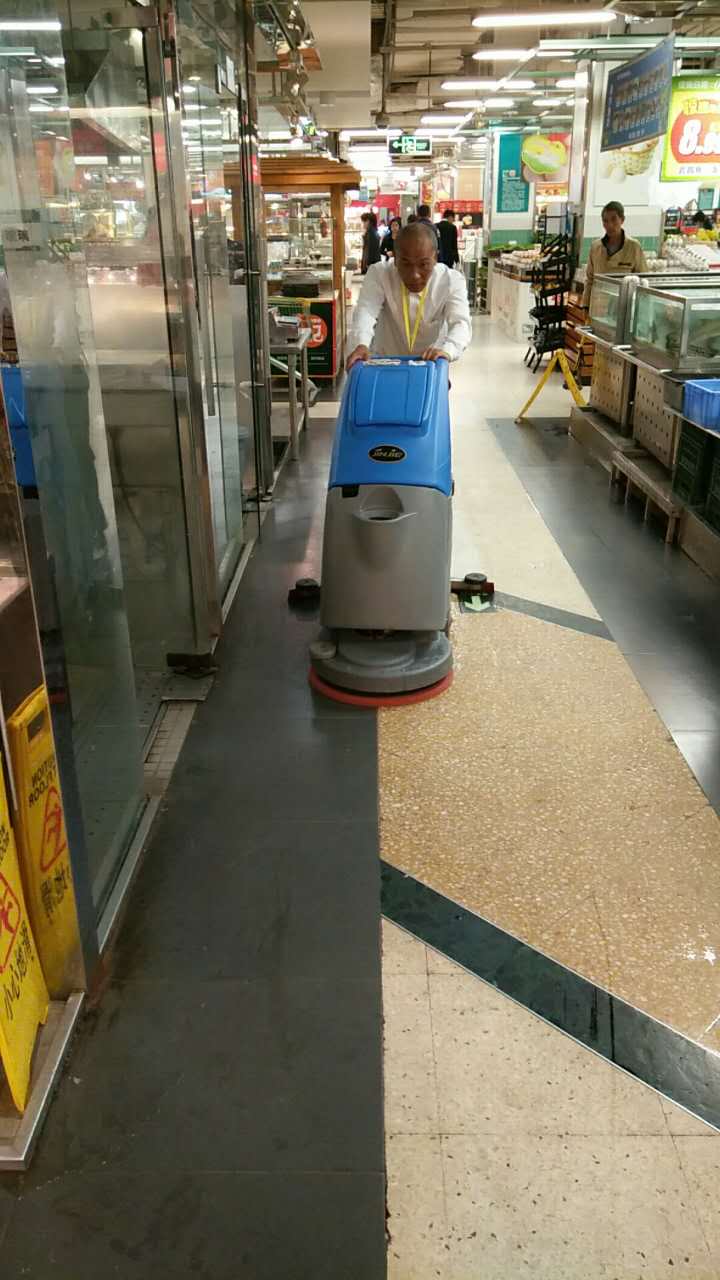
The confirmed project description is that a cleaning contractor responsible for CR Vanguard cleaning services centrally purchased Wanshenglong equipment for South China stores. It must not be described as a direct purchase by CR Vanguard. A scene image or current product link cannot establish one model for every historical store. Specific historical configurations depend on the project records.
This case illustrates the connection between group procurement and store-level deployment. It is not proof that J-D3C, J-D5R or another current model suits every supermarket.
Involve the receiving team
Keep the model, nameplate, assigned area, receiving staff, training and parts record together. Assign filling, emptying, charging, daily cleaning and fault reporting. Wanshenglong and the contractor should align the order scope with operating needs. New enquiries still need their own store information; do not extend the case into unrecorded quantities, uniform coverage or savings.
Practical acceptance check
Standardise identification, acceptance records, consumable codes and training documentation. Check access, surfaces and utilities at each store. One flagship-store trial cannot validate every branch. Reassess the route and tooling when shelving or flooring changes.
Applying the method to a site problem
A narrow store with frequent turns and a store with long open aisles may need different machines. Standardise the procurement process and check the configuration for each location.
Contractor purchasing and in-store use
The cleaning contractor serving China Resources Vanguard purchased Wanshenglong equipment centrally for stores in South China. The contractor handled procurement. Individual stores differed in flooring, aisles, restocking and cleaning windows. Check the delivery list for the model at each store.
View the contractor purchase and store application ↗
Applying a project example to a new task
Identify the purchasing organisation, operator, task and equipment in each project. Wanshenglong headquarters coordinates requirements and technical information, Guangzhou handles customer discussions, and Zhaoqing prepares equipment for delivery. Use the agreed specification for the current project.
What to record on site
Keep a store-by-store register of machines, operators, consumables and service history. Centralise training and maintenance records, then confirm the equipment for each site. Before transferring a machine, check the new store’s aisles, surfaces and access.
How site conditions affect equipment performance
Customers, restocking and cleaning crews share each store’s working window. Plan replenishment, cleaning, recovery and close-down within it. Procurement and store staff should use the same task description.
Floor scrubbers · Jinjie J-D3C Walk-Behind Scrubber-Dryer · Shenzhen headquarters and technical support · Guangzhou demonstrations and customer support · Zhaoqing manufacturing and delivery
Discuss equipment for your site ↗
Shenzhen Wanshenglong Cleaning Products Co., Ltd. | Jinjie J-D3C walk-behind scrubber. Check the model specification and site conditions. Updated 2026-11-6.
Checks after reading
- Site area, routes and narrowest access
- Floor, dust, oil, debris or pipe-blockage type
- Daily frequency and continuous working time
- Power, water, wastewater, consumables and service conditions
Explore products and selection information
Planning supermarket floor care across shifts and stores — frequently asked questions
Can we copy the equipment configuration from a case study?
Verify who purchased the equipment and what it did. For a new site, check surfaces, routes, utilities and delivery scope before adopting the configuration. A project photograph cannot establish unrecorded quantities or performance.
How can a case study help with procurement?
Use the case to identify the machine’s tasks, the work left to other processes, and responsibility for handover and maintenance.