
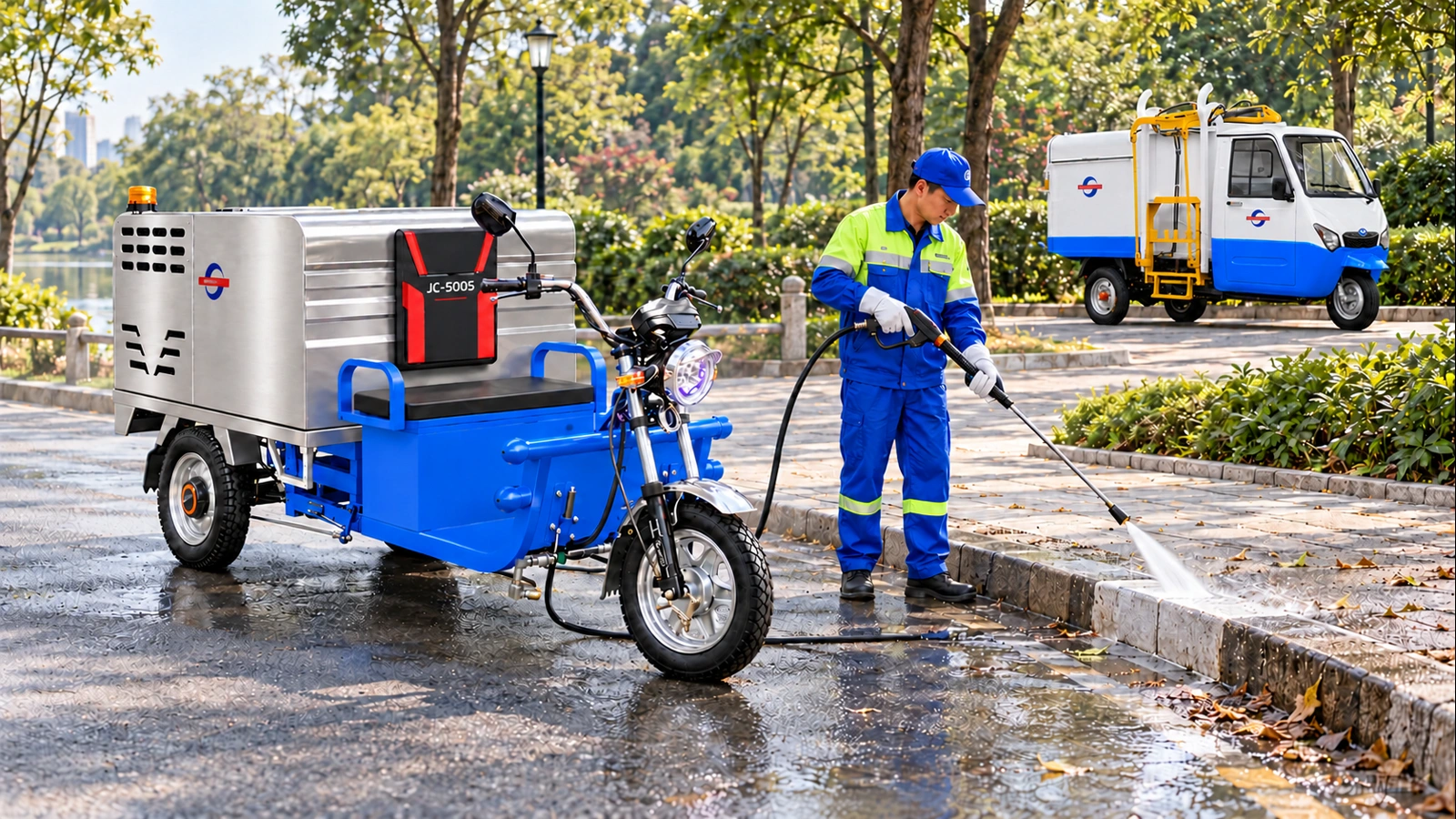
For road flushing, water sweeping and outdoor rounds, assess pressure, flow, tanks, battery runtime, working width and refill points when comparing three-wheel pressure-washing/water-sweeping and four-wheel pressure-washing vehicles.
Road washing and water-sweeping require more than pressure comparisons. Municipal roads, property estates, factory grounds, visitor routes and square kerbs differ in contaminants, operating radius and refill conditions. Match verified equipment capability to the route.
Distinguish pressure washing, water-sweeping and patrol cleaning
Three-wheel pressure-washing vehicles address property roads, estate kerbs, public-area stains and local washing. Three-wheel water-sweeping vehicles address dust, grit and accumulated road dirt on patrol routes. Four-wheel washing vehicles are considered for larger factory grounds and longer municipal routes.
For barriers, kerbs, drains, paving and oil-contaminated spots, identify the actual cleaning object before matching pressure, flow, tank capacity and vehicle dimensions.
Assess pressure, water capacity and operating range together
For road washing, assess pressure, nozzle configuration and hose length. Water-sweeping also requires assessment of working width, dirt/grit handling and refill frequency. Tank capacity, the source-mentioned48V battery arrangement, charging locations and shifts must be checked against the actual route and model.
Public tenders and outsourced-service notices often specify road area, work frequency, cleaning scope, staffing shifts and assessment requirements. These fields can inform equipment-selection discussions.
Related equipment and application solutions
JC-500S three-wheel pressure-washing vehicles, JC-500JY three-wheel water-sweeping vehicles and JC-1800 four-wheel pressure-washing vehicles are presented for estate washing, road water-sweeping and longer municipal cleaning routes respectively. Confirm the actual task and configuration.
— FAQ
How do three-wheel pressure-washing and water-sweeping vehicles differ?
Washing vehicles focus on pressure washing and local stains. Water-sweeping vehicles focus on road dust, grit and recurring water-sweeping. The choice depends on the route and contaminants.
Where should four-wheel washing vehicles be considered?
Four-wheel washing vehicles are considered for municipal roads, factory grounds, large estates and squares with longer routes and more dispersed refill points.
Public source references:National Public Resources Trading Platform
Source information
- Source name: www.ggzy.gov.cn
- Source title: National Public Resources Trading Platform
- Source link:https://www.ggzy.gov.cn/
Checks after reading
- Site area, routes and narrowest access
- Floor, dust, oil, debris or pipe-blockage type
- Daily frequency and continuous working time
- Power, water, wastewater, consumables and service conditions
Explore products and selection information
Selecting road pressure-washing and water-sweeping vehicles: pressure, tanks, runtime and routes — questions
What does this article address?
For road flushing, water sweeping and outdoor rounds, assess pressure, flow, tanks, battery runtime, working width and refill points when comparing three-wheel pressure-washing/water-sweeping and four-wheel pressure-washing vehicles.
What site information is needed before equipment selection?
Provide area, aisle width, floor/pipe conditions, contamination, frequency, power/water, city and budget range.
After reading “Selecting road pressure-washing and water-sweeping vehicles: pressure, tanks, runtime and routes”, is a site trial still needed?
This article offers selection guidance. For complex sites, heavy contamination or continuous work, verify models and configurations through equipment information, video or a trial.