
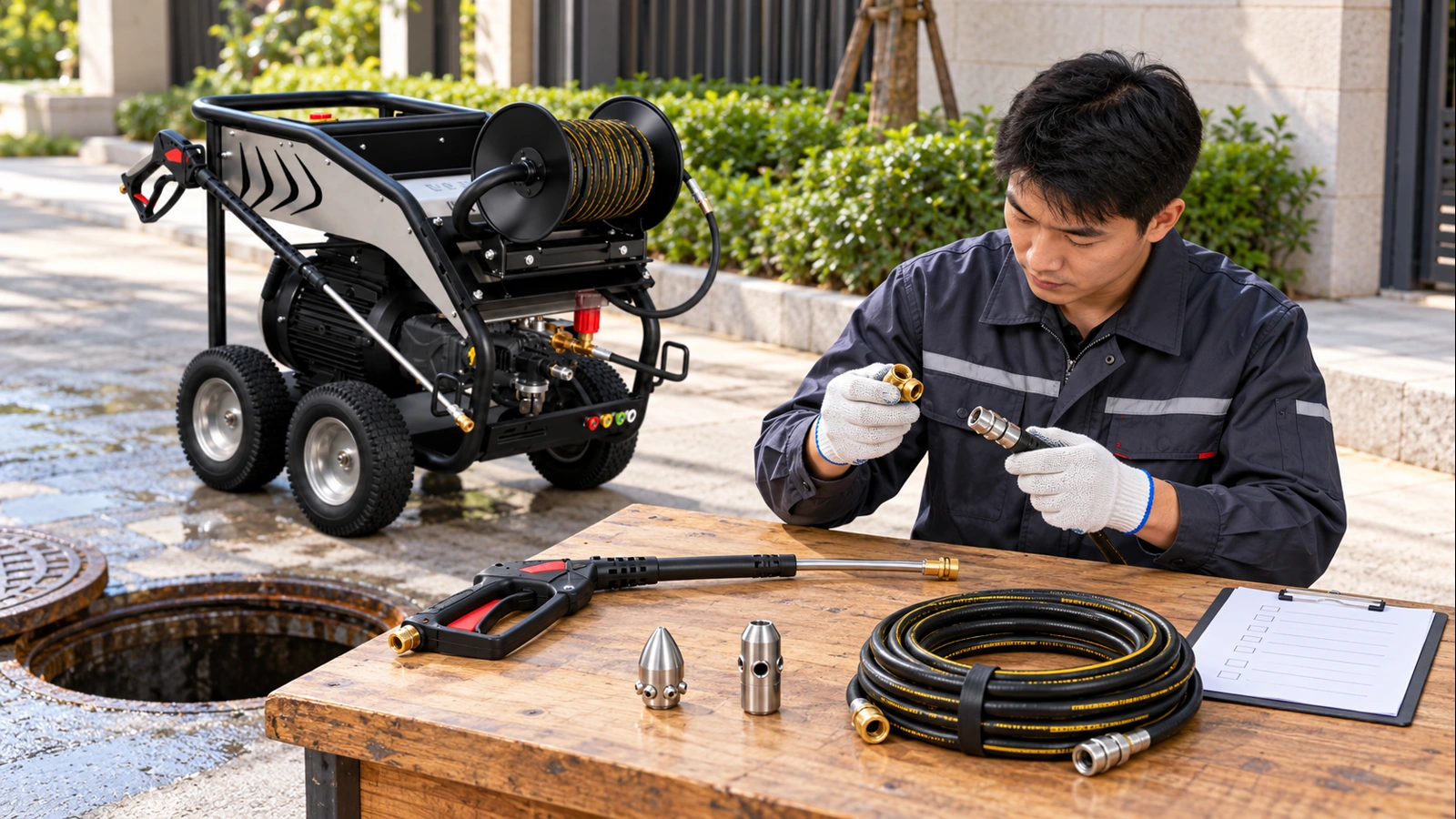
Drain jetting should not be selected by maximum pressure alone. Flow, hose length, nozzle angle and blockage material also affect suitability.
First distinguish surface washing from internal drain jetting. The source positions J-1020D for smaller property drains, kitchen discharge pipes and light-to-moderate blockages, and J-1730H/J-2050H for comparison on longer runs, larger diameters or heavier deposits. Confirm actual pipe and nozzle suitability.
At 100 bar (10 MPa), 20 L/min and 30 m of hose, water flow carries loosened material out of the pipe.
Confirm pipe diameter, number of bends, blockage material, water supply, wastewater handling, access-opening space and working distance.
Source information
- Source name: www.chinacleanexpo.com
- Source title: Compilation of public cleaning-equipment industry information
- Source link:https://www.chinacleanexpo.com/
Checks after reading
- Site area, routes and narrowest access
- Floor, dust, oil, debris or pipe-blockage type
- Daily frequency and continuous working time
- Power, water, wastewater, consumables and service conditions
Explore products and selection information
Selecting a drain jetter: pressure, flow, hose length, nozzles and pipe diameter — questions
What does this article address?
Drain jetting should not be selected by maximum pressure alone. Flow, hose length, nozzle angle and blockage material also affect suitability.
What site information is needed before equipment selection?
Provide area, aisle width, floor/pipe conditions, contamination, frequency, power/water, city and budget range.
After reading “Selecting a drain jetter: pressure, flow, hose length, nozzles and pipe diameter”, is a site trial still needed?
This article offers selection guidance. For complex sites, heavy contamination or continuous work, verify models and configurations through equipment information, video or a trial.