

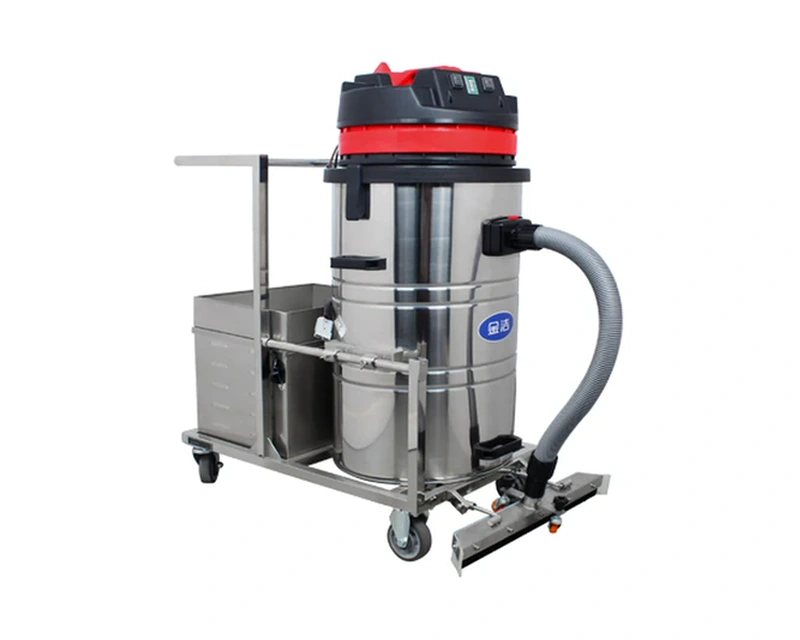
JGY-80P
Industrial vacuuming
Warehouse floors and around stored goods;Workshop workstations;Equipment rooms and locations without fixed sockets
Find products by model, equipment type or conditions.
8 models found
Industrial vacuuming
Warehouse floors and around stored goods;Workshop workstations;Equipment rooms and locations without fixed sockets

Industrial vacuuming
Offices and meeting rooms;Hotel rooms and carpeted corridors;Commercial shared areas


Industrial vacuuming
Metalworking areas in hardware factories;Around machine tools in engineering workshops;Warehouse floors and around stored goods

Industrial vacuuming
Ordinary workshop;Warehouse;Maintenance room and equipment surroundings

Industrial vacuuming
Textile workshop;Garment workshop;Packaging and light-industry workshops

Industrial vacuuming
Factory workshop floor;Production-equipment surroundings;Warehouse floors and aisles

Industrial vacuuming
Building-material factory;Stone-processing site;Construction-site warehouse
No matching products. Reset conditions or contact us.
Select up to three models to compare tasks and configurations.
No equipment selected.
Assess dust, fibres, metal chips, wet/dry mixtures and continuous work against airflow, vacuum, filtration, power and capacity; power alone is insufficient.
Describe dust, particles, wet/dry conditions and working time before airflow or vacuum specifications.
More power is not universally suitable. Describe material, particles, temperature and wet/dry conditions to avoid filtration or protection mismatches.
Check daily quantity, suction distance, filter cleaning, emptying, power and special protection.
| Compare models | Why consider this category first? |
|---|---|
| JGY-3078P | Assess the 80 L container, filtration and cleaning system together with airflow, vacuum and hose requirements. |
| JGY-3070 | Check this model's own dust/debris configuration; do not reuse JGY-3078P specifications or videos. |
| JGY100-75 | For gravel and heavier solid waste, verify particle size, pickup distance and emptying method. |
Container capacity affects emptying; airflow and vacuum depend on resistance. A series name does not prove wet/dry capability, filtration grade or certification.
Without appropriate evidence, no suitability for combustible/toxic dust, hot chips or corrosive materials is promised. Assess JGY-3078BA against its own records, not another model's evidence.
Check the model nameplate, configuration and accessories. Trial critical cleaning conditions and access on site before purchase.
Provide material/photos, daily quantity, temperature, wet/dry state, hose distance and power. We draw on over 20 years of experience and identify items requiring confirmation.
Submit conditions to compare configurationsDust, debris and liquids have different collection requirements. Confirm material properties, temperature, dry or wet condition and hose distance before comparing filtration, filter cleaning and emptying.
No. Combustible, toxic, hot or corrosive materials require appropriate evidence and protection. Do not substitute an ordinary vacuum without proof; provide material information first.
Only documented specifications are shown; unspecified airflow, vacuum or filter area is not filled with placeholders.
Cards show images, models, positioning and confirmed key specifications; consult details for full capability.
Show confirmed fields; do not fill unknown or candidate specifications with public placeholders.
For workshop dust, grit and ordinary production debris, assess dust load, container capacity, filtration and filter cleaning first.
Lightweight fibres may entangle and clog filters; assess filter design, airflow, filter cleaning and hose diameter.
For heavy particles, assess vacuum, hose diameter, filter protection and safety limits.
Only documented wet/dry models qualify; container size does not establish liquid pickup capability.
Assess 220 V for ordinary light-industrial supply, 380 V for fixed industrial sites, and battery configurations for mobile work without outlets.
Without documented duty data, do not invent runtime or all-day continuous-operation claims.
Compare dust load, particle weight, capacity and filtration; ordinary dust and heavy dust require different assessments.
Compare: JGY-3070 / JGY-3078A / JGY100-75For bulky light lint, assess filtration, airflow, cleaning and hose diameter.
Compare: JGY-3610PFor heavy particles, assess vacuum, pickup-tool design, hose diameter and filter protection rather than power alone.
Compare: JGY-3078P / JGY100-75Large floors emphasize coverage; equipment recesses and workstations may suit hose vacuuming.
Compare: JGY100-75 / JGY80-40Assess battery equipment for mobile workstations, warehouse rounds and temporary cleaning, checking runtime, charging and suction requirements.
Compare: JGY-80PCompare documented wet/dry models and confirm liquid load, filter protection and draining.
Compare: JGY-3078P / JGY-3078A| Assessment factor | What it means | Selection reminder |
|---|---|---|
| Power | One indicator of motor input/output capability. | Power is not equivalent to suction; assess airflow, vacuum, filter resistance and tool design. |
| Airflow | Relates more to air and light-dust transport per unit time. | Lint, cotton dust and broad dust collection often emphasize airflow and unobstructed filtration. |
| Vacuum | Relates more to overcoming resistance and lifting heavier particles. | For metal chips, grit and long hoses, compare vacuum, hose diameter and pickup tools. |
| Hose | Length and diameter affect airflow resistance and working reach. | Longer hoses and more bends increase demands on airflow, vacuum and unobstructed filtration. |
| Dust type | Light dust, heavy particles, wet/dry mixtures and corrosive liquids have different operating limits. | Ordinary industrial vacuums are not assumed suitable for sparks, hot particles, combustible dust or corrosive liquids. |
| Factor | Description | Public display rules |
|---|---|---|
| Filtration method | Assess filter area, star filters and cartridge filters by the exact model configuration. | Present documented facts only, not candidate references as confirmed configurations. |
| Filter-cleaning method | Manual shaking, manual reverse-air and automatic reverse-air cleaning affect maintenance frequency. | Show a specification only when documented for that exact model. |
| Continuous operation | Continuous cleaning requires assessment of motors, cooling, filter resistance, container capacity and filter cleaning. | Do not invent operating hours without documented continuous-duty data. |
| JGY-3078P demonstration | 3600 W, 220 V, 572 m³/h, 205 mbar, three independently controlled 1200 W motors, nonwoven star filter, 26800 cm², 80 L, manual reverse-air cleaning, wet/dry use, 40 mm, 8 m cable/hose; retain source configuration boundaries. | These specifications apply only to this model and must not be copied to other industrial vacuums. |
Prioritize the first option when:Consider JGY-3078P where airflow, vacuum, filter area and filter-cleaning details need closer assessment.
Compare the alternative model:Compare JGY-3078A for assessed routine factory and general wet/dry tasks.
Prioritize the first option when:For mixed dust and routine maintenance, consider JGY-3078A or JGY-3078P.
Compare the alternative model:Compare JGY-3610P for assessed lint, cotton dust and light-fibre tasks.
Prioritize the first option when:High dust loads, frequent cleaning and fixed workstations require assessment of airflow, vacuum and filtration.
Compare the alternative model:Consider JGY100-75 for gravel, heavy solid waste and high-capacity collection tasks.
Prioritize the first option when:Compare JGY-80P for mobile rounds without fixed power.
Compare the alternative model:Compare 220 V/380 V industrial vacuums for sustained fixed-workshop duties.
Sparks, hot particles, combustible dust/metals, corrosive liquids and large liquid loads require specialist assessment.
Only explicitly wet/dry-rated models enter that selection direction; capacity and appearance are insufficient evidence.
Commercial vacuums emphasize noise, portability and light office/hotel dust; industrial selection emphasizes dust load, filtration, capacity, airflow/vacuum and sustained duty.
 Selecting industrial vacuums for dust, metal chips, grit and fibresAssess industrial vacuums by dust, metal chips, grit, fibres and wet-pickup requirements rather than power alone.
 Choose an industrial vacuum by the material it will collectIdentify the material being collected before comparing bin capacity and motor ratings.Building a matching set of vacuum tools, hoses and connectorsCheck the working tool, hose and connections on site.How filtration, sealing and filter cleaning work togetherFor fine dust, review filter media and seal integrity alongside suction.Tracing suction loss from the pickup tool to the filterA change in sound, slow pickup or repeated blockages can originate in the material, hose, filter or machine.Choosing an industrial vacuum for sustained dutyAssess continuous duty against the particular machine and working conditions.
Not necessarily. Power is only one factor; suction also depends on airflow, vacuum, filter resistance, hose length/diameter and tool design.
It depends on the dust. Airflow matters more for light dust, lint and broad pickup areas; vacuum matters more for heavy particles, long hoses and higher pipe resistance.
Compare 220 V or battery options for light/mobile work, and 380 V configurations for assessed fixed, higher-power or frequent continuous duties.
Recommend wet pickup only where wet/dry capability is explicit; a large container does not prove liquid suitability.
Some industrial vacuums can collect metal chips and machining debris. Confirm weight, temperature, sparks, hose diameter and filter protection.
Light, bulky fibres can tangle and accumulate on filters; assess area, structure and cleaning method.
Yes. Longer hoses and bends add airflow resistance; results depend on airflow, vacuum, diameter and filter resistance.
Do not assume suitability. Sparks, hot particles, combustible dust or metals and corrosive liquids require specialist assessment and appropriate protection.
Provide dust, liquids, frequency, power, hose length, filtration and daily hours to narrow vacuum options.
Assess suction, filtration, capacity, mobility and recovery process. Different dust, chips and liquids need different structures.
Dust, metal chips, gravel, packaging debris and liquids require different assessments, particularly explosion protection, filtration grade and wet/dry capability.
Frequent-duty workstations and central collection areas require capacity, filtration maintenance and efficient emptying to avoid repeated interruptions.
Fixed points, workshop transfers and restricted areas need appropriate chassis, hoses and attachments for routine deployment.