CN EN
Jinjie J-1730H high-pressure pipe jetter property wellhead jetting operation
Jinjie · pipe jetting equipment

Jinjie J-1730H high-pressure pipe jetter

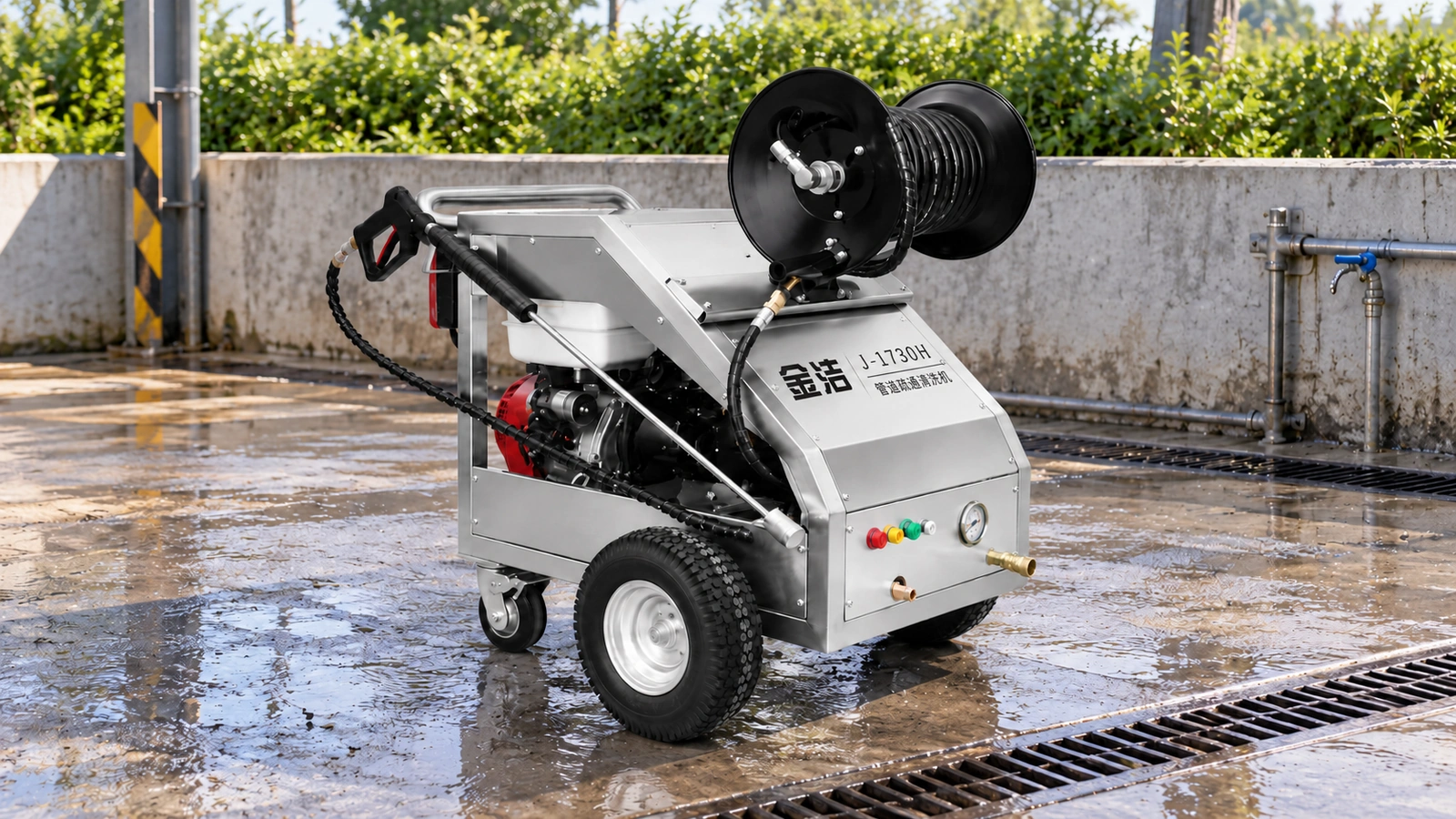
This machine is more suitable for outdoor drainage maintenance points without fixed power supply, with gasoline power convenient for following inspection wells, and the black coiling tube tool works in conjunction with hose retrieval and organization.

170bar(17MPa)30L/minPetrol power

01 Intended use

For maintenance of outdoor branch lines without a fixed power source, a gasoline-powered unit is convenient for moving between points, with a black roll hose compatible with hose handling. Water supply and fuel are arranged simultaneously.

02 Key performance figures

170 bar (17 MPa)combined with 30 L/min water flow, balances the scouring of the pipe wall and the loosening of dirt for removal; the nozzle and pressure selection should be combined with the pipe material and the type of blockage.

03 Working configuration

The gasoline engine and black roll pipe are used according to the machine's version. When transferring outdoors, confirm the exhaust, fuel, water supply, and hose retrieval routes.

Product and operation video

J-1730H Product Introduction Video

View the model's appearance and operation; discuss configuration against actual site conditions.

J-1730H Selection Consultation

Provide cleaning tasks, site conditions and frequency to confirm suitable configuration.

Enquire about this model
Start with your site

Where is the pipe that needs treatment? From your task begins.

Around the gasoline-powered outdoor sweep, the black roll tube is used in conjunction with daily feed and retrieve of the hose. First, find the nearby task, then judge based on the on-site conditions.

What would you like to clean?

What maintenance aspects need to be considered together for the pipeline?

When choosing J-1730H, consider the actual pipeline and the following issues together to avoid comparing only one parameter.

Water sources are dispersed, so when the field changes, the machines are not just moved.

The gasoline-powered model solves the dependency on external power sources for operation, but water supply and drainage still require preparation at specific locations.

Keep the work hose stored, then start at the next position.

View hose, fittings, and bends, organized according to this machine's training, to avoid continuing work with unaddressed damage.

Outdoor start-up also needs to consider the surrounding environment

Confirm the opening of outdoor, exhaust, and personnel and vehicle activities, and do not interpret "no fixed power supply" as meaning it can be used anywhere.

Site conditions, configuration and selection

J-1730H, how do you match your pipeline conditions?

The gasoline-powered outdoor sweeper is equipped with a black roll hose that is used for regular feed and retrieve of the hose. The specific configuration still needs to be combined with the machine's documentation, pipeline conditions, and trial operation to confirm.

01 dispersed property inspection wells

Outdoor points, machine parking, and water source.

02 drainage outside the factory area

Well distance, vehicle activity and hose path

03 Routine Branch Patrol

Blockage characteristics, elbows, and recovery conditions

04 Frequent Transfer Tasks

Fuel, hose feeding and refilling position.

Field or taskConfiguration and conditions of interestJ-1730H Selection Judgment
Disperse property inspection wellOutdoor points, machine parking, and water source.Not relying on a fixed power source, but each point still needs to ensure water supply and drainage.
Factory perimeter drainageWell distance, vehicle activity and hose pathWork in sections. Route the equipment clear of vehicle wheels and pedestrian trip hazards.
Daily branch line maintenance.Blockage characteristics, elbows, and recovery conditionsUse typical points to understand the progress and retraction situation, without guaranteeing the processing distance based on hose length.
Frequent scene changesFuel, hose feeding and refilling position.Compare complete shifts' transfer, supply, and removal; do not just look at continuous rinsing time.
Clean pipe diameter and inletClear pipe bore, pipe material, narrowest access point and bendsProvide dimensions or a pipeline diagram to determine whether the nozzle and working pipe can enter, bend, and safely retrieve.
Pipe length and segment division.Two well spacing, elbow count, and available working hose lengthSeparate the length of the work hose from the actual reachable distance; first evaluate the segment plan for long lines or complex bends.

Bring these four sets of on-site documents together and assess them collectively.

  1. Clean pipe diameter, pipe material, total length, well distance, elbows, and blockage indications such as oil, sand, or hard objects.
  2. Inlet size, nozzle outer diameter, connection, working pipe length, and advance and recovery routes
  3. Open the outdoor area, fuel, and transfer conditions, as well as a continuous water supply.
  4. Discharge destination, daily working hours, and maintenance schedule.
Place the equipment at the site.

Application scenarios and operating conditions of J-1730H

Use the existing scenario diagram for this model. Specific configurations and On-site conditions can Be discussed together with photos

J-1730H Wellhead hose feeding, daily blockage handling is more convenient, AI application scenario illustration.

J-1730H | Pipe jetting

Not relying on a fixed power source, but each point still needs to ensure water supply and drainage.

J-1730H Multi-nozzle flushing

J-1730H|optional pipe jetter reference

Arrange tasks and orders to confirm attachments, nozzles, and compatible operating conditions; do not consider display images as standard or multi-person multi-gun capability.

Configuration and technical parameters

First understand several configurations related to the job

Pressure indication, overall flow, and power should be compared; working pressure, maximum pressure, and allowable operating conditions also need to be verified against the corresponding technical data.

Pressure indication

170bar(17MPa)

Overall flow rate indication

30L/min

Power type

Petrol power

Full specifications for View +
Product modelJ-1730H
Pressure indication170bar(17MPa)
Overall flow rate indication30L/min
Power typePetrol power
Hose-reel specificationsBlack hose reel

Flow rate is not a guarantee for the diameter or distance of the pipe that can be cleared. Actual progress, flushing, and operation time are also affected by the pipeline, nozzle, water supply, and blockages.

Exterior view of the J-1730H
Appearance of J-1730H product
Look at the picture to understand the equipment.

Components and their functions

The left figure shows the overall appearance of this model, with six items indicating functional descriptions; do not misrepresent general descriptions as internal structure diagrams.

01 frame and transport

Park the main unit according to the outdoor point arrangement and move it for transfer, leaving space for the hose entry and exit and on-site passage.

02 Power and Supply

The gasoline-powered model is convenient for moving between locations without fixed power sources; water supply, fuel, and exhaust conditions should be implemented simultaneously.

03 high-pressure pump and water source

A machine flow rate of 30 L/min needs a continuous water supply. Check the pump type and allowable operating conditions in the documentation for the machine.

04 work pipe and fitting

Before each shift, check the roll tube organization and connection status according to the instructions, and keep records of fuel, power anomalies, and wear of the working tubes.

05 nozzle and flushing

Select an appropriate nozzle based on the pipe material, blockage type, and inlet; arrange the advancement, retraction, and direction of the waste together.

06 coiling and operation of the hose

Black roll pipe adapter working with the hose organizer, advance and retract the hose and finish according to the machine instructions and training schedule.

Operating principle

From the pump group pressurization, to the nozzles scrubbing and the removal of the dirt.

Look at the direction of clean water flow and waste matter, then determine how to coordinate with your pipeline. This is a general jetting process explanation. Specific operations are carried out according to the machine's manual and training.

01 Pump Group Pressurization

The gasoline engine drives the pump unit, which pressurizes the incoming water and sends it to the working hose. The main unit is arranged in an open outdoor area, with fuel and continuous water supply prepared.

02 Work Pipe Transport

The water is delivered to the jetting nozzle via the work hose; the length, bend, and connection conditions affect the end conditions, and the hose length is not equal to the effective jetting distance.

03 nozzle directional flushing

Outdoor dispersed points require sequential verification of entrances and nozzles, and the coiled tube retriever organizes working pipelines, which is not equal to automatic pipeline feeding.

04 Water flow with contamination and collection

The waste from flushing still needs to be discharged with water and properly collected, combined with segmented treatment at inspection wells to avoid the re-deposition of waste downstream.

Professional configuration

How do the work hose, spray nozzle, and reel structure work together to perform tasks?

First, clarify the pipeline and waste, then match the working hose, jetting nozzle, and water supply and drainage. Whether the accessories are standard and their specific specifications are subject to the delivery list of this model.

How to coordinate pressure and water volume with the task?

170 bar (17 MPa)combined with 30 L/min water flow, balances the scouring of the pipe wall and the loosening of dirt for removal; the nozzle and pressure selection should be combined with the pipe material and the type of blockage. The pressure and pipe diameter should be referred to the machine's data, and the maximum pressure cannot be considered as the continuous working pressure.

How to select the appropriate work hose based on pipe diameter and pipe length?

Pipe diameter limits nozzle size and clearance. Assess pipe length together with bends and access points. The hose length in the machine specification alone does not establish how far a blockage can be cleared.

Different blockages require different working attachments

Distinguish between oil, loose sand, and hard objects blocking; select separately the internal spray nozzles and surface cleaning attachments, and check the hole size, interface, and pressure according to the specifications of this machine.

Correspondence between nozzles, work pipes, and pipeline tasks
What does the customer provide?What needs to be matchedHow to make a selection and judgment?
Clear pipe diameter, inlet, and elbowNozzle outer diameter, working pipe and connection formVerify whether it can enter, turn, and retrieve, not only comparing the cleaning pressure.
Oil, sand, or other blockagesNozzle spray form, pressure flow and pipe material resistanceFirst, distinguish between soft, removable debris that can be flushed and hard objects or blockages that require separate handling.
Total length of the pipeline and distance between the two wells.Working hose length, hose winding and segment position.The length is determined based on the actual delivery, combined with the end conditions, and no fixed effective distance is promised.
Pipe jetting or auxiliary surface cleaning.Specialized pipe jetter nozzle or corresponding cleaning attachmentTwo types of tasks should be checked separately against the interface, operating conditions, and delivery list; no conclusion can be drawn from the display images regarding the standard configuration.

Combine the machine's details for further understanding of the configuration.

J-1730H · Petrol power, pump head and black hose reel
J-1730H · Black reel, brass fittings, high-pressure hose and jetting nozzle
Comparison of similar models

How do I choose between J-1730H and similar configurations?

First, check the pipeline task, then compare the power and pressure ratings and water volume. Boundary models use task or power references, which do not necessarily mean the left or right model is smaller or larger.

Comparison criteriaAppearance of J-1730D productJ-1730D →Appearance of J-1730H productJ-1730H →Appearance of J-1730HS productJ-1730HS →
Pressure indication170bar(17MPa)170bar(17MPa)170bar(17MPa)
Overall flow rate indication30L/min30L/min30L/min
Power type380V electric powerPetrol powerPetrol power
What is the main focus of this product?Industrial power supply at fixed points, with daily maintenance organized around the inspection well.Gasoline-powered outdoor sweepers, black roll-up hose attachments for regular feed and retrieval of the hose.The 304 stainless-steel hose reel is intended for frequent deployment, rewinding and storage on site.
Power and site arrangementFixed point power supply and work hose line, eliminating fuel preparation.Open the outdoor area, fueling station, and dispersed points for transfer.Open the outdoor area, fueling station, and dispersed points for transfer.
Tube and working attachment attention.Operate the working attachment according to the machine's hose reel design, interface, and task configuration.Black roll pipe adapter; compatible with work pipe and nozzle304 stainless steel coiling tool; compatible with the working hose and nozzle

Pressure diameter, flow test conditions, and specific configuration need to be confirmed separately; they should not be based on the highest numerical promise for applicable pipe diameter, distance, or shift output.

Operating cost

How to calculate the complete cost of a single pipeline maintenance?

Divide the inspection of scattered property manholes into specific tasks and statistically count them according to the four stages: preparation, operation, supply, and conclusion.

Prepare for actual manual work.

Outdoor multi-point tasks separately record fuel, water source preparation, hose retrieval and transfer time, then compare with the fixed electric plan for the same task. If needed, communicate with the site to understand or arrange trial operation.

Energy, consumables, and disposal

Record the amount of gasoline, actual water used, wear and tear of the work hose and nozzle, daily maintenance, and waste disposal separately.

Compare under the same task.

Compare the same pipeline, same completion requirements, and same cycle. Procurement costs and depreciation allocation are not added redundantly, and no preset savings ratio or payback period is assumed.

MAINTENANCE

Before and after each operation, check these positions.

Specific steps, maintenance cycles, and disassembly requirements shall be followed according to the machine's manual and training, and the web is not to be used instead of the maintenance manual.

Site checks before work begins

Outdoor points, machine positioning, and water source are key factors. After task changes, re-evaluate and do not carry forward the previous on-site conclusions.

Work hose and fitting.

Before each shift, check the roll tube organization and connection status according to the instructions, and keep records of fuel, power anomalies, and wear of the working tubes.

Correspondence between nozzles and task records

Record the type of pipe material, the type of blockage, and the type of nozzle used, and inspect for visible damage; the cleaning method should be carried out according to the machine's instructions.

Power and Accessories

Check and maintain the machine according to the gasoline power instructions. The maintenance cycle, fuel type, or electrical requirements cannot be applied to similar models.

Feed and retrieve the hose and park the machine.

Follow the machine training to organize the work hose, coil hose, and body, record abnormalities, and do not carry over unresolved faults into the next task.

Abnormal Feedback

Retain the model, configuration, operation time, and abnormal phenomena; after following the instructions to stop the machine, contact after-sales service, and do not attempt to disassemble the hose under pressure or modify the protection settings on your own.

Delivery and after-sales service

Six delivery and after-sales services, with corresponding support before and after use

Service scope, costs, and on-site arrangements are confirmed based on the actual project and agreement.

Delivery inspection

Check the equipment, configuration, and random documents together before delivery.

Operator training

Combine the machine's working pipe, nozzle, and on-site conditions for understanding operations.

Usage guidance

Bring the model number, pipeline conditions, and usage issues for communication.

Parts supply

Check the work hose, nozzle, fittings, and consumables against the machine version.

On-site fault repair

Service scope, costs, and arrival arrangements should be confirmed in advance.

Scheduled on-site maintenance

Combine usage frequency, location, and actual agreement arrangements.

— FAQ

You may also be interested in J-1730H

Bring in the specific pipeline conditions you are concerned about, and continue to communicate the specific configuration.

What is the most important feature to consider when selecting J-1730H?

For outdoor branch line maintenance without a fixed power source, a gasoline-powered unit is convenient for moving between points, with a black roll pipe tool and hose handling. Water supply and fuel should be arranged simultaneously. Specific applicability still depends on the pipeline, blockage, and site conditions, and is not guaranteed by the model name.

How should pressure and flow be viewed respectively?

170 bar (17 MPa) combined with 30 L/min water flow balances the scouring of the pipe wall and the loosening of dirt for removal; the nozzle and pressure selection should be combined with the pipe material and the type of blockage. The indicated pressure, maximum pressure, and sustainable operating conditions should be checked separately, and the pressure value is not guaranteed to handle all blockages.

How to arrange the turn-around between dispersed manholes?

First, confirm the open outdoor space for the machine body parking, hose inlet, and hose retrieval. Then, divide the work into sections based on the well spacing. Also, confirm the fuel, water source, and wastewater collection points as needed.

What are the on-site conditions required for the machine's power?

Gasoline internal combustion engines are not used in indoor or semi-enclosed spaces; even in open outdoor areas, exhaust, fuel, fire sources, water supply, and drainage must be arranged according to the instructions.

How does the black roll pipe adapter work with daily maintenance?

Combine this machine manual to understand the handling and organization of the work hose, check the connections, winding, and wear; the hose structure is convenient for organization but does not increase the effective cleaning distance.

How to choose between J-1730H and J-1730HS?

Two models can be compared around the roll tube structure: the black roll tube of this machine and the stainless steel roll tube structure of HS should be confirmed according to the actual version, and then judged based on the frequency of hose retrieval and usage environment.

Where should daily maintenance begin?

Keep the original manual and configuration sheet. Check the water source, working hose, nozzle, fittings, coiled hose, and power status according to the instructions. Do not use cycle, oil type, and disassembly information from other models.

What to do in case of pressure fluctuation, water leakage, or abnormal hose insertion/removal?

First, follow the machine's instructions to shut down and handle the machine. Record the water supply, nozzle, pipeline, and any abnormal phenomena, then contact after-sales service. Do not disconnect the pipe without pressure, and do not adjust the safety valve setting on your own or force the pipeline to be sent.

J-1730H in use
Product enquiry

Let's talk about your pipelines to see if J-1730H is suitable

First, discuss the actual pipelines of the dispersed property inspection wells, then organize the outdoor points, machine parking, water sources, and daily work arrangements together.

Phone consultation:0755-25621811

Start with the actual pipeline and together determine the configuration.

Outdoor multi-point tasks separately record fuel, water source preparation, hose retrieval and transfer time, then compare with the fixed electric plan for the same task. If needed, communicate with the site to understand or arrange trial operation.