
01 Intended use
- Medium to small push-type floor scrubber
- For commercial sites such as shopping malls and office buildings, first verify the traffic, floor materials, and operating hours, then arrange the equipment.

The Jinjie J-D3L is a walk-behind scrubber for staged cleaning of retail and warehouse aisles. Its 510 mm scrubbing coverage and wastewater recovery should be assessed with operating windows, pushing distance and water points.
View the model's appearance and operation; discuss configuration against actual site conditions.
Provide cleaning tasks, site conditions and frequency to confirm suitable configuration.
Enquire about this modelDivide the business area, shelf aisles, and entry/exit points into separate routes, record the cleaning window and areas that need to be avoided. J-D3L should be pushed by personnel, and for longer straight routes, the full load operation feel should be checked. When comparing J-D3C or self-propelled equipment, use the same floor material, dirt, and timing range, rather than just looking at the water tank or theoretical area.
Shelf spacing, water resistance of doors and floors
Elevator size, corridor, and parking location
Water replenishment, frequency, and pedestrian traffic.
Actual cleaning area and personnel pushing.
| Site type | Configuration that requires attention | J-D3L Selection Recommendation |
|---|---|---|
| Commercial stores | Shelf spacing, water resistance of doors and floors | First, confirm the narrowest passage and turning space, and coordinate with the business hours for cleaning. |
| Office floor | Elevator size, corridor, and parking location | Verify the floor transfer and charging schedule, suitable for daily cleaning on hard surfaces with clear conditions. |
| Property common areas | Water replenishment, frequency, and pedestrian traffic. | Schedule the cleaning and recovery by floor zones, handling mud and large debris first. |
| Small and medium commercial spaces | Actual cleaning area and personnel pushing. | Combine available working time with the burden of implementation to determine if the hand-pushed method is appropriate. |
The above is a reference for selection; finally, combine with the machine's configuration, on-site dimensions, and trial operation confirmation.
Starting from the areas you need to clean daily, combined with traffic routes, dirt, and work hours, determine if it is appropriate.

For small areas with frequent cleaning, assess turns, doorways and filling/draining locations.
Look at relevant scenarios →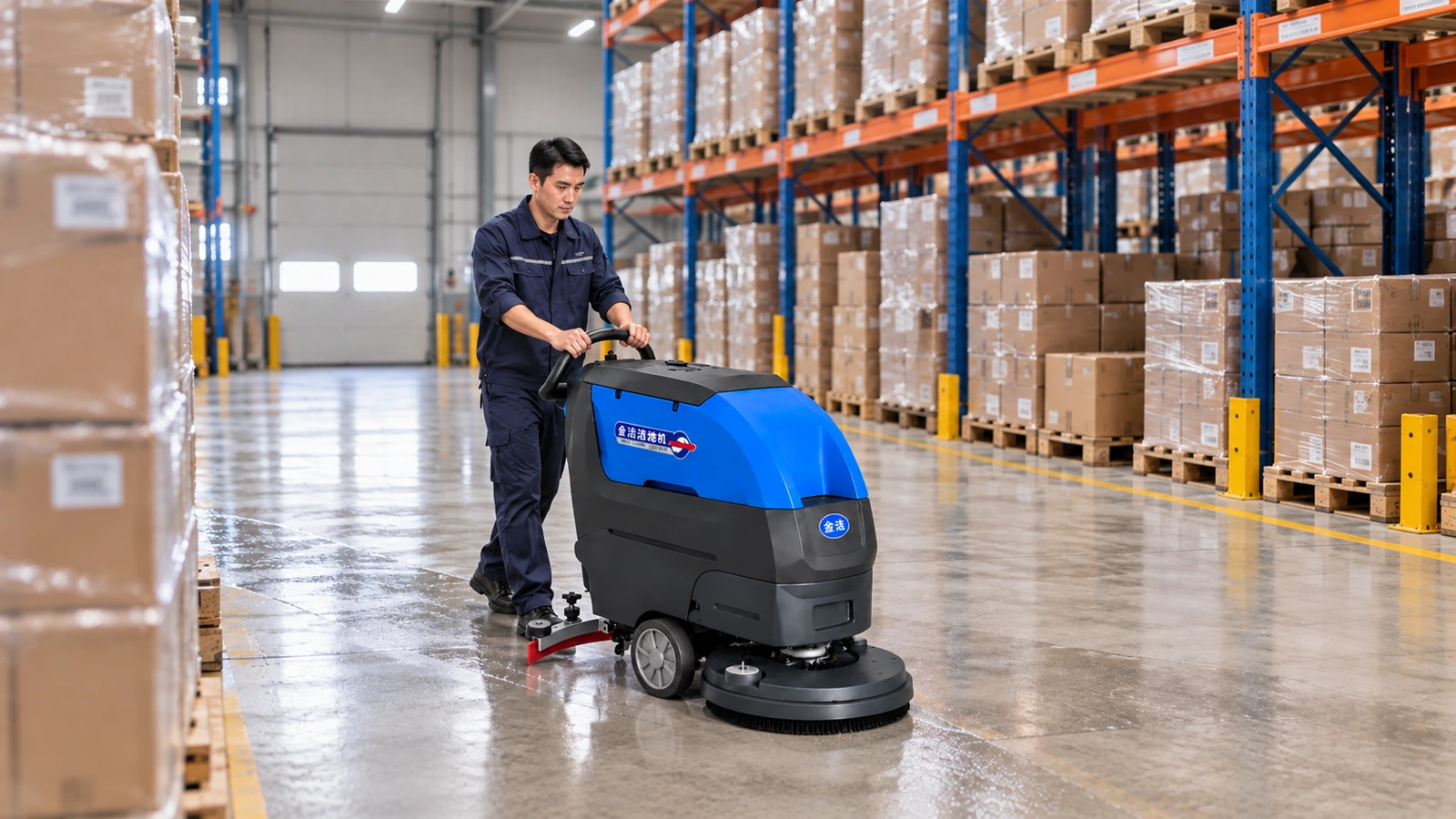
Where routes are clear but local stains are common, organise scrubbing and water pickup by zone.
Look at relevant scenarios →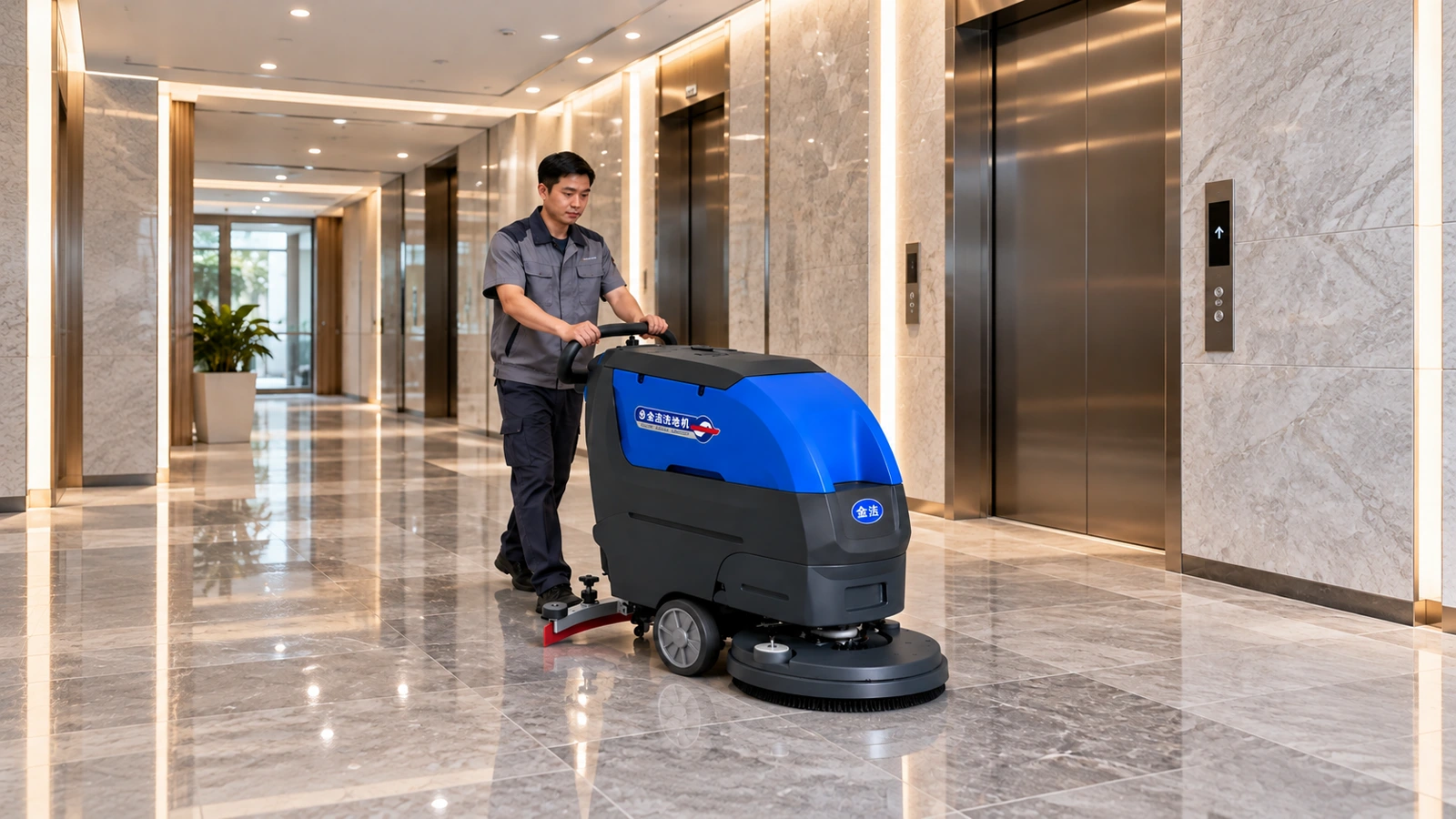
For local areas unsuitable for ride-ons, first check passage width and turning space.
Look at relevant scenarios →First check the configurations closely related to daily use. Detailed specifications are retained below for easy verification item by item.
| Key operating figures | |||
|---|---|---|---|
| Cleaning width | 510mm | Squeegee width | 780mm |
| Clean water tank | 50L | sewage tank | 60L |
| Runtime reference | 3-4h | Theoretical cleaning coverage (calculated) | 2550㎡/h |
| Theoretical calculation speed | 5 km/h | ||
| Drive and electrical system | |||
| Operating voltage | 24V | Battery | 12V100Ah×2 |
| Brush motor | 500W | Recovery motor | 500W |
| Battery capacity | (100AH*12V)*2 | ||
| Machine configuration | |||
| Travel mode | Walk-behind | Machine dimensions | 720*440*900mm |
| Machine weight | 55kg | Product model | J-D3L |
| Work method | Walk-behind | ||
Existing documentation indicates 3–4 hours; actual range requires confirmation based on load and battery condition. Dimensions, weight, and battery type still require original technical documentation for verification and are not part of this test certification.

50 L clear water tank, 60 L wastewater tank, separate arrangement for water supply and wastewater recovery, clean Up timely after use
510 mm clear width, brush disk motor 500 W; select matching brush according to floor material, test wash for special contaminants first.
780 mm squeegee, 500 W squeegee motor. Check the rubber strip contact with the ground and the pipeline sealing, and determine the actual residual water through trial washing.
24 V working voltage, existing data lists 12 V100 Ah battery × 2; battery type and charging requirements are confirmed according to actual configuration.
The device is pushed by personnel. When the continuous route is long, compare the pushing burden with the self-propelled model.
Check and verify the drainage and recharging positions, as well as the storage location; inspect the brush roll, rubber strip, and wastewater recovery channel, and perform maintenance according to the manual after shutdown.
The clear width is not equal to the overall machine width; the dimensions of the door, corners, and squeegee must be checked.
Water usage, waste, and cleaning area affect the frequency of water replenishment and drainage, confirm water intake and drainage locations first.
Long routes can be compared with J-D5SL self-propelled method, not only judged by water tank size.
The data includes 12 V100 Ah×2; actual range and charging requirements are confirmed according to the delivered battery and manual.
Compare related models
Place the three models together and see the differences in configuration and operating method.
| Comparison criteria |  J-D3C → | J-D3L → |  J-D5SL → |
|---|---|---|---|
| Cleaning width | 460mm | 510mm | 510mm |
| Squeegee width | 720mm | 780mm | 780mm |
| Clean water tank | 45L | 50L | 50L |
| sewage tank | 50L | 60L | 60L |
| Battery configuration | 48V / 20Ah | 12V100Ah×2 | 2 × 12V × 100Ah |
| Work time for the data. | 2-3 hours | 3-4h | 3–4h |
| Operating method | Hand-pushed, personnel push. | Hand-pushed, personnel push. | Self-propelled with personnel operation. |
First, check the passage and operation methods, then compare the water tank, working time, and maintenance schedule. The data in the table is based on the current technical specifications of each model. The working time in the documentation does not equal the actual runtime under all operating conditions.
Operating cost
Compare using the same floor, same cleaning requirements, and actual records.
Labor cost = number of people × actual working hours × hourly labor cost.
Record actual expenditure on tools, detergent and clean-up.
Single-use cost = operator labor + water and electricity with cleaning agent + consumable maintenance allocation + equipment investment allocation.
Turns, water replenishment, sewage discharge, and cleaning conclusion should all be counted as actual working time.
First, check the application scenario of this page. Combine it with your floor type, route, and work schedule to make a judgment. Real customer projects are only displayed according to the verified model, and the scenario images are not used as proof of customer results.
Understand customer applications → Talk about the site and trial run →Check the equipment and configuration list together before delivery.
Understand service arrangements →Communicate startup, brushing, replenishment of water, and daily cleaning.
Understand service arrangements →In case of operational issues, communicate with the model and usage conditions.
Understand service arrangements →Check the brush roll, rubber strip, and other parts against the model.
Understand service arrangements →Service scope, costs, and arrival arrangements need to be confirmed first.
Understand service arrangements →Coordinate maintenance plans with the frequency of use and the location.
Understand service arrangements →For selection requirements suitable for segmental scrubbing of hard floors according to business areas, first determine the conditions of passage through the shelves, customer avoidance, and wastewater recovery. Loose packaging, ropes, and other garbage should be cleared first, and not all garbage should be entrusted to the scrubbing disk.
The former describes cleaning coverage, while the latter relates to wastewater recovery and outer perimeter access; both should be considered. At the entrance, at the ends of the shelves, and at turns, the actual machine and personnel space should be checked, and it cannot be determined solely based on 510 mm that a narrow passage can definitely pass through.
First, mark the water intake, drainage, and equipment parking areas in the store. Then, record the number of water and drainage refills based on the actual water supply and waste conditions. The 50 L clean water tank and 60 L waste water tank provide the basis for refill planning. The route between the shelves should be arranged in zones to reduce the need to repeatedly pass through the business area for water refilling.
The current data retains 3–4 hours of work time, but actual performance may also be affected by battery condition and load. Shifts should also include additional time for machine retrieval, water replenishment, avoidance, and post-operation cleanup; the battery, charger, and charging schedule should be confirmed according to the delivered version.
Trial the shop route and record total completion time including rack turns, yielding, water handling and finishing, while checking soil removal and residual water. The listed theoretical 2550 m²/h supports comparison; schedule from route records rather than area divided by that figure alone.
First, check the workload, throughput, and finishing work of the operator on the same route. J-D3C and J-D3L should be compared based on their respective widths and water tanks; for long-distance pushing, J-D5SL self-propelled assistance can be compared, but this does not mean automatic navigation.
Stop work and safely disconnect the power according to the instructions. Then check the wastewater tank, seal, piping, and rubber gasket in contact with the ground. Seams, sharp turns, or foreign objects in the gasket can affect residual water; do not add water continuously to hide recovery issues. If the problem cannot be resolved, contact after-sales service.
Send aisle and rack-end photos, working windows, floor and soil information, water points and any inter-floor transfer needs. Wanshenglong can discuss equipment trials, training and wear-part matching; service arrangements require project-specific confirmation.
Discuss the floor, routes, and daily cleaning schedule, and together see if J-D3L is suitable.
Phone consultation: 0755-25621811 View other contact information →
Product enquiryTell us about the usage area and the issues you hope to improve, and the equipment consultant will combine with the passage, ground and work arrangement, communicate the suitable configuration with you. The area is temporarily unclear, you can contact us first.