
01 Intended use
- Self-propelled floor scrubber
- For commercial areas such as shopping malls, stores, and office building public zones, first verify the traffic flow, floor materials, and operating hours, then arrange the equipment.

Jinjie J-D5SL self-propelled floor scrubber, designed for continuous cleaning in commercial superstores and warehouse corridors, combining walking assistance with 510 mm brushing and wastewater recovery; personnel still need to follow the control direction, with key considerations being the ease of pushing, turning, and water replenishment.
First, compare the manual push and self-propelled models along the same route, observing the start, stop, turn, and full load operations. The walking assistance of J-D5SL is not equivalent to unmanned navigation, and the operator needs to continuously manage direction and the site. The battery, drive, and overall machine data should be verified according to the current machine version, and they are not considered the same configuration just because the J-D3L width is similar.
Channel, corner, and drive operation.
Elevator, entrance, and transfer points
Continuous route and pedestrian flow.
Debris, floor surface, and additional water drainage
| Site type | Configuration that requires attention | J-D5SL Selection Recommendation |
|---|---|---|
| Commercial and retail stores. | Channel, corner, and drive operation. | When hoping to reduce the burden of continuous operation, it is possible to compare by testing the route. |
| Office public areas | Elevator, entrance, and transfer points | First verify the entry and exit spaces, then confirm the floor operation and charging arrangement. |
| Property Management Passage | Continuous route and pedestrian flow. | Consider following operational habits and on-site passage together, and divide the cleaning into zones during off-peak hours. |
| Warehouse hard floor surface | Debris, floor surface, and additional water drainage | Clear large debris first, and arrange brush washing and recovery according to the type of waste and route |
The above is a reference for selection; finally, combine with the machine's configuration, on-site dimensions, and trial operation confirmation.
Starting from the areas you clean daily, consider how self-propelled assistance, brushing, and wastewater recovery can integrate into your daily work.

When the workshop route is long, use the self-propelled assistance to reduce the burden of pushing; combine with production shifts, brush and recover wastewater in each area.
Look at relevant scenarios →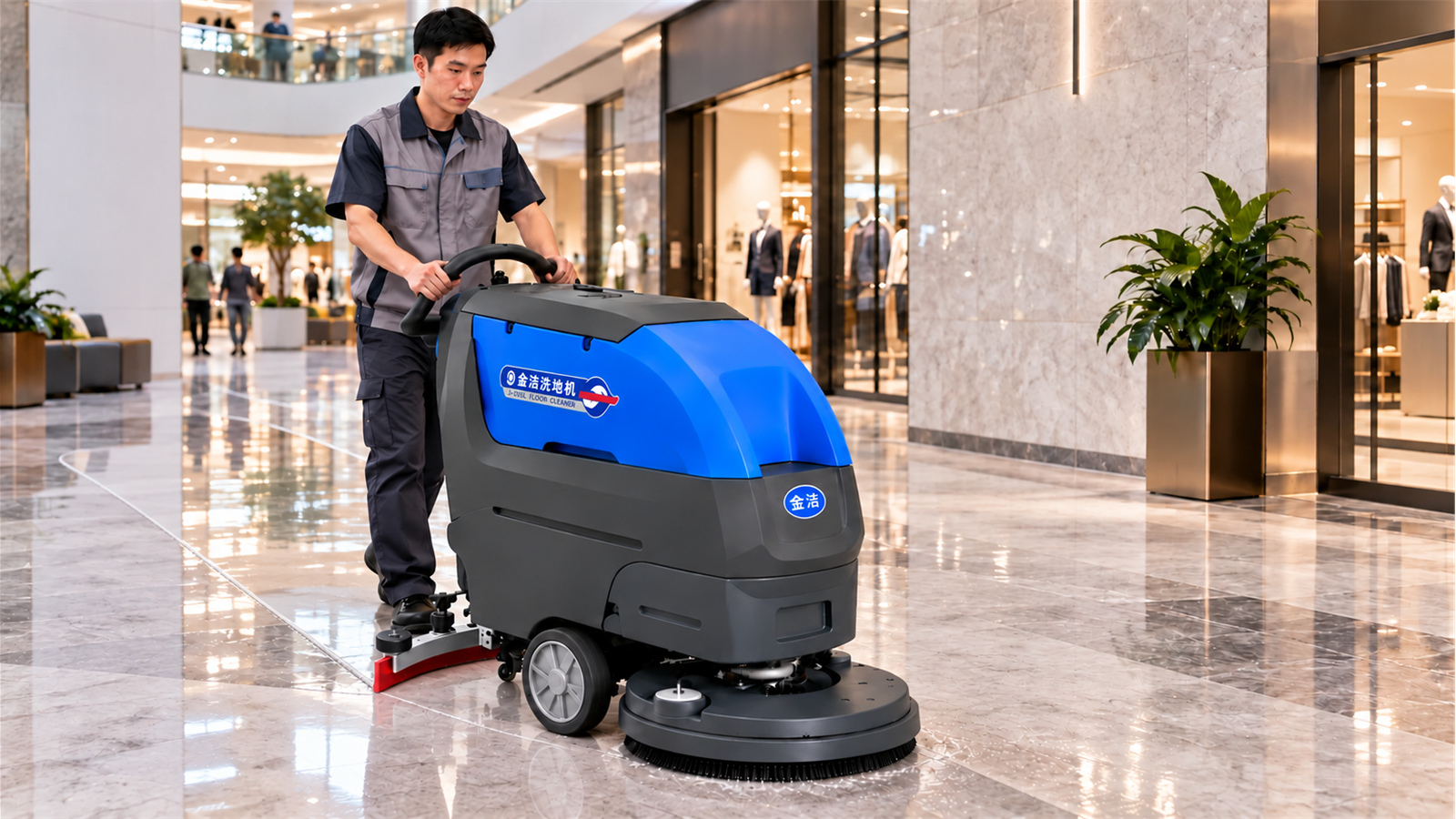
Public passages are busy with people coming and going; we can arrange cleaning times together. Combining brushing and wastewater recovery can reduce the need for repeated scrubbing.
Look at relevant scenarios →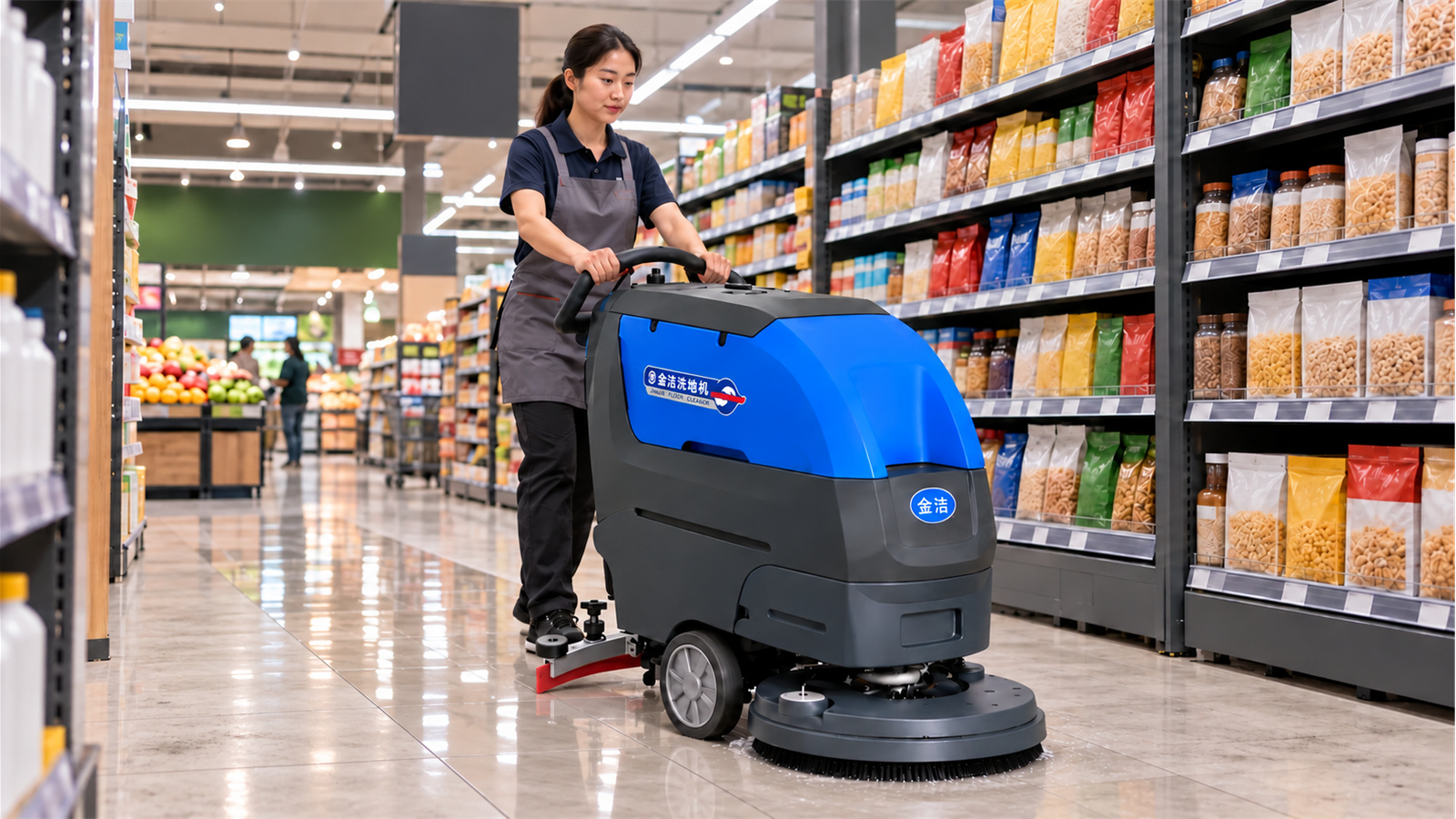
Clean along the shelf area, first check if the machine can smoothly enter and turn, then combine with business arrangements for operations.
Look at relevant scenarios →First check the cleaning configuration and walking assistance, detailed specifications are retained below for easy verification against your work route.
| Key operating figures | |||
|---|---|---|---|
| Cleaning width | 510mm | Squeegee width | 780mm |
| Clean water tank | 50L | sewage tank | 60L |
| Runtime reference | 3–4h | Theoretical cleaning coverage (calculated) | 2550㎡/h |
| Theoretical calculation speed | 5 km/h | ||
| Drive and electrical system | |||
| Operating voltage | 24V | Battery | 2 × 12V × 100Ah |
| Travel motor | 24V / 500W | Brush motor | 500W |
| Recovery motor | 500W | ||
| Machine configuration | |||
| Machine dimensions | 720 × 440 × 900mm | Machine weight | 55kg |
| Product model | J-D5SL | Work method | Self-propelled |
Note: The theoretical work efficiency of push-type and self-propelled push-type floor scrubbers is calculated uniformly as cleaning width × 5 km/h, and is only for theoretical area efficiency comparison, not representing actual operating efficiency.
For continuous cleaning in small/medium areas. Also check passages, turns and routes; width alone does not identify a push or self-propelled configuration.
 123
Drive assist for walking, personnel follow to control direction, focus on reducing the burden of continuous route pushing.
The cleaning width is 510 mm and the listed brush motor rating is 500 W. Select a brush to suit the floor and the soil.
780 mm squeegee combined with wastewater recovery, check the rubber strip contact with the ground and the pipeline condition before use.
50 L clear water tank, 60 L wastewater tank; combine area distribution and cleaning frequency for water and drainage arrangement
The data includes 24 V / 500 W drive, 2×12 V×100 Ah battery. The specific configuration is confirmed by the machine's technical specification.
Autonomous operation is not unmanned autonomous driving. Follow the manual for operation and maintenance. If abnormal movement is detected, stop the machine for processing first.
Digital solutions must ultimately be put to use: how the cleaning route is planned, whether water is easily discharged, and how personnel operate. We combine key configurations with on-site conditions to help you make judgments.
510 mm cleaning width, balancing daily brushing with route planning.
Check together: narrowest entrance / shelf spacing / turning space.50 L clear water tank and 60 L wastewater tank, combine zone division operations for water and drainage arrangement
Take a look: water refill points / drainage points / cleaning area per session.Alleviate the continuous pushing burden, but operators still need to follow the control direction.
Take a look: route length / operating habits / ramp conditions.Arrange shifts based on the machine's battery configuration and actual operating conditions.
Take a look: daily cleaning time / usage frequency / charging location.First check the passage conditions, then the daily cleaning route and operational load; the selection is not only based on the size of the water tank.
| Comparison criteria |  J-D3L → | J-D5SL → |  J-56BF → |
|---|---|---|---|
| Cleaning width | 510mm | 510mm | 560mm |
| Squeegee width | 780mm | 780mm | 800mm |
| Clean water tank | 50L | 50L | 70L |
| sewage tank | 60L | 60L | 75L |
| Runtime reference | 3-4h | 3–4h | 3–4h (reference value) |
| Travel mode | Walk-behind | Self-propelled | Ride-on |
| Selection direction | Small and medium-sized areas with hand-pushed carts, comparing water tanks and route arrangements | Hope to reduce the burden of continuous operation | Open routes with ride-on access |
Working time is the current value for each model. Actual battery life is affected by battery condition, floor type, and operation method. Configuration is based on the technical specification and delivery list for the corresponding model.
When the continuous route is long, you can first try J-D5SL self-propelled assistance. Personnel still need to follow the control direction, focusing on turning, stopping, and daily operations.
When appropriate, the J-D3L hand-pushed configuration is also worth comparing. Based on cleaning frequency, transitions, and personnel arrangements, it is not necessary to upgrade solely for increased driving.
The J-56BF can be further compared, and the entrance, elevator, turn, and storage space should be checked to confirm that the equipment can pass through and transfer.
Operating cost
Compare using the same floor, same cleaning requirements, and actual records.
Labor cost = number of people × actual working hours × hourly labor cost.
Record actual expenditure on tools, detergent and clean-up.
Single-use cost = operator labor + water and electricity with cleaning agent + consumable maintenance allocation + equipment investment allocation.
The self-propelled model is still operated by personnel following, and the self-propelled function cannot be directly converted into a reduction in personnel.
First, check the application scenario of this page. Combine it with your floor type, route, and work schedule to make a judgment. Real customer projects are only displayed according to the verified model, and the scenario images are not used as proof of customer results.
Understand customer applications → Talk about the site and trial run →Check the equipment and configuration list together before delivery.
Understand service arrangements →Communicate startup, brushing, replenishment of water, and daily cleaning.
Understand service arrangements →In case of operational issues, communicate with the model and usage conditions.
Understand service arrangements →Check the brush roll, rubber strip, and other parts against the model.
Understand service arrangements →Service scope, costs, and arrival arrangements need to be confirmed first.
Understand service arrangements →Coordinate maintenance plans with the frequency of use and the location.
Understand service arrangements →J-D5SL drive assistance helps travel while an operator follows and controls direction and cleaning. Autonomous scrubbers involve navigation, task deployment and exception takeover. A drive motor does not make a machine navigate obstacles or complete routes independently.
Compare them for longer pushing distances or operator-effort concerns. Check doors, corners, obstacles and staffing, and let the team use the same route. Area or motor configuration alone does not establish suitability.
The cleaning width description covers the water tank replenishment. The current 780 mm squeegee and the entire machine's outer edge also need to be checked, and it cannot be determined solely based on the 510 mm clearance at the door. The frequency of water replenishment is still determined by the amount of waste, water supply, and route.
Check the listed 3–4 hours against the delivered battery and load, then record turns, yielding, water stops and finishing on a representative route. The theoretical 2550 m²/h is a comparison reference. Schedule from complete-task time, frequency and charging.
Check permitted slopes, wet surfaces, turns and operating conditions in the instructions before planning a route. The 500 W drive rating does not establish ramp suitability. Assistance does not authorize unverified wet or inclined operation; stop safely if travel is abnormal.
Compare assisted travel with manual pushing, while separately checking delivered configuration and maintenance. Similar widths and tanks do not establish identical drives, controls or handling. Trial results cannot automatically transfer between models.
Besides tanks, brushes, squeegee and hose, inspect travel controls and charging connections as instructed. Do not dismantle energized drive components. Record control state and fault conditions for service diagnosis.
To plan a trial, describe the pushing distance, turning points, floor and soil, staffing and refill arrangements. Check parts for the J-D5SL and the J-D5R ride-on scrubber against their respective model specifications.
Discuss the floor, routes, and daily cleaning schedule, and together see if J-D5SL is suitable.
Phone consultation: 0755-25621811 View other contact information →
Product enquiryTell us about the usage area and the issues you hope to improve, and the equipment consultant will combine with the passage, ground and work arrangement, communicate the suitable configuration with you. The area is temporarily unclear, you can contact us first.