
01 Intended use
- Dual brush drive, follow the route arrangement.
- Balances coverage in relatively continuous areas with passage conditions in columns, aisles, and doorways.

The Jinjie J-D7SL is a twin-brush ride-on option for continuous garage and commercial hard floors, with 710 mm cleaning coverage and 70 L/75 L tanks. Assess main aisles, turns, pedestrians and wastewater recovery.
First, separate the main open passage, column sides, and parking area. When testing with J-D7SL, observe the double brush coverage, turning overlap, and water recovery separately; arrange for refilling and draining before calculating the shift. When comparing single brush or wider driving equipment, maintain the same ground material, dirt, and route, rather than simply comparing theoretical area.
First, check the on-site conditions, then determine the appropriate equipment configuration together.
Channel width, turning position, business hours.
Handling large crowds, corridors, and elevators
Conditions of hard surfaces, drainage, and ramps
Oil stains, dust, obstacles, and work routes
| Site type | The on-site conditions for joint checking | J-D7SL Selection Recommendation |
|---|---|---|
| Commercial spaces and shopping malls. | Channel width, turning position, business hours. | First confirm whether the equipment can turn and pass, then divide the continuous cleaning area. |
| Office and public buildings | Handling large crowds, corridors, and elevators | Verify the passage and floor transfer conditions; in narrow areas, pair with smaller models. |
| Property management garage and public areas | Conditions of hard surfaces, drainage, and ramps | Clarify and level the work area; slopes and elevation differences must be checked against the technical specifications of this machine. |
| Factory and warehouse floor cleaning equipment. | Oil stains, dust, obstacles, and work routes | First distinguish the type of dirt and the floor surface material, then arrange pre-treatment, brushing, and wastewater recovery. |
Starting from the areas you clean daily, consider how driving operations, dual-brush cleaning, and wastewater recovery can be integrated into daily work.

Relatively continuous routes allow a ride-on to scrub and recover water by zone.
Look at relevant scenarios →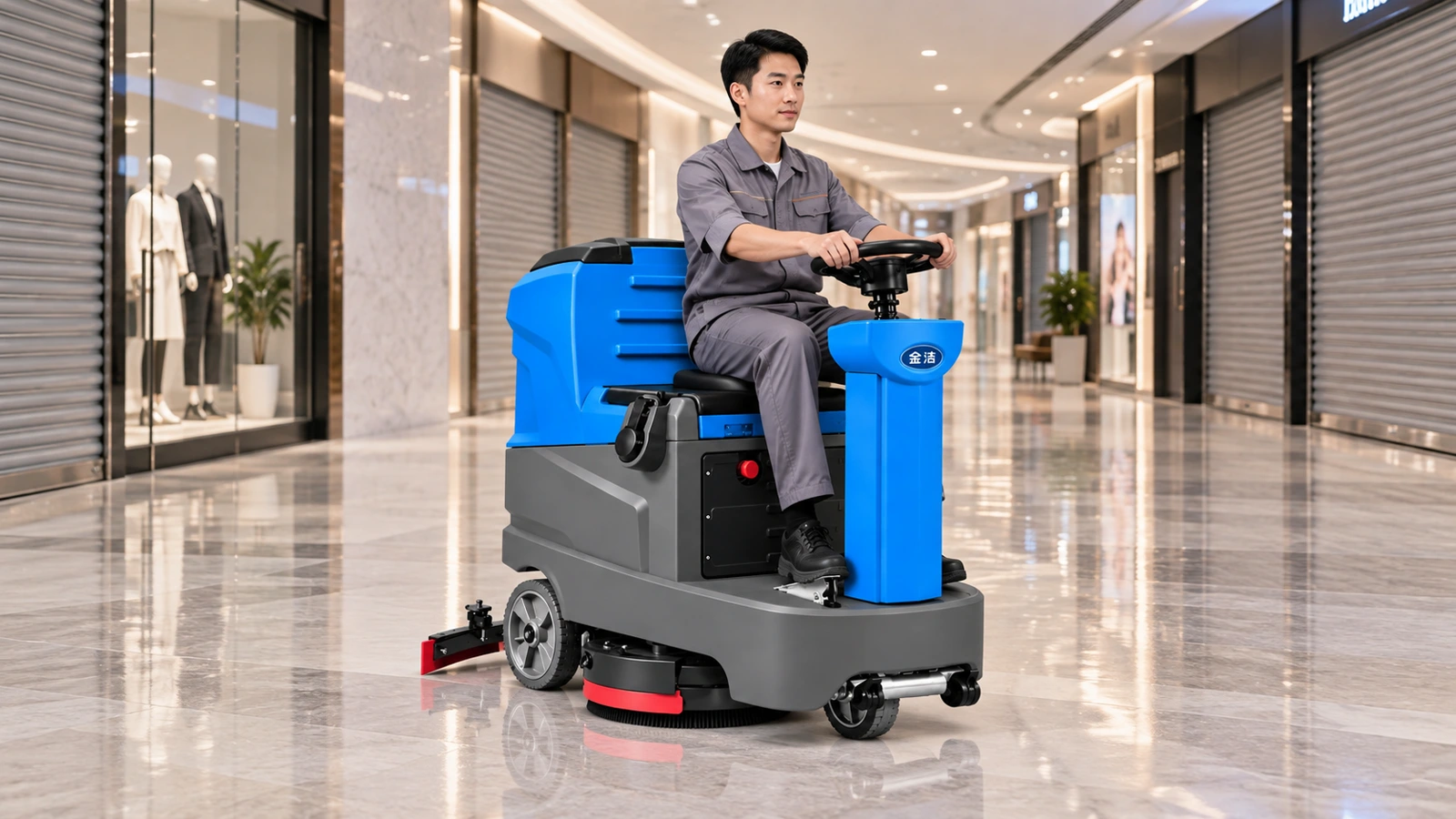
Busy pedestrian areas need scheduled cleaning and prompt reopening checks.
Look at relevant scenarios →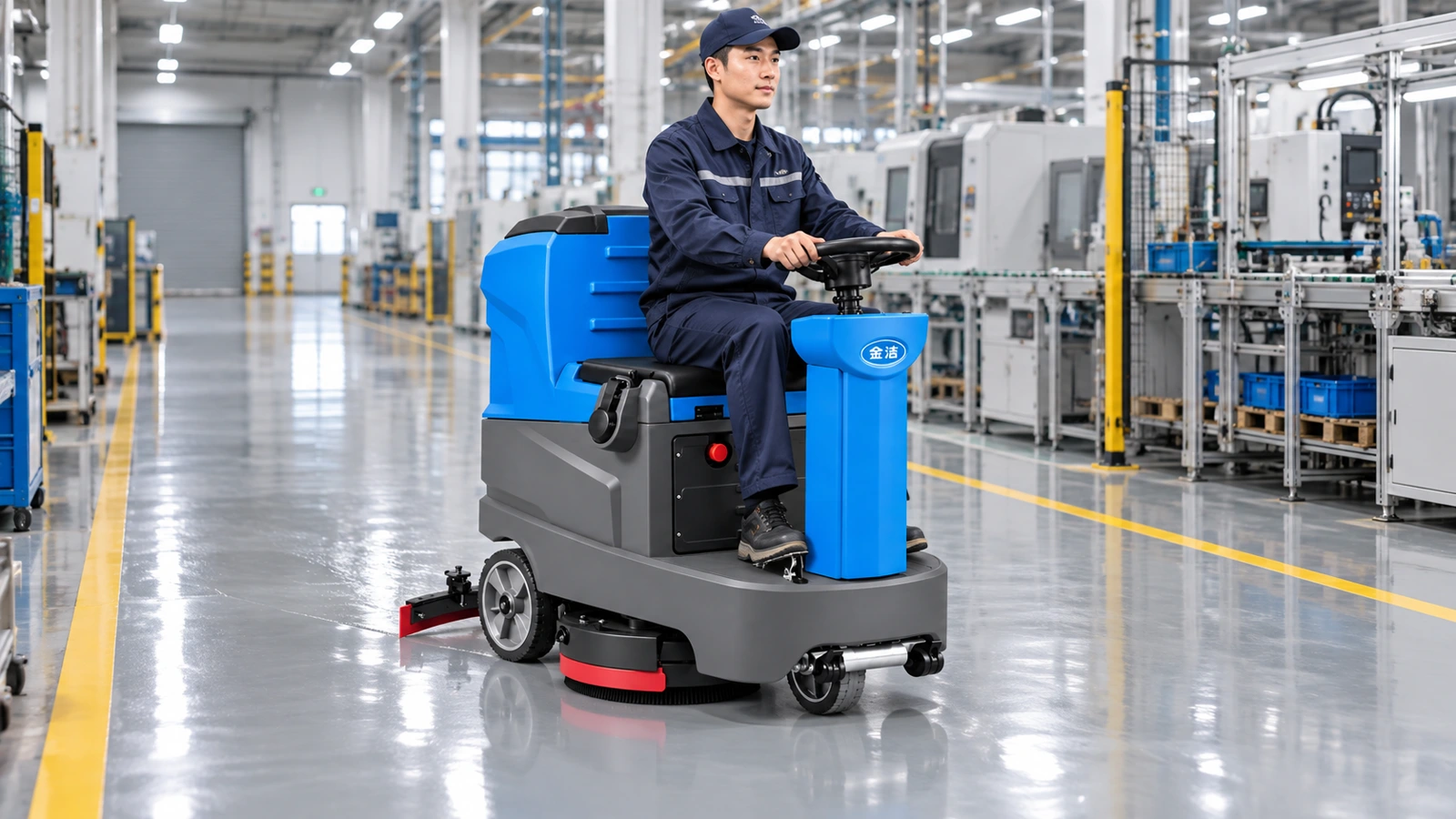
For larger areas and longer routes, check access, turning and filling/draining carefully.
Look at relevant scenarios →First understand several configurations closely related to daily use. Detailed specifications are also organized below for easy comparison.
| Key operating figures | |||
|---|---|---|---|
| Cleaning width | 710mm | Clean water tank | 70L |
| sewage tank | 75L | Runtime reference | 3–4h |
| Theoretical cleaning coverage (calculated) | 7100㎡/h | Theoretical calculation speed | 10 km/h |
| Product type | Ride-On Floor Scrubbers | ||
| Drive and electrical system | |||
| Operating voltage | 24V | Battery | 24V/100Ah |
| Travel motor | 24V / 500W | Brush motor | 24V / 350W × 2 |
| Recovery motor | 24V / 500W | ||
| Machine configuration | |||
| Machine dimensions | 1460 × 830 × 1100mm | Machine weight | 225kg |
| Product model | J-D7SL | Brush size | 350mm × 2 |
Note: website theoretical coverage for ride-on scrubber-dryers is calculated as cleaning width × the standard theoretical calculation speed of 10 km/h. It is for theoretical area comparisons, not actual productivity or the machine's maximum travel speed.
The cleaning width affects the coverage of a single pass, and the relationship between the fresh water tank and the dirty water tank affects the convenience of continuous operation. The battery, drive, and water suction system affect the daily floor scrubbing schedule.
7100 m²/h is calculated from the confirmed cleaning width × the website theoretical calculation speed of 10 km/h. It is for theoretical coverage comparisons only, not actual or measured productivity.

Sitting driving reduces the need for continuous pushing during longer cleaning routes; follow the on-site route arrangement.
710 mm cleaning width, 350 mm brush disk × 2, suitable for continuous cleaning of hard surfaces.
Coordinated with 24 V / 500 W water-absorbing motor, combine brushing with wastewater recovery.
70 L clear water tank, 75 L wastewater tank, combine zone division with water and drainage position arrangement for cleaning
24 V working voltage, battery is 24 V/100 Ah; schedule shifts and charging according to actual usage conditions.
Check the entrance, corridors, turns, and parking spaces. The conditions of the ramp will be confirmed on-site.
Digital solutions must ultimately be put to use: how the cleaning route is planned, whether water is easily discharged, and how personnel operate. We combine key configurations with on-site conditions to help you make judgments.
710 mm dual brush cleaning, combined with actual route scheduling for continuous operation.
Check together: narrowest passage / entrance / turning space.70 L clear water tank and 75 L wastewater tank, coordinate with zone division cleaning arrangement
Take a look: water refill points / drainage points / cleaning area per session.Sitting driving reduces the need for continuous pushing over long routes, but still requires personnel operation.
Take a look: continuous route / operating habits / ramp conditions.Operate according to the 24 V/100 Ah battery capacity and actual working conditions.
Take a look: daily operating time / usage frequency / charging location.Compare related models
Place the three models together and see the differences in configuration and operating method.
| Comparison criteria |  J-D6SL → | J-D7SL → | 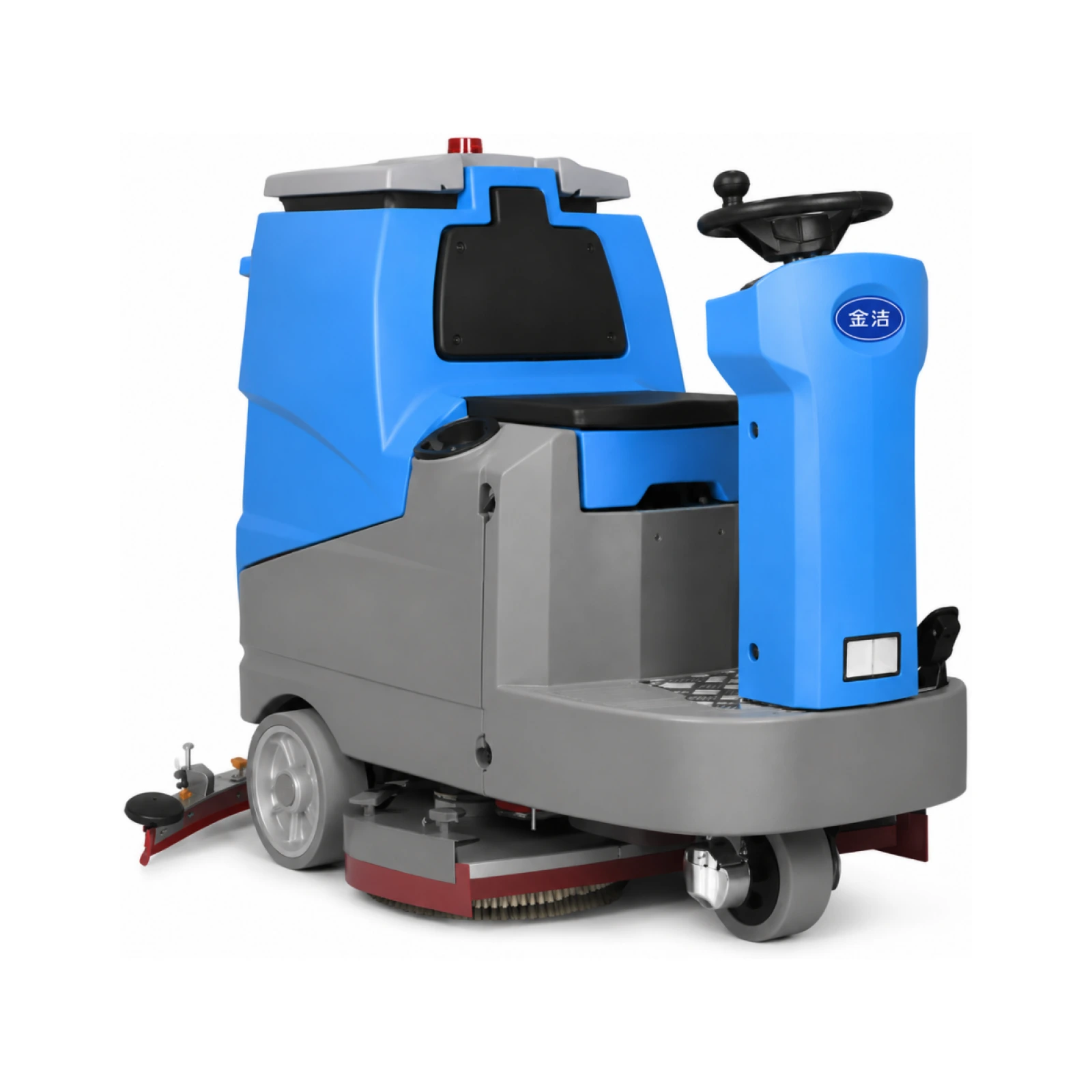 J-D8SL → |
|---|---|---|---|
| Cleaning width | 560mm | 710mm | 810mm |
| Squeegee width | 780mm | Request the specification for this configuration. | 1100mm |
| Clean water tank | 70L | 70L | 110L |
| sewage tank | 75L | 75L | 110L |
| Battery configuration | 24V / 100Ah | 24V/100Ah | 24V / 150Ah |
| Work time for the data. | 3–4h | 3–4h | 3–4h |
| Operating method | Operator-controlled. | Operator-controlled. | Operator-controlled. |
First, check the passage and operation methods, then compare the water tank, working time, and maintenance schedule. The data in the table is based on the current technical specifications of each model. The working time in the documentation does not equal the actual runtime under all operating conditions.
Operating cost
Compare using the same floor, same cleaning requirements, and actual records.
Labor cost = number of people × actual working hours × hourly labor cost.
Record actual expenditure on tools, detergent and clean-up.
Single-use cost = operator labor + water and electricity with cleaning agent + consumable maintenance allocation + equipment investment allocation.
Turns, water replenishment, sewage discharge, and cleaning conclusion should all be counted as actual working time.
First, check the application scenario of this page. Combine it with your floor type, route, and work schedule to make a judgment. Real customer projects are only displayed according to the verified model, and the scenario images are not used as proof of customer results.
Understand customer applications → Talk about the site and trial run →Check the equipment and configuration list together before delivery.
Understand service arrangements →Communicate startup, brushing, replenishment of water, and daily cleaning.
Understand service arrangements →In case of operational issues, communicate with the model and usage conditions.
Understand service arrangements →Check the brush roll, rubber strip, and other parts against the model.
Understand service arrangements →Service scope, costs, and arrival arrangements need to be confirmed first.
Understand service arrangements →Coordinate maintenance plans with the frequency of use and the location.
Understand service arrangements →Assess usable coverage on continuous main aisles and how pillars and edges will be finished. Obstacles can increase turning and overlap even with 710 mm coverage. Verify the garage or commercial route through a trial.
Before cleaning, check the coating of the epoxy garage to ensure it is intact and has reached the appropriate curing stage. Select compatible brushes or pads and a low-foam cleaner to avoid damage from hard abrasives. For cement garages, first determine if the surface has cured, is sanding, or is loose. Collect dust and debris before testing the cleaning. For areas with surface damage or sanding, address the floor issues first. For diamond sand garage floors, check the surface roughness, sealing layer, and contamination. Conduct a small-scale test cleaning to determine the appropriate brush and water usage, and check the fit and water retention of the sponge strip during turns. J-D7SL A dual-brush configuration does not mean that all floor materials are suitable for hard brushes; slopes should be checked separately for equipment conditions and slip resistance management.
Use the listed 710 mm machine cleaning width rather than independently calculating coverage or a no-miss guarantee from disc diameters. Layout, overlap and surface conditions affect scrubbing; check the delivered equipment and trial result.
Identify the distance to water and disposal points, then record replenishment for the soil and water setting. Tank capacity is not battery runtime; wider scrubbing does not guarantee fewer stops. Include return travel in total time.
Trial the same garage route and record detours around bays and columns, turning overlap, water handling, finishing and total time, together with soil removal and water residue. The listed 7100 m²/h is theoretical comparison data. Plan staffing and shifts from complete-task records.
Test 710 mm twin-brush and 560 mm options for coverage and turning on the same route. Both currently list 70 L/75 L tanks, but actual envelopes, recovery and handling must still be checked independently.
Shut down the machine safely according to the instructions, remove any tangled brushes on both sides, check for wear and fixation status, then clean the wastewater tank, and inspect the water-absorbing rubber strip, piping, seals, and connections. Record the location and symptoms if there is a difference in cleaning on one side or an increase in residual water, then have the after-sales service team assist in determining adjustments to consumables or repairs.
Record the cleaning and residual water in straight sections, turns, column edges, and seams, including the total time including replenishment and drainage. Provide the floor material, dirt, and shift requirements together to facilitate communication between Wanshenglong and Jinjie regarding equipment configuration and delivery training.
Discuss the floor, routes, and daily cleaning schedule, and together see if J-D7SL is suitable.
Phone consultation: 0755-25621811 View other contact information →
Product enquiryTell us about the usage area and the issues you hope to improve, and the equipment consultant will combine with the passage, ground and work arrangement, communicate the suitable configuration with you. The area is temporarily unclear, you can contact us first.