
Property management
- Typical site
- Underground car parks / property facilities
- Why it fits
- On relatively continuous car-park routes, ride-on operation can reduce prolonged pushing along bays and main aisles.

The Jinjie J-D8SL is a twin-brush ride-on scrubber for continuous commercial and workshop hard floors, with 810 mm coverage and 110 L/110 L tanks. Assess recovery edges, turning and replenishment together.
Separate the continuous working area from the doorways, column edges, and around equipment. J-D8SL should be combined with 1100 mm squeegee and the actual measured passage of the entire machine's outline, recording the total time for brushing, recovery, water replenishment, and final cleanup; retain its independent model and configuration, and do not use the main view, parameters, or efficiency metrics of J-D9R.
Floor surface, dirt properties, obstacles, and operating hours
Clearance between shelves, connection sections, corners, and pedestrian and vehicle traffic
column grid, slope, drainage, and ground condition.
Pedestrian hours, storage, charging, and cleaning frequency.
| Site | Configuration and operating conditions to check | J-D8SL recommendation |
|---|---|---|
| Factory hard floors | Floor surface, dirt properties, obstacles, and operating hours | First, separate the particles and special contaminants, then check if the machine's brush washing and recycling are compatible. |
| Warehouse and continuous passage | Clearance between shelves, connection sections, corners, and pedestrian and vehicle traffic | Include the entire machine and the water-absorbing components in the actual measurement, without using the cleaning width as a substitute for the passage conditions. |
| Property and parking areas | column grid, slope, drainage, and ground condition. | Arrange the route and water supply and drainage according to the site conditions; the slope capability must be confirmed based on the machine's data. |
| Commercial shared areas | Pedestrian hours, storage, charging, and cleaning frequency. | First confirm the parking and supply conditions as well as maintenance requirements, then organize shifts according to actual cleaning needs. |
The above is a reference for on-site judgment, and no commitment is made that all similar sites are applicable.
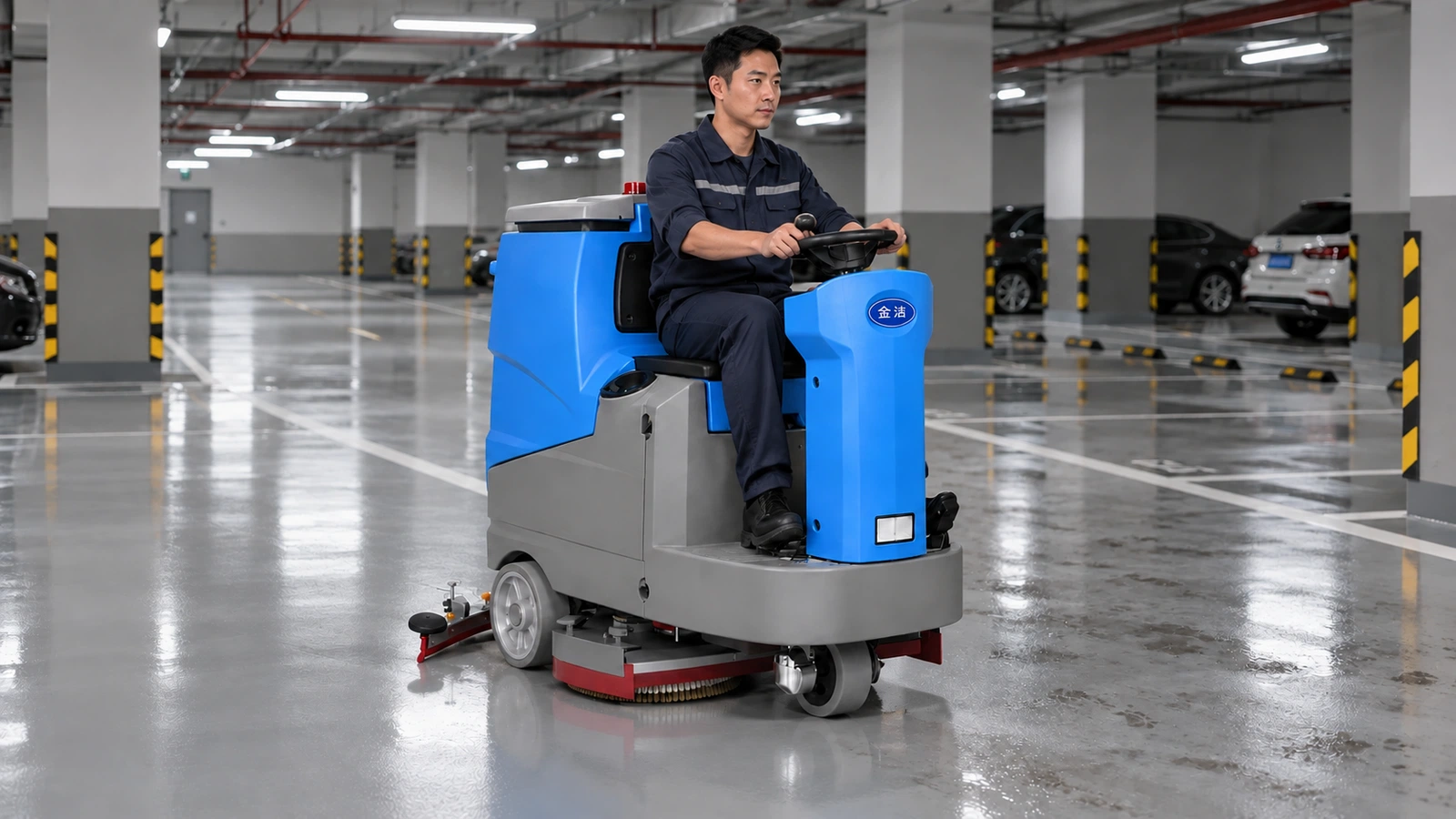
Relatively continuous routes allow a ride-on to scrub and recover water by zone.
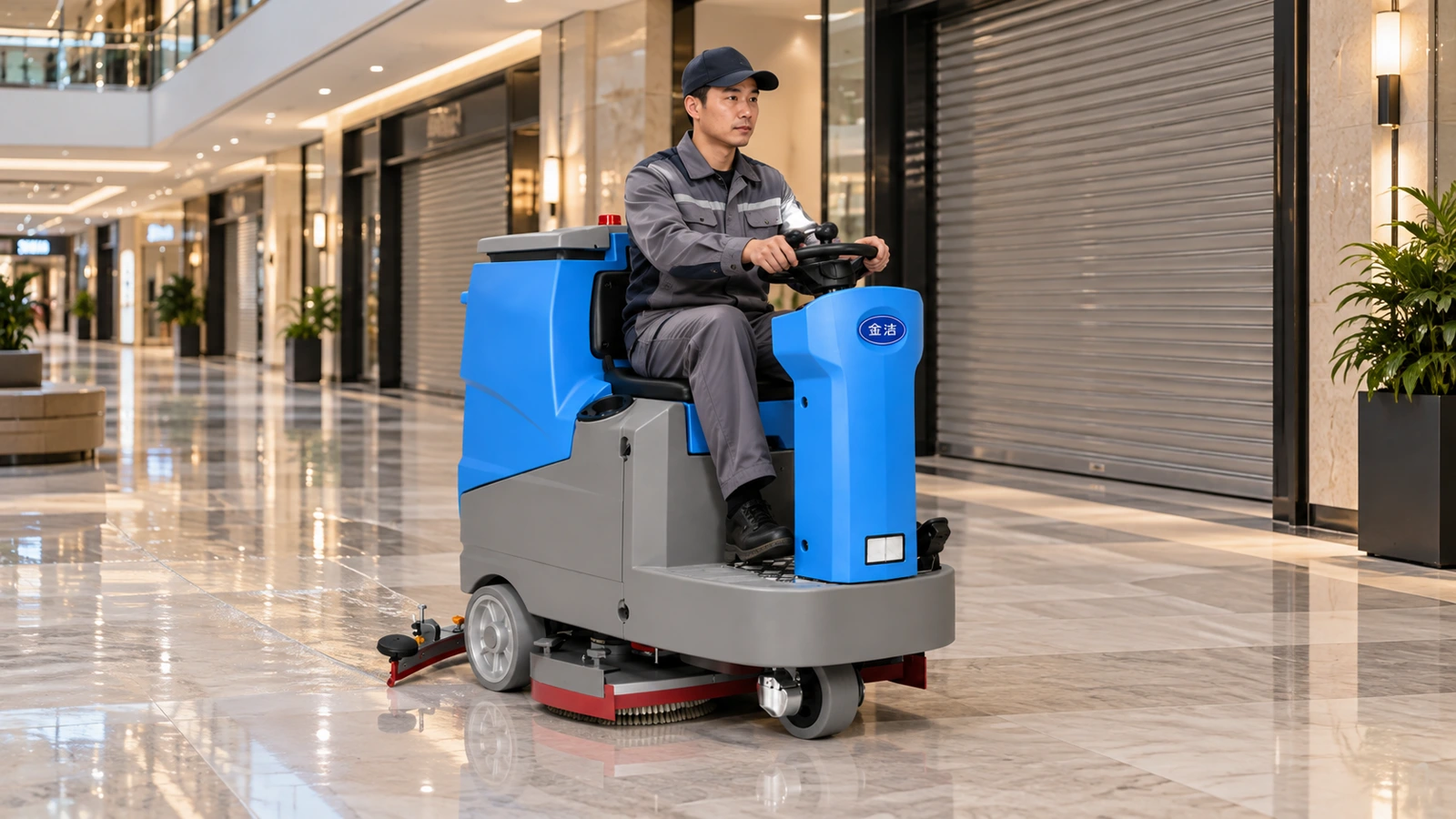
Busy pedestrian areas need scheduled cleaning and prompt reopening checks.
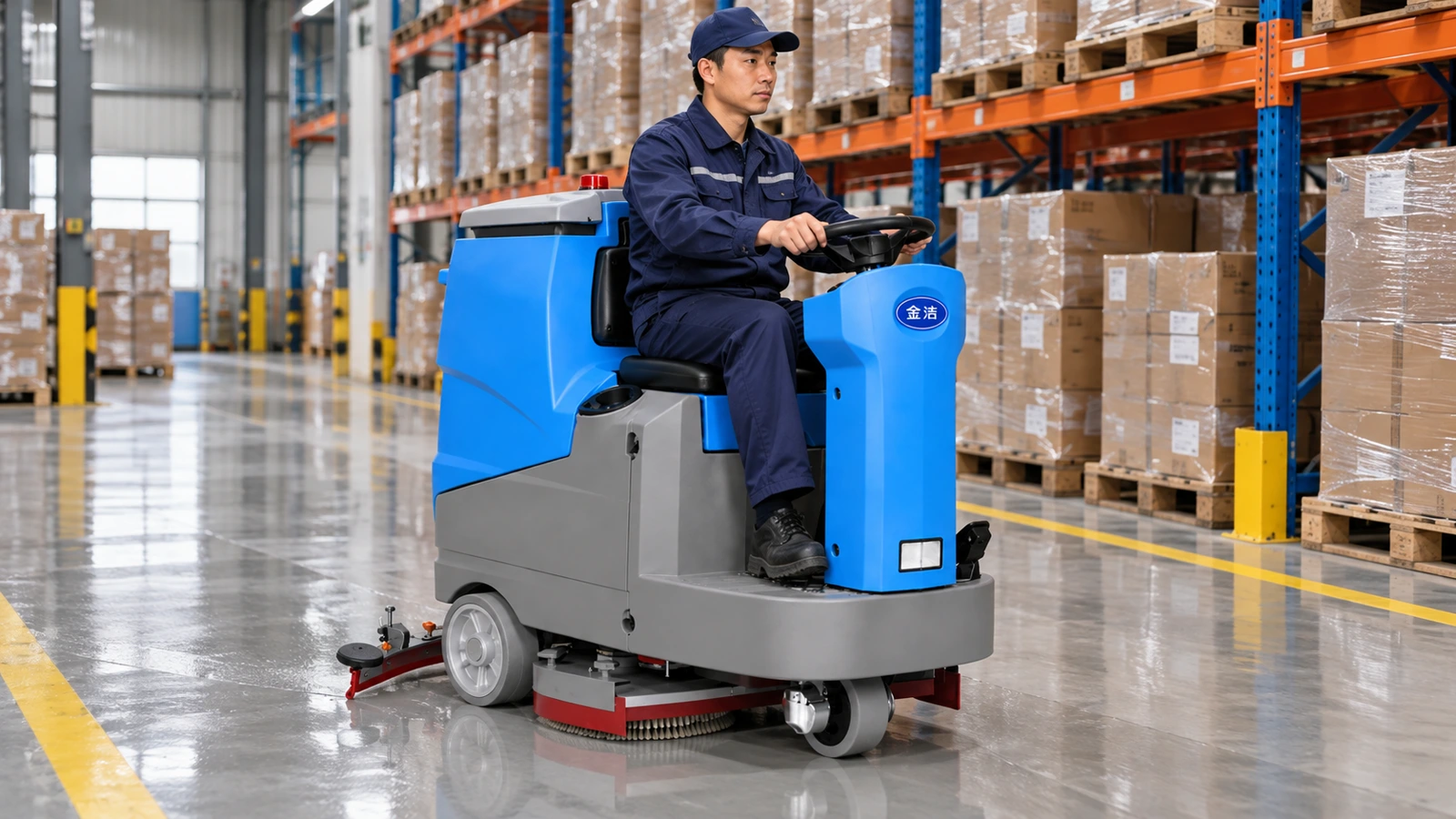
For larger areas and longer routes, check access, turning and filling/draining carefully.
Do not select a ride-on by machine size alone. Assess cleaning width, tanks, routes, turns, ramps and filling/draining together.
Larger areas mean more passes and interruptions for small machines.
An operator drives along continuous routes, a closer fit for larger areas.
Tank capacity and filling/draining points determine the pace of continuous work.
Review day-to-day configuration first. Expand the full specifications for more detail.
| Key operating figures | |||
|---|---|---|---|
| Cleaning width | 810mm | Squeegee width | 1100mm |
| Clean water tank | 110L | sewage tank | 110L |
| Runtime reference | 3–4h | Theoretical cleaning coverage (calculated) | 8100㎡/h |
| Theoretical calculation speed | 10 km/h | ||
| Drive and electrical system | |||
| Operating voltage | 24V | Battery | 24V / 150Ah |
| Travel motor | 24V / 500W | Brush motor | 24V / 400W × 2 |
| Recovery motor | 24V / 500W | ||
| Machine configuration | |||
| Machine dimensions | 1630 × 1130 × 1280mm | Machine weight | 250kg |
| Product model | J-D8SL | Work method | Ride-on |
| Brush size | 400mm × 2 | ||
Note: website theoretical coverage for ride-on scrubber-dryers is calculated as cleaning width × the standard theoretical calculation speed of 10 km/h. It is for theoretical area comparisons, not actual productivity or the machine's maximum travel speed.
The cleaning width affects the coverage of a single pass, and the relationship between the fresh water tank and the dirty water tank affects the convenience of continuous operation. The battery, drive, and water suction system affect the daily floor scrubbing schedule.
8100 m²/h is calculated from the confirmed cleaning width × the website theoretical calculation speed of 10 km/h. It is for theoretical coverage comparisons only, not actual or measured productivity.
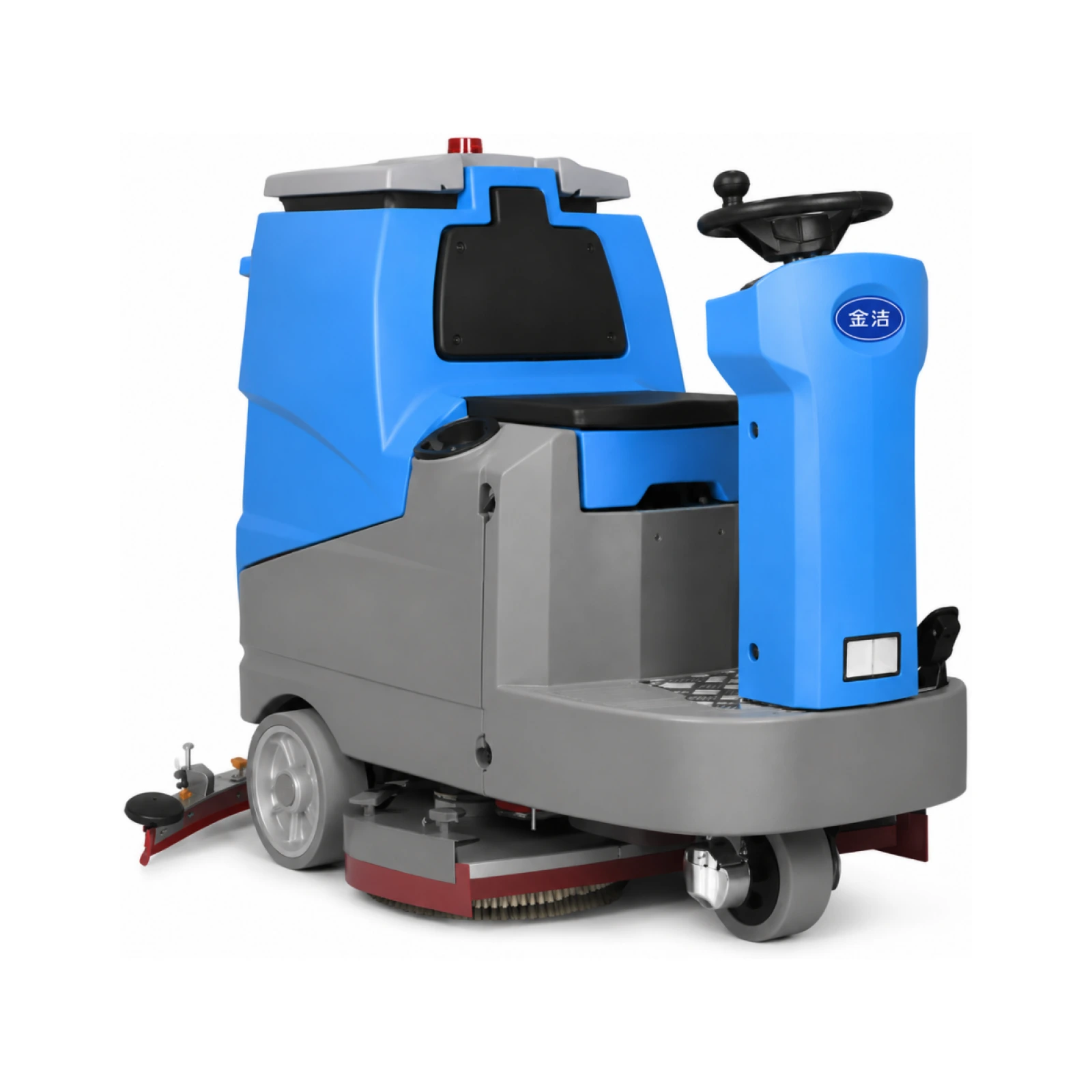
Separate the management of clear water and sewage, and combine the replenishment and discharge locations to plan the daily route.
Drive the sweeper to clean the floor, combining the floor material and the type of dirt to select the appropriate brush and work rhythm.
The squeegee works with wastewater recovery. Before operation, check the rubber seals, gaskets, and visible connections.
After shutdown, check brush wear and entanglement, and disassembly and reassembly should be carried out according to the machine instructions and training.
Battery and charger are matched according to the actual configuration; working duration is confirmed based on the route and load.
Check the entrance, turns, height clearance, and avoidance space, and be familiar with the control and parking sequence in advance.
Compare ride-on scrubber-dryers by cleaning width, tanks, routes, access and drive requirements.
| Item |  J-D5SL → |  J-56BF → |  J-66BF → |  J-85BH → |  J-D9BF → | J-D8SL → |
|---|---|---|---|---|---|---|
| Cleaning width | 510mm | 560mm | 660mm | 850mm | 860mm | 810mm |
| Squeegee width | 780mm | 800mm | 800mm | 1100mm | 1100mm | 1100mm |
| Clean water tank | 50L | 70L | 90L | 110L | 120L | 110L |
| sewage tank | 60L | 75L | 95L | 115L | 140L | 110L |
| Operating voltage | 24V | 24V | 24V | 24V | 24V | 24V |
| Battery configuration | 2 × 12V × 100Ah | 2 × 12V / 100Ah | 2 × 12V / 100Ah | 4 × 6V × 200Ah | 4 × 6V × 200Ah | 24V / 150Ah |
| Indicative operating time | 3–4h | 3–4h (reference value) | 3–4h (reference value) | 4.5–6h | 4.5–5h | 3–4h |
| Overall dimensions | 720 × 440 × 900mm | 1250 × 830 × 1000mm | 1250 × 830 × 1000mm | 1505 × 905 × 1270mm | 1600 × 900 × 1320mm | 1630 × 1130 × 1280mm |
| Overall weight | 55kg | 110 kg (excluding batteries) | 110 kg (excluding batteries) | 230kg | 375kg | 250kg |
| Task scale | Self-propelled | Compact ride-on | Dual brush drive | Medium/large rear-wheel drive | Large area ride-on type | 810 mm medium-to-large ride-on scrubber-dryer |
| Key checks | Pushing effort | Compact access | Twin brushes and tanks | Rear-wheel drive | Large area shift | Check access, routes, flooring, shifts and filling/draining against this model's confirmed configuration |
Parameter comparison with each model's 'View complete technical specifications'. Working time is a reference value, actual duration varies with battery, load, and on-site operating conditions; specific configuration is checked against delivery documents.
Confirm passages, doorways, lifts, ramps and turning space first.
Tanks, filling/draining, shifts and floor conditions also affect productivity.
For fragmented routes and frequent turns, a compact walk-behind or self-propelled model may fit better.
Record the cleaning, scrubbing, and recovery according to the same cleaning requirements and cycle, without taking theoretical efficiency directly as on-site output.
Labour cost = crew size × hours per person × hourly rate. Record preparation, cleaning, transfers and close-down separately.
Include operation or supervision, energy, consumables, disposal and maintenance. Allocate equipment and battery costs over a suitable service period.
Record daily operating hours, routes, garbage or contaminants, and supply and shutdown times; under the same conditions, compare, and do not commit to any savings ratio that has not been calculated.
Check the equipment and configuration list together before delivery.
Understand service arrangements →Communicate startup, brushing, replenishment of water, and daily cleaning.
Understand service arrangements →In case of operational issues, communicate with the model and usage conditions.
Understand service arrangements →Check the brush roll, rubber strip, and other parts against the model.
Understand service arrangements →Service scope, costs, and arrival arrangements need to be confirmed first.
Understand service arrangements →Coordinate maintenance plans with the frequency of use and the location.
Understand service arrangements →Consider continuous commercial or workshop hard floors, checking surfaces, soil and turns first. Allocate other methods to dense equipment areas and edges. Twin brushes do not remove access or manual-finishing requirements.
Two correspond to brushing and recovery of coverage, and cannot be considered as the same passage size. The entrance, corners, and parking positions should be measured according to the entire machine and outer edge; the machine entering the site does not mean it can smoothly complete the entire route.
Confirm route filling and drainage points, then record stops according to water setting, soil and repeat passes. Twin 110 L tanks inform water planning, not runtime or a fixed cleaning area. Include travel to supply points in the shift.
Use the actual battery configuration, condition and load as context, allowing charging, replenishment and finishing. It is not a guaranteed duration of continuous scrubbing for every site. Trial records should identify the task and operating conditions.
It is calculated from 0.81 m × a uniform theoretical 10 km/h for comparison, excluding turns, yielding and replenishment. Agree surfaces, soil, route and timing conditions, and inspect both cleaning and recovery.
They retain separate models and pages. The J-D8SL currently uses 810 mm and 110 L/110 L information, while J-D9R uses 860 mm and 140 L/150 L, with different efficiency-source definitions. Compare each delivery list on the same task.
After safely shutting down according to the instructions, check separately the brushes, rubber seals, suction hoses, and sealing of the wastewater tank on both sides. Record any discrepancies on a single side, residual water, and abnormal noises. Do not disassemble without power, and do not directly attribute all issues to motor power.
Provide the existing model/version, parts photographs and fault conditions for consumable and maintenance matching. New enquiries should include routes and water arrangements. Trials, on-site service and charges depend on the project and agreement.
Discuss the floor, routes, and daily cleaning schedule, and together see if J-D8SL is suitable.
Phone consultation: 0755-25621811
Provide area, aisle width, flooring, ramps, daily cleaning frequency and ride-on requirements so we can assess J-D8SL suitability.