
01 Intended use
- Drive-type scrubbing, compare the overall configuration.
- Compare the equipment based on the actual floor type, route, and operating hours, not just one item of power.

The Jinjie J-D9BF is a ride-on scrubber for level continuous factory and warehouse routes, combining 860 mm coverage and 120 L/140 L tanks. Assess its front-wheel-drive configuration with actual turns, stopping and access.
First, record the main passage, shelf corners, loading/unloading cross points, and the type of dirt. J-D9BF comparison with rear-wheel drive or different water tank models should use the same route to test turning, stopping, scrubbing, and recovery; the driving method, theoretical efficiency, or water tank of any single item cannot be directly considered as the conclusion of the project.
First, check the on-site conditions, then determine the appropriate equipment configuration together.
Channel width, turning position, business hours.
Handling large crowds, corridors, and elevators
Conditions of hard surfaces, drainage, and ramps
Oil stains, dust, obstacles, and work routes
| Site type | The on-site conditions for joint checking | J-D9BF Selection Recommendation |
|---|---|---|
| Commercial spaces and shopping malls. | Channel width, turning position, business hours. | First confirm whether the equipment can turn and pass, then divide the continuous cleaning area. |
| Office and public buildings | Handling large crowds, corridors, and elevators | Verify the passage and floor transfer conditions; in narrow areas, pair with smaller models. |
| Property management garage and public areas | Conditions of hard surfaces, drainage, and ramps | Clarify and level the work area; slopes and elevation differences must be checked against the technical specifications of this machine. |
| Factory and warehouse floor cleaning equipment. | Oil stains, dust, obstacles, and work routes | First distinguish the type of dirt and the floor surface material, then arrange pre-treatment, brushing, and wastewater recovery. |
Starting from the areas you clean daily, consider how driving operations, brushing, and wastewater recovery can be integrated into your daily routine. Please let us know your route and usage schedule, and we will assess together.

Coordinate cleaning schedules with foot traffic, combining brushing and wastewater recovery to reduce repeated scrubbing and accommodate personnel movement.
Look at relevant scenarios →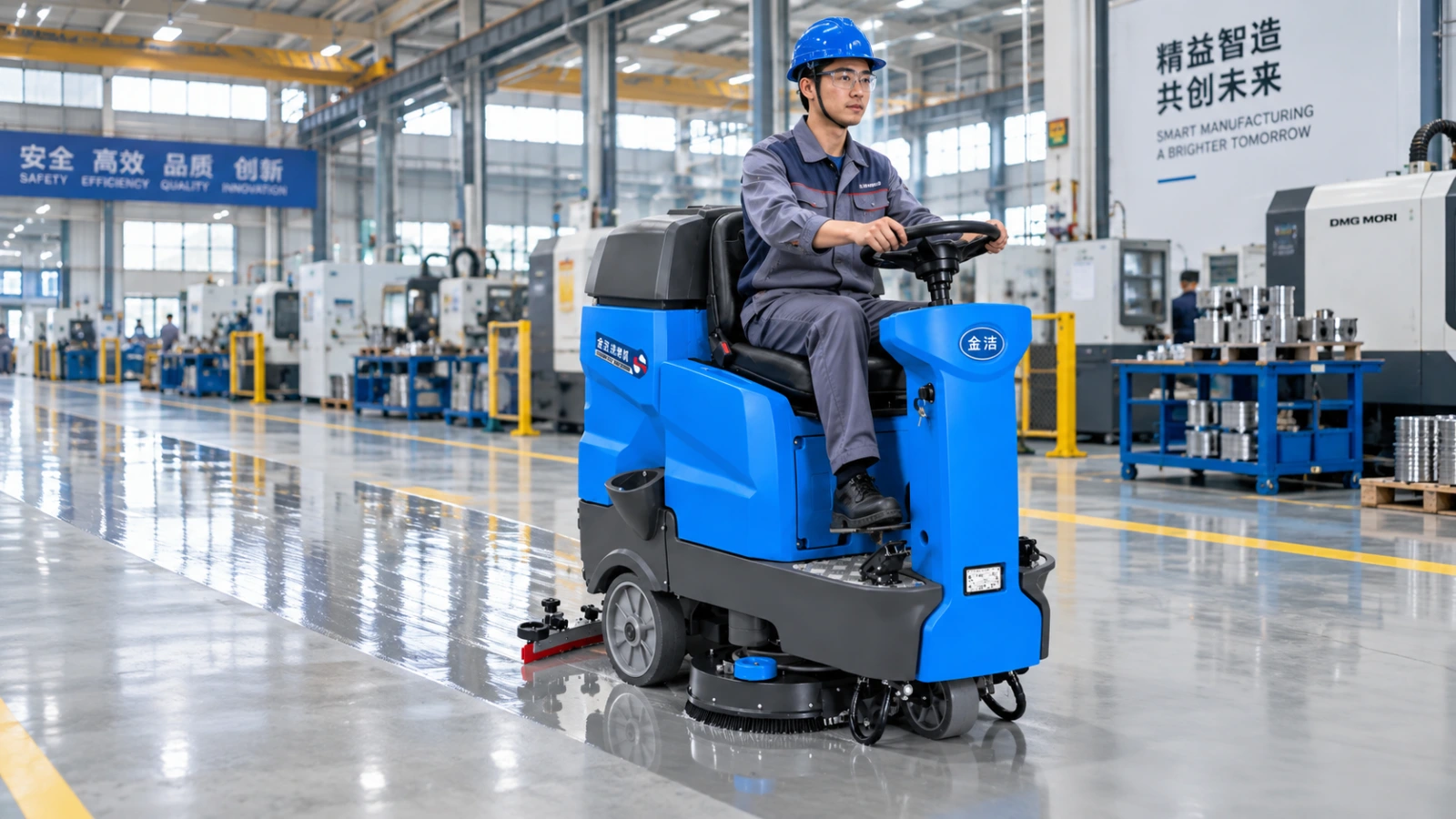
Schedule cleaning zone by zone around production. Check the soil, clearances between machines and travel routes before planning scrubbing and wastewater recovery.
Look at relevant scenarios →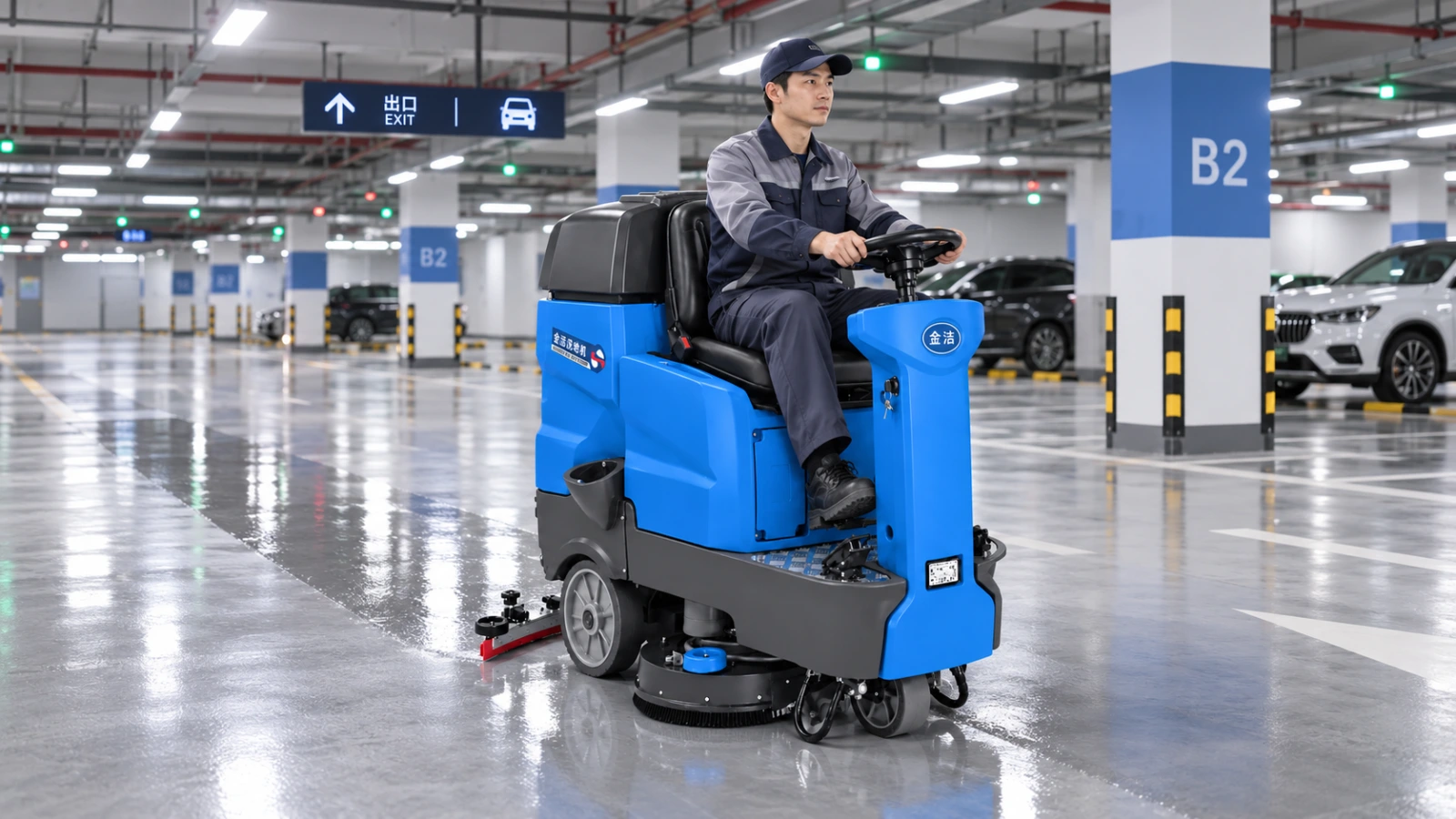
Operator-driven operation reduces the need for prolonged pushing along long routes, with the machine cleaning and recovering wastewater in designated parking areas and main channels, and the slope conditions are also checked together.
Look at relevant scenarios →First understand several configurations closely related to daily use. Detailed specifications are also organized below for easy comparison.
| Key operating figures | |||
|---|---|---|---|
| Cleaning width | 860mm | Squeegee width | 1100mm |
| Clean water tank | 120L | sewage tank | 140L |
| Runtime reference | 4.5–5h | Theoretical cleaning coverage (calculated) | 8600㎡/h |
| Theoretical calculation speed | 10 km/h | Product type | Ride-On Floor Scrubbers |
| Drive and electrical system | |||
| Operating voltage | 24V | Battery | 4 × 6V × 200Ah |
| Travel motor | 750W | Brush motor | 2 × 550W |
| Recovery motor | 600W | ||
| Machine configuration | |||
| Drive arrangement | Front-wheel drive | Machine dimensions | 1600 × 900 × 1320mm |
| Machine weight | 375kg | ||
Note: website theoretical coverage for ride-on scrubber-dryers is calculated as cleaning width × the standard theoretical calculation speed of 10 km/h. It is for theoretical area comparisons, not actual productivity or the machine's maximum travel speed.
The cleaning width affects the coverage of a single pass, and the relationship between the fresh water tank and the dirty water tank affects the convenience of continuous operation. The battery, drive, and water suction system affect the daily floor scrubbing schedule.
8600 m²/h is calculated from the confirmed cleaning width × the website theoretical calculation speed of 10 km/h. It is for theoretical coverage comparisons only, not actual or measured productivity.

Front-wheel drive, 750 W; reduce continuous pushing on longer routes, operate with on-site traffic considerations.
860 mm clear width, brush disk motor 2 × 550 W; determine the cleaning configuration based on the floor material and dirt.
The width of the squeegee is 1100 mm. The washing and wastewater recovery system combines, and actual residual water can be confirmed through on-site testing.
120 L clear water tank, 140 L wastewater tank, combine zone division and water and drainage position arrangement for operations
24 V working voltage, battery is 4 × 6 V × 200 Ah; schedule shifts according to actual working conditions.
Check together the entrance, passage, turning space, ramp, and slippery areas for additional confirmation.
Digital solutions must ultimately be put to use: how the route is arranged, whether water and drainage are convenient, and how shifts are scheduled. We combine key configurations with on-site conditions to help you make judgments.
860 mm clear width, combined with actual route arrangement for continuous operation.
Check together: narrowest entrance / passage / turning space.120 L clear water tank and 140 L wastewater tank, coordinate with zone division cleaning arrangement
Take a look: water refill points / drainage points / cleaning area per session.Combine the machine's drive configuration and on-site route to reduce continuous pushing.
Take a look: continuous route / operating habits / ramp conditions.Arrange shifts based on the machine's battery and actual usage conditions.
Take a look: daily operating time / usage frequency / charging location.Compare related models
Place the three models together and see the differences in configuration and operating method.
| Comparison criteria | 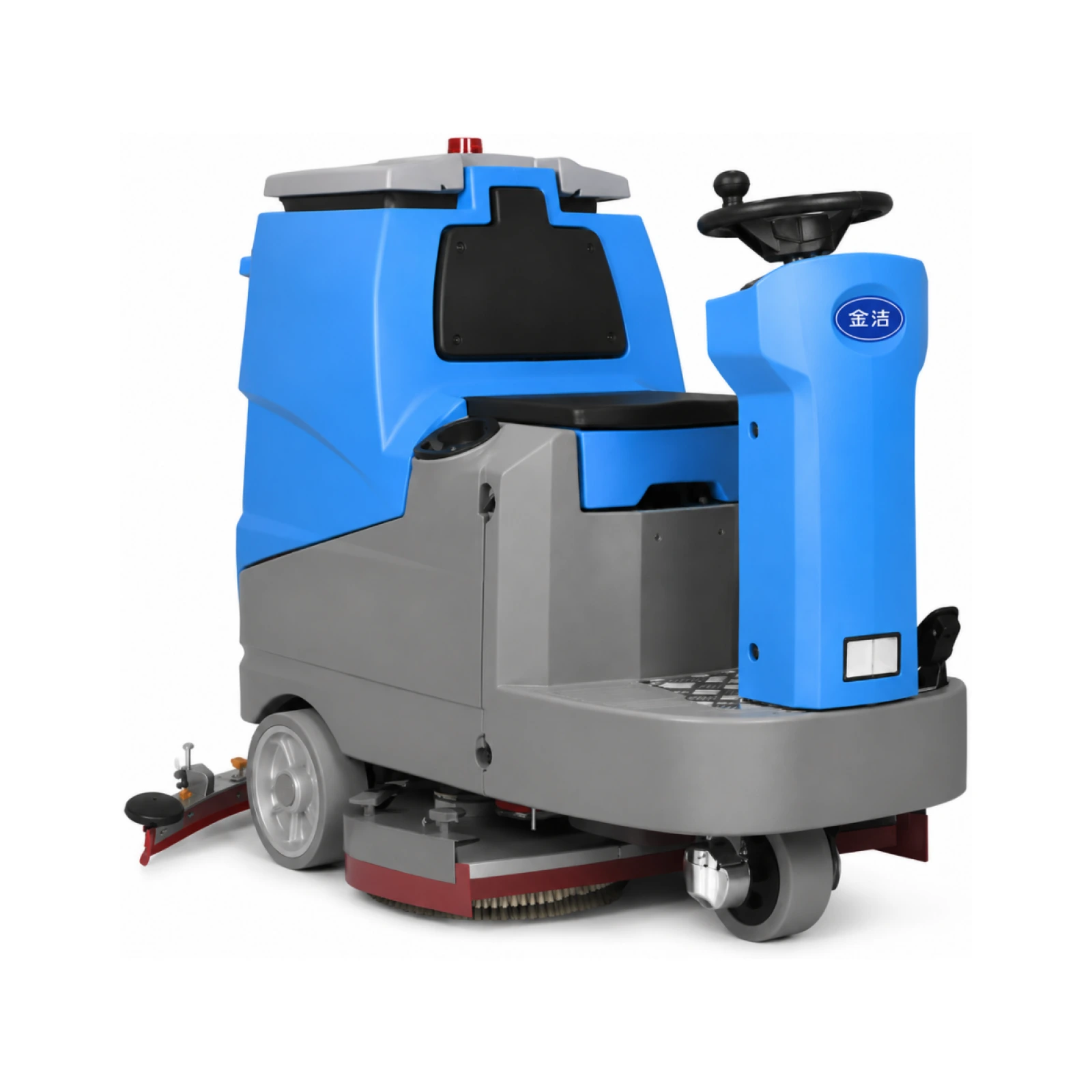 J-D8SL → | J-D9BF → |  J-D9BH → |
|---|---|---|---|
| Cleaning width | 810mm | 860mm | 860mm |
| Squeegee width | 1100mm | 1100mm | 1100mm |
| Clean water tank | 110L | 120L | 120L |
| sewage tank | 110L | 140L | 140L |
| Battery configuration | 24V / 150Ah | 4 × 6V × 200Ah | 4 × 6V × 200Ah |
| Work time for the data. | 3–4h | 4.5–5h | 4.5–5h |
| Operating method | Operator-controlled. | Operator-controlled. | Operator-controlled. |
First, check the passage and operation methods, then compare the water tank, working time, and maintenance schedule. The data in the table is based on the current technical specifications of each model. The working time in the documentation does not equal the actual runtime under all operating conditions.
Operating cost
Compare using the same floor, same cleaning requirements, and actual records.
Labor cost = number of people × actual working hours × hourly labor cost.
Record actual expenditure on tools, detergent and clean-up.
Single-use cost = operator labor + water and electricity with cleaning agent + consumable maintenance allocation + equipment investment allocation.
Turns, water replenishment, sewage discharge, and cleaning conclusion should all be counted as actual working time.
First, check the application scenario of this page. Combine it with your floor type, route, and work schedule to make a judgment. Real customer projects are only displayed according to the verified model, and the scenario images are not used as proof of customer results.
Understand customer applications → Talk about the site and trial run →Check the equipment and configuration list together before delivery.
Understand service arrangements →Communicate startup, brushing, replenishment of water, and daily cleaning.
Understand service arrangements →In case of operational issues, communicate with the model and usage conditions.
Understand service arrangements →Check the brush roll, rubber strip, and other parts against the model.
Understand service arrangements →Service scope, costs, and arrival arrangements need to be confirmed first.
Understand service arrangements →Coordinate maintenance plans with the frequency of use and the location.
Understand service arrangements →Verify steering, stopping, sight lines and crossing traffic, with controls used as instructed. Front-wheel drive is a configuration difference, not proof of suitability for every surface, ramp or wet condition.
First assess whether particles affect brushes or recovery and whether oil and detergent suit the surface and waste-handling requirements. Pre-clean where needed and test a small area. Ordinary scrubbing is not a universal industrial-contamination treatment.
Check whether straight-line coverage is usable, then plan around soil, water settings and filling/disposal points. Dense racks and pillars may add turns and overlap; total floor area is not a substitute for route assessment.
It uses 0.86 m × a uniform theoretical 10 km/h and excludes yielding, replenishment and finishing. It is not the recommended site cleaning speed. Plan shifts from representative task time and results.
Compare the front and rear wheel drive positions, brush and water absorption configurations, operating methods, and delivery accessories of the two models. Then, test turning, parking, and cleaning on the same route. Compare the results based on the team's operational experience, cleaning effectiveness, and residual water records. Do not solely determine the superiority of front or rear drive based on motor power.
The J-D9BF currently lists 120 L/140 L tanks and the J-D9R 140 L/150 L. Replenishment differs, and efficiency-source definitions must not be mixed. Keep separate specifications and delivery lists rather than treating them as one model.
After safely shutting down, check the brush, rubber strip, suction hose, and wastewater tank, and complete the cleaning and charging according to the instructions. When retrieving and lowering, first locate the seal, block, or wear, and do not add water to conceal the problem; complex faults should be handed over to after-sales service.
Discuss aisles, turns, material traffic, surfaces and shifts before trials and brush selection. Retain trial records and the delivery list so Wanshenglong can match parts and service to the actual Jinjie version.
Discuss the floor, routes, and daily cleaning schedule, and together see if J-D9BF is suitable.
Phone consultation: 0755-25621811 View other contact information →
Product enquiryTell us about the usage area and the issues you hope to improve, and the equipment consultant will combine with the passage, ground and work arrangement, communicate the suitable configuration with you. The area is temporarily unclear, you can contact us first.