
Car-park property management
- Typical site
- Large underground car parks
- Why it fits
- Plan continuous driving routes between bays and columns, maintaining floors by zone. Assess ramp access separately.

The Jinjie J-D9BH is a rear-wheel-drive scrubber for longer factory and warehouse hard-floor routes, with 860 mm coverage and 120 L/140 L tanks. Assess its configuration separately from front-wheel-drive models.
View the website playback version for operation reference, while assessing selection against the actual task and conditions.
The video helps explain appearance and operation; it does not replace site verification.
Separate the evaluation of particles, oil stains, and daily footprints, and first determine the appropriate cleaning process for this machine.
The continuous route is still affected by backfilling and drainage, turns, and vehicle and pedestrian avoidance, and the full shift requires on-site recording.
Observe the seal strip, the return path, and the residual water on the ground, and confirm the actual effect through typical ground washing tests.
Evaluate J-D9BH with a route including straight lines, shelf corners, and parking points, observing driving control, brushing, and wastewater recovery, and record water replenishment and charging arrangements. Rear-wheel drive 1200 W is part of the configuration information and is not used to expand on unconfirmed slope, load, traction, or cleaning performance.
Floor surface, dirt properties, obstacles, and operating hours
Clearance between shelves, connection sections, corners, and pedestrian and vehicle traffic
column grid, slope, drainage, and ground condition.
Pedestrian hours, storage, charging, and cleaning frequency.
| Site | Configuration and operating conditions to check | J-D9BH recommendation |
|---|---|---|
| Factory hard floors | Floor surface, dirt properties, obstacles, and operating hours | First, separate the particles and special contaminants, then check if the machine's brush washing and recycling are compatible. |
| Warehouse and continuous passage | Clearance between shelves, connection sections, corners, and pedestrian and vehicle traffic | Include the entire machine and the water-absorbing components in the actual measurement, without using the cleaning width as a substitute for the passage conditions. |
| Property and parking areas | column grid, slope, drainage, and ground condition. | Arrange the route and water supply and drainage according to the site conditions; the slope capability must be confirmed based on the machine's data. |
| Commercial shared areas | Pedestrian hours, storage, charging, and cleaning frequency. | First confirm the parking and supply conditions as well as maintenance requirements, then organize shifts according to actual cleaning needs. |
The above is a reference for on-site judgment, and no commitment is made that all similar sites are applicable.

Where lanes and main aisles are long and need continuous scrubbing and water pickup, rear-wheel drive is worth assessing.
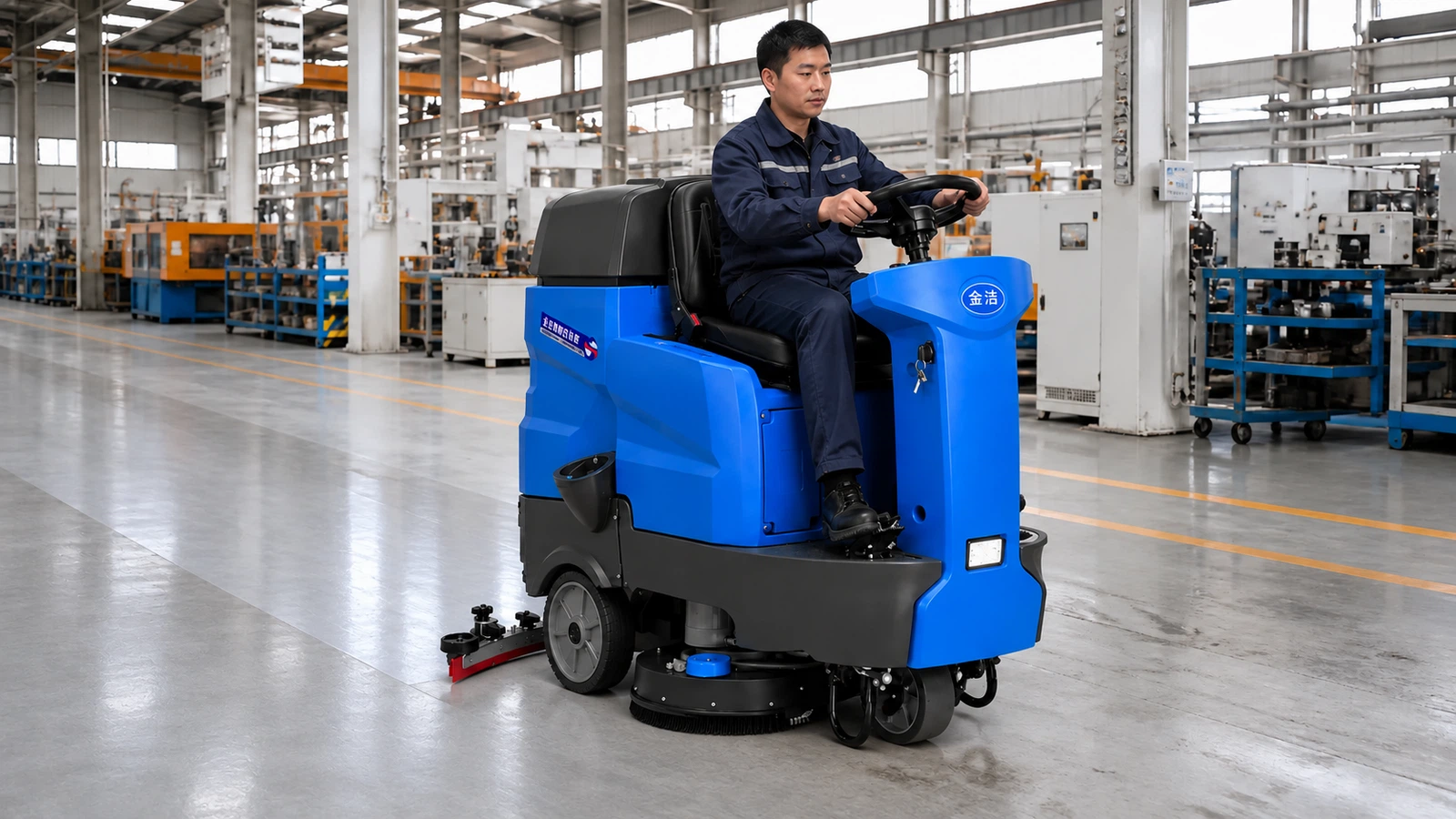
Where hard-floor areas are large, routes are fairly fixed and reducing walking is important, organise the task around continuous ride-on operation.
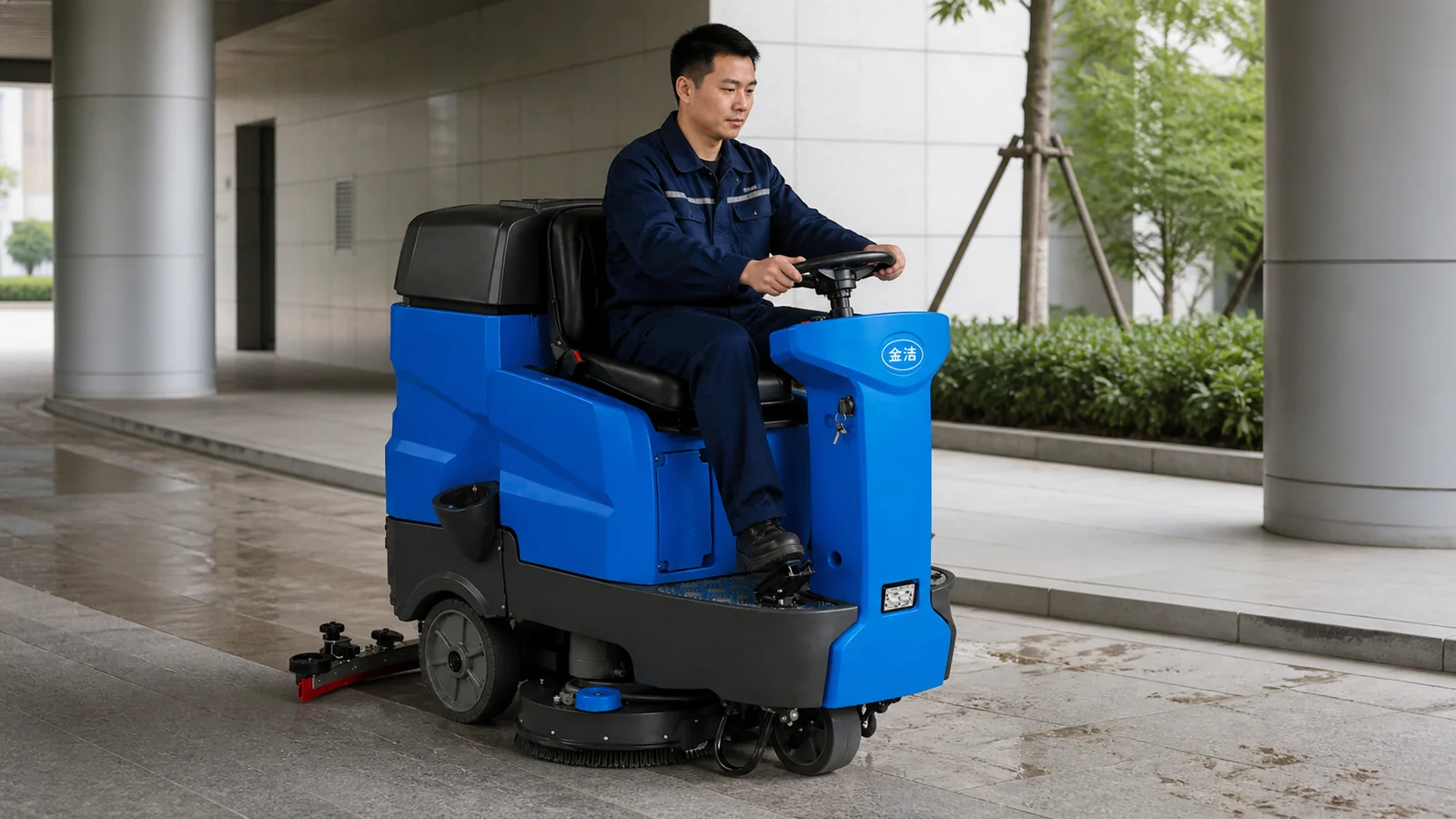
Where ramps, loaded transfers or slippery sections are present, assess rear-wheel drive, flooring and site safety arrangements carefully.
Review day-to-day configuration first. Expand the full specifications for more detail.
| Key operating figures | |||
|---|---|---|---|
| Cleaning width | 860mm | Squeegee width | 1100mm |
| Clean water tank | 120L | sewage tank | 140L |
| Runtime reference | 4.5–5h | Theoretical cleaning coverage (calculated) | 8600㎡/h |
| Theoretical calculation speed | 10 km/h | Product type | Ride-On Floor Scrubbers |
| Drive and electrical system | |||
| Operating voltage | 24V | Battery | 4 × 6V × 200Ah |
| Travel motor | 1200W | ||
| Machine configuration | |||
| Drive arrangement | Rear-wheel drive | Machine dimensions | 1600 × 900 × 1320mm |
| Machine weight | 385kg | ||
Note: website theoretical coverage for ride-on scrubber-dryers is calculated as cleaning width × the standard theoretical calculation speed of 10 km/h. It is for theoretical area comparisons, not actual productivity or the machine's maximum travel speed.
Look beyond the numbers: consider how they affect cleaning coverage, filling/draining frequency, drive suitability and site access.
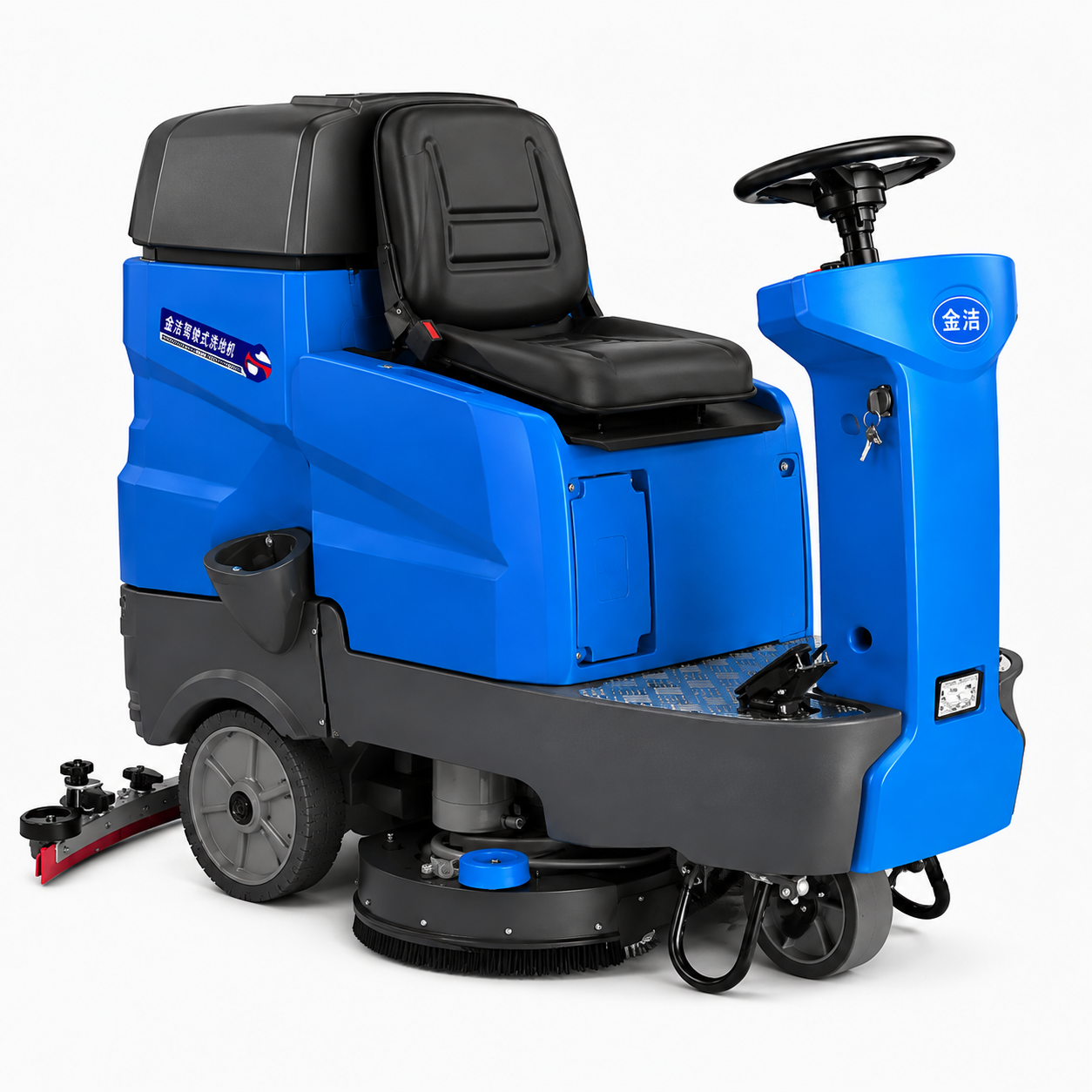
The rear of the image shows the body and water tank shell. Daily check the box cover, seal, and visible connection areas. Refill, drain, and clean the tank according to the machine's instructions.
The driver's seat and footrest provide an operating position for the driver. Before operation, confirm the posture, field of view, route, and avoidance conditions, and control the operating rhythm near personnel and obstacles.
The rear squeegee works in conjunction with the wastewater recovery system to treat the floor after brushing. When residual water marks appear, first stop the machine to check the rubber strip, foreign objects, and connection status, then follow the operating instructions to handle the situation.
The bottom is visible brush cleaning unit. The brush or cleaning pad should be selected according to the ground material and pollution level; replacement, removal of entanglement, and inspection before installation should be done after safely stopping the machine.
The image shows the position of the wheels and chassis. On-site, check the door, corners, ground bearing capacity, and ramp conditions. Reserve space for turning and vehicle and pedestrian avoidance.
The steering wheel and front control area are operated by the driver. The steps of turning on, walking, brushing, water absorption, and parking are based on the actual delivered configuration and on-site training.
The brush roll, squeegee, clear water system, wastewater recovery, drive, battery, and frame structure will collectively affect the stability of the equipment during long-term use, the convenience of maintenance, and the scheduling of operations.
Manual mopping or repeated passes with a small machine across medium/large sites can cause frequent interruptions within a shift.
Rear-wheel drive is relevant to route assessment, but does not replace site checks of gradients, slippery sections and loaded conditions.
The 1100 mm water-pickup width collects dirty water after scrubbing and helps prepare the floor for reopening.
Before ordering brushes, blades, batteries or chargers, provide the machine model and original-part dimensions for confirmation.
For medium/large hard floors, longer routes and sites with some gradient changes.
Loaded travel and route suitability are key considerations. Gradient capability must be assessed on site.
Balances the cleaning coverage for large and medium-sized areas and wastewater recovery, with actual results affected by the route, ground conditions, and rubber strip status.
For organising continuous cleaning along longer routes with fewer filling/draining interruptions.
Compare cleaning width, tank capacity, drive arrangement, access conditions and continuous routes to identify the machine closest to your site's needs.
| Item |  J-D9BF → |  J-D9BH → |  J-920B → |
|---|---|---|---|
| Cleaning width | 860mm | 860mm | 920mm |
| Squeegee width | 1100mm | 1100mm | 1260mm |
| Clean water tank | 120L | 120L | 160L |
| sewage tank | 140L | 140L | 165L |
| Operating voltage | 24V | 24V | 36V |
| Battery configuration | 4 × 6V × 200Ah | 4 × 6V × 200Ah | 6 × 6V × 200Ah |
| Indicative operating time | 4.5–5h | 4.5–5h | 6h |
| Overall dimensions | 1600 × 900 × 1320mm | 1600 × 900 × 1320mm | 1450 × 930 × 1100mm |
| Overall weight | 375kg | 385kg | 632kg |
| Why customers compare these options | Mainly level medium/large routes; assess front-wheel-drive configuration | Longer routes or gradient changes: assess rear-wheel drive | Need larger tanks to reduce filling/draining interruptions |
| Drive / reasons to compare | 750 W front-wheel drive; assess level routes | 1200 W rear-wheel drive; assess route suitability | Large ride-on; tank capacity for continuous work |
Parameter comparison with each model's 'View complete technical specifications'. Working time is a reference value, actual duration varies with battery, load, and on-site operating conditions; specific configuration is checked against delivery documents.
J-D9BH is worth comparing where routes are long and ramps, loaded transfers or drive suitability need assessment.
For level floors and simple routes without significant filling/draining interruptions, first compare front-wheel-drive or smaller models.
Assess gradients, slippery sections, loads, turning and site safety arrangements together.


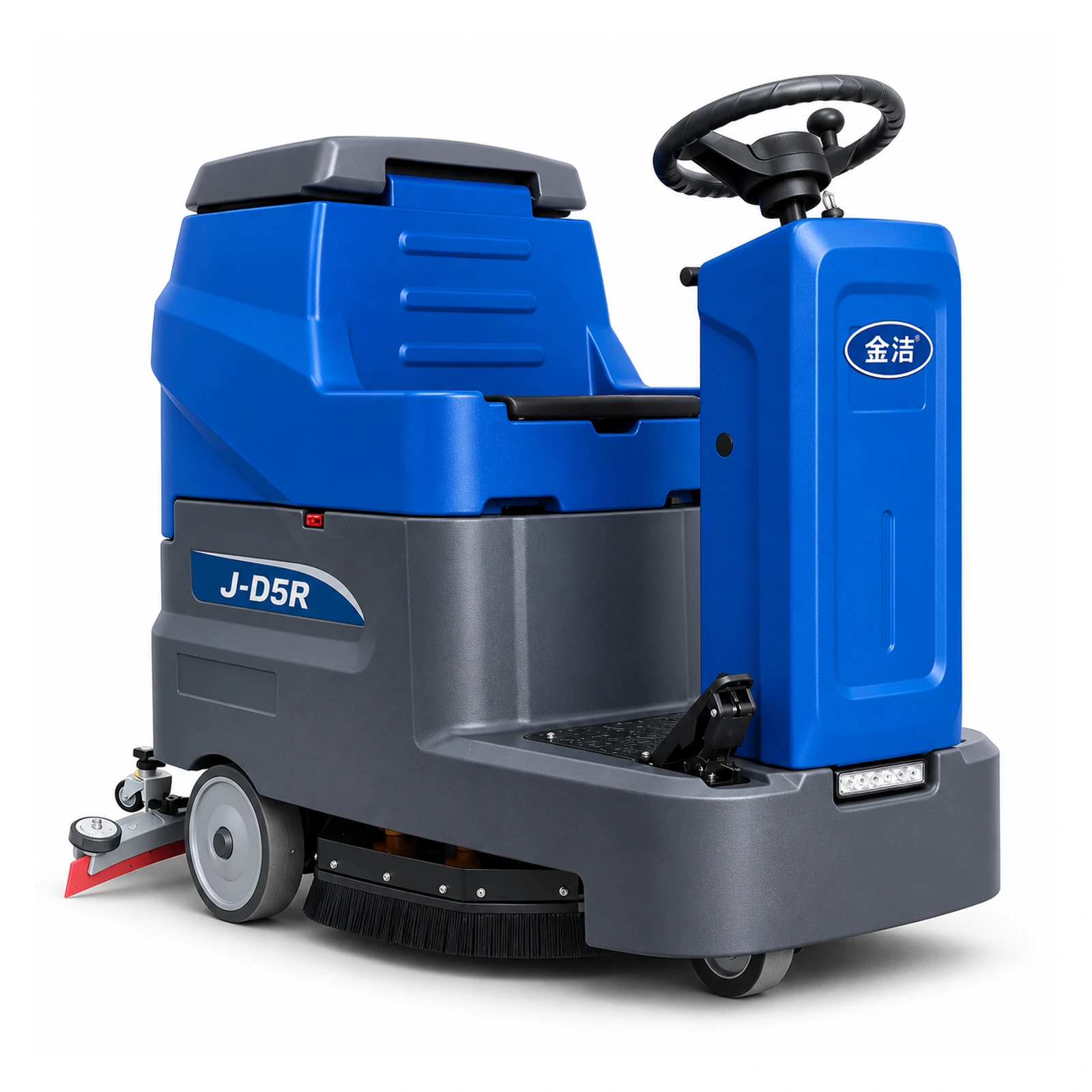

Record the cleaning, scrubbing, and recovery according to the same cleaning requirements and cycle, without taking theoretical efficiency directly as on-site output.
Labour cost = crew size × hours per person × hourly rate. Record preparation, cleaning, transfers and close-down separately.
Include operation or supervision, energy, consumables, disposal and maintenance. Allocate equipment and battery costs over a suitable service period.
Record daily operating hours, routes, garbage or contaminants, and supply and shutdown times; under the same conditions, compare, and do not commit to any savings ratio that has not been calculated.
Check the equipment and configuration list together before delivery.
Understand service arrangements →Communicate startup, brushing, replenishment of water, and daily cleaning.
Understand service arrangements →In case of operational issues, communicate with the model and usage conditions.
Understand service arrangements →Check the brush roll, rubber strip, and other parts against the model.
Understand service arrangements →Service scope, costs, and arrival arrangements need to be confirmed first.
Understand service arrangements →Coordinate maintenance plans with the frequency of use and the location.
Understand service arrangements →Assess how rear drive operates, turns and stops on the target route. Record floor condition, crossing traffic and operator experience and trial within the permitted conditions. Rear drive is not inherently better than front drive at every site.
Assess gradient, bends, wet surfaces, braking and pedestrian clearance together against the machine instructions. The 1200 W rating describes drive configuration, not a climbing grade. Until ramps are confirmed, plan work on verified flat routes.
Straight coverage, water replenishment, and finishing should be scheduled separately. The water tank capacity is used to plan the replenishment route and cannot be directly committed to a continuous area; the recovery performance at seams, column edges, and turns needs to be observed separately during trial washing.
Use the listed 4.5–5 hours as a reference while checking the delivered battery and scrubbing/travel loads. Include cleaning, water stops, after-shift care and charging, then refine the schedule with target-route records rather than treating runtime as fixed.
Similar coverage and tanks make separate checks of rear/front drive, controls and delivery configuration important. Trial steering, stopping and recovery on the same route. Do not transfer one model’s specifications or results to the other.
Record the actual completed tasks, manual corner finishing, water and drainage supplementation, consumables, maintenance, and charging arrangements during a consistent statistical period. Then compare the usage costs of different equipment options. The theoretical 8600㎡/h is only for configuration reference. Personnel savings and investment returns should be based on actual performance of the same task.
Shut down the machine safely according to the instructions, check the wastewater tank, seal, suction hose, and rubber strip, and then check if the remaining water is concentrated in the turn or seam. Record the fault location and conditions, and do not disassemble for repair while powered. Also, do not attribute all the remaining water solely to the motor power.
Send main routes, turns, surfaces, soil, crossing-traffic windows and water points to Wanshenglong. Discuss trials, operator training and parts against the actual Jinjie version and project-specific service agreement.
Discuss the floor, routes, and daily cleaning schedule, and together see if J-D9BH is suitable.
Phone consultation: 0755-25621811 View other contact information →
Product enquiryTell us about the usage area and the issues you hope to improve, and the equipment consultant will combine with the passage, ground and work arrangement, communicate the suitable configuration with you. The area is temporarily unclear, you can contact us first.