
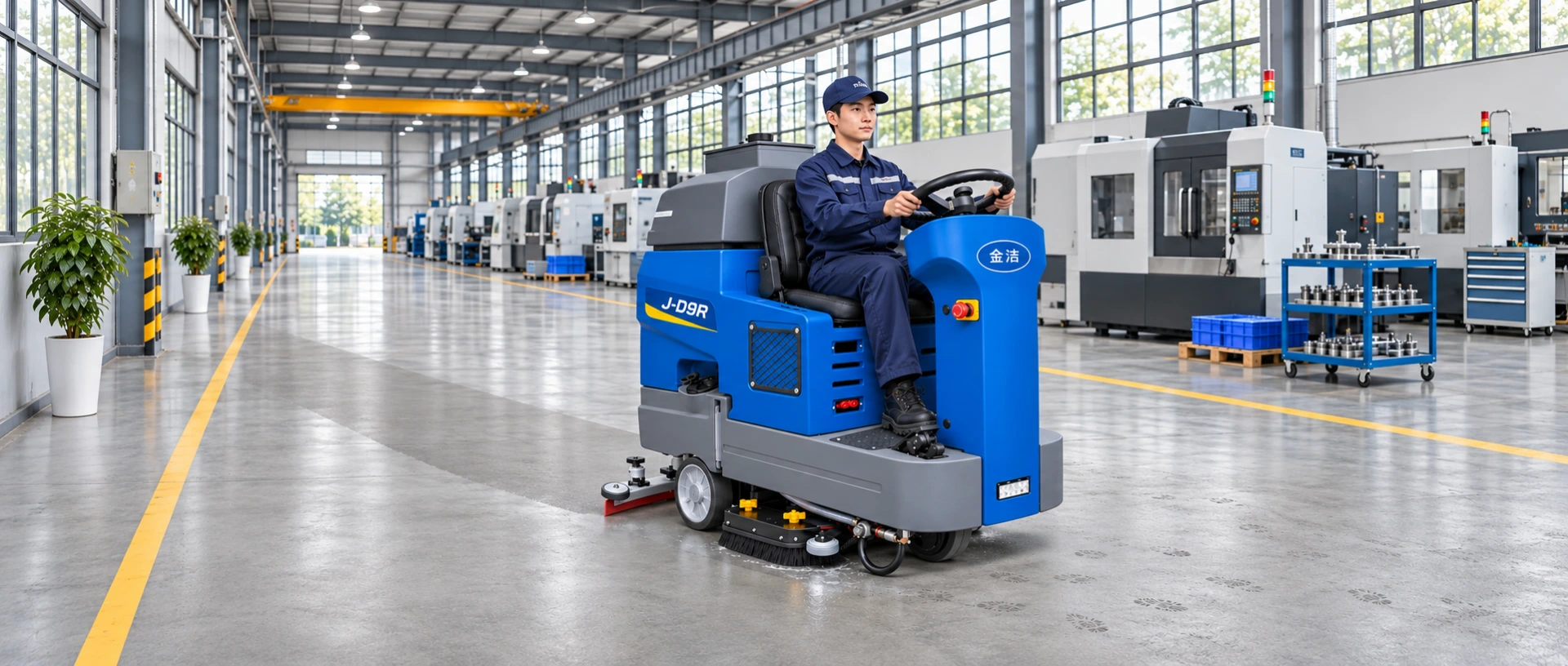
J-D9R · Factory and warehouse floor care
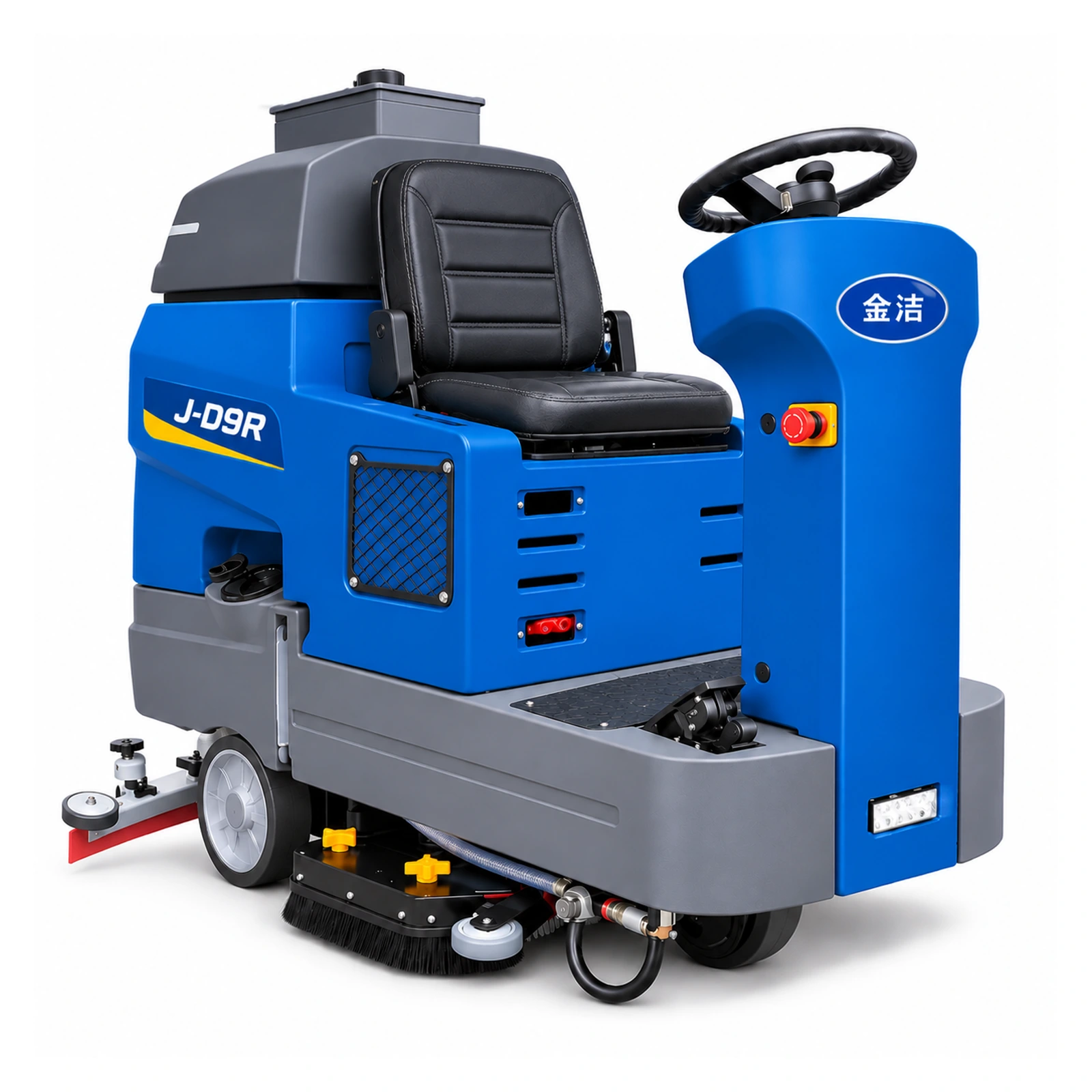
Jinjie J-D9R Twin-Brush Ride-On Floor Scrubber
The Jinjie J-D9R is a ride-on option for relatively continuous factory and warehouse hard floors, using 860 mm twin-brush cleaning and 140 L/150 L tanks. Assess access, turns, soil and replenishment as a coordinated task.
01 Product positioning
Ride-on operation for continuous hard-floor routes, reducing long pushing distances.
02 Core performance
Twin-disc scrubbing and wastewater recovery for routine light soil and footprints.
03 Operating configuration
Battery-powered driving, with separate brush, vacuum and drive motor specifications.
Match the machine to your cleaning route
Continuous work involves more than cleaning width
Repeated routes
Plan cleaning zones to reduce unnecessary travel; do not convert the supplied efficiency figure into staffing savings.
Water interruptions
Match the 140L solution and 150L recovery tanks to filling, drainage and operating schedules.
Water left behind
Check floor material, squeegee contact and blade condition when assessing recovery.
Check floor, access and water logistics together
Separate open working areas from dense racks and pillars. Check clearance for the 1200 mm recovery width as well as the machine and turns. Efficiency, coverage and tanks have different roles in selection; record replenishment, handover and finishing rather than promising completion from an efficiency figure.
| Site condition | Configuration | Selection check |
|---|---|---|
| Continuous main aisles | 860mm twin-disc cleaning | Measure access, turns and passing space. Cleaning width is not machine width. |
| Water servicing | 140L solution / 150L recovery | Plan by soil load and drainage route; tank capacity does not guarantee runtime. |
| Doors, lifts and transfers | 160×90×132cm machine | Also check squeegee envelope and turning clearance. Machine weight must be confirmed for lift loading. |
| Hard flooring | Scrubbing and recovery | Remove large loose debris and entangling objects first. Assess slopes, steps and damaged floors separately. |
J-D9R application reference
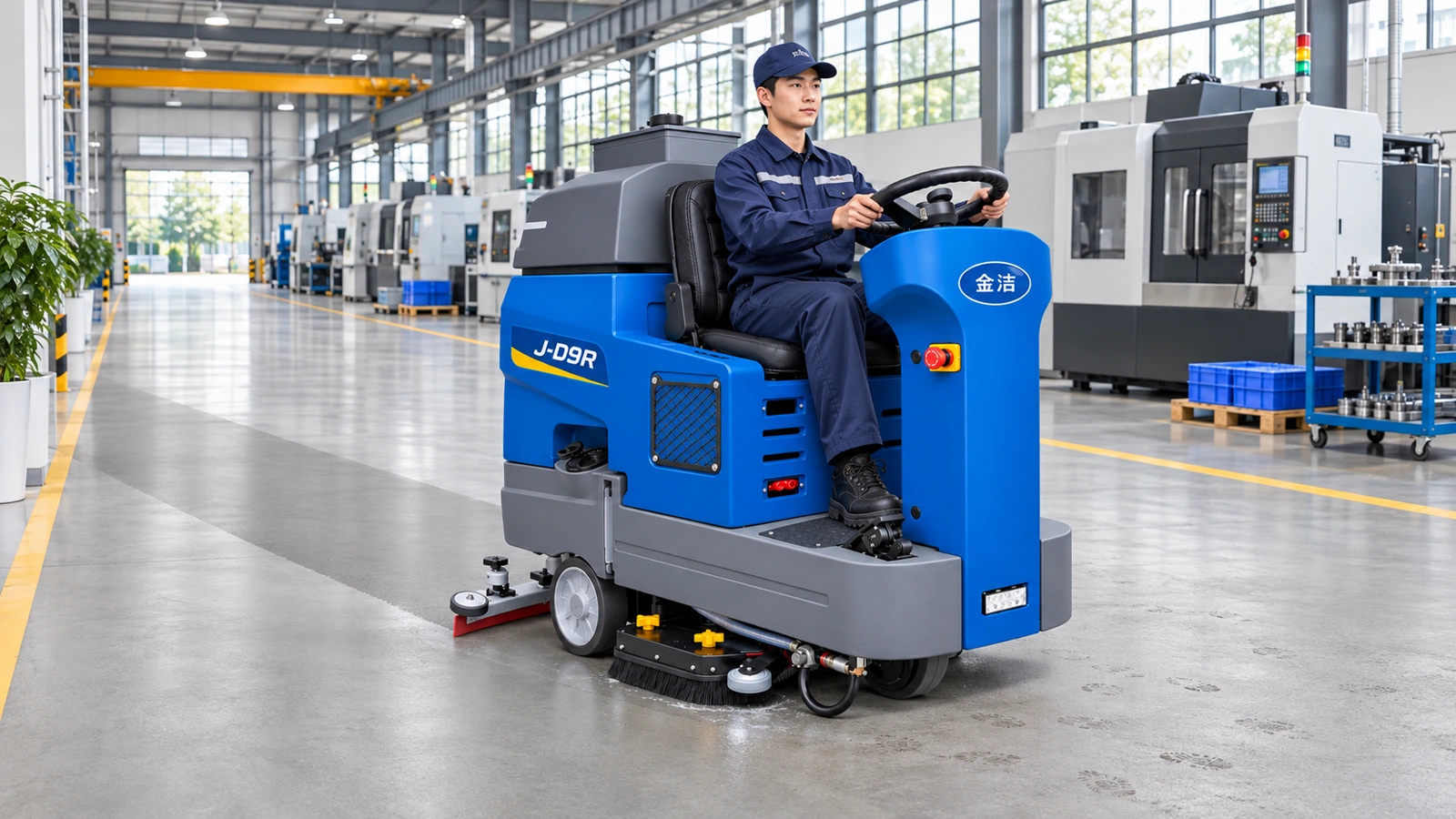
Jinjie J-D9R Ride-on Floor Scrubber · Typical application
Factory hard floors
Plan continuous main-aisle and equipment-perimeter routes while avoiding production obstructions.
View application guidance →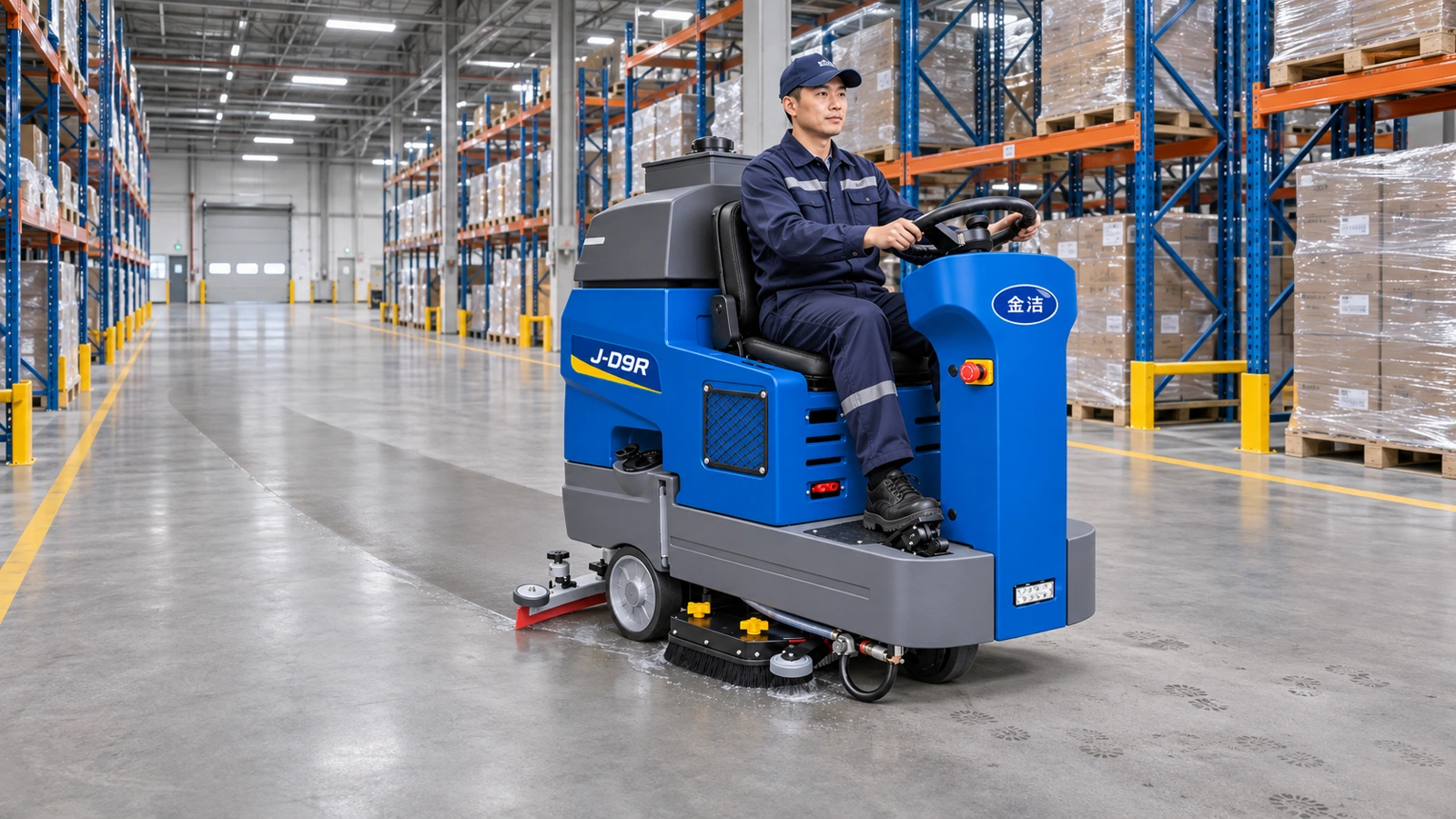
Jinjie J-D9R Ride-on Floor Scrubber · Typical application
Warehouse main aisles
Plan around racks, forklifts and water-servicing points.
View application guidance →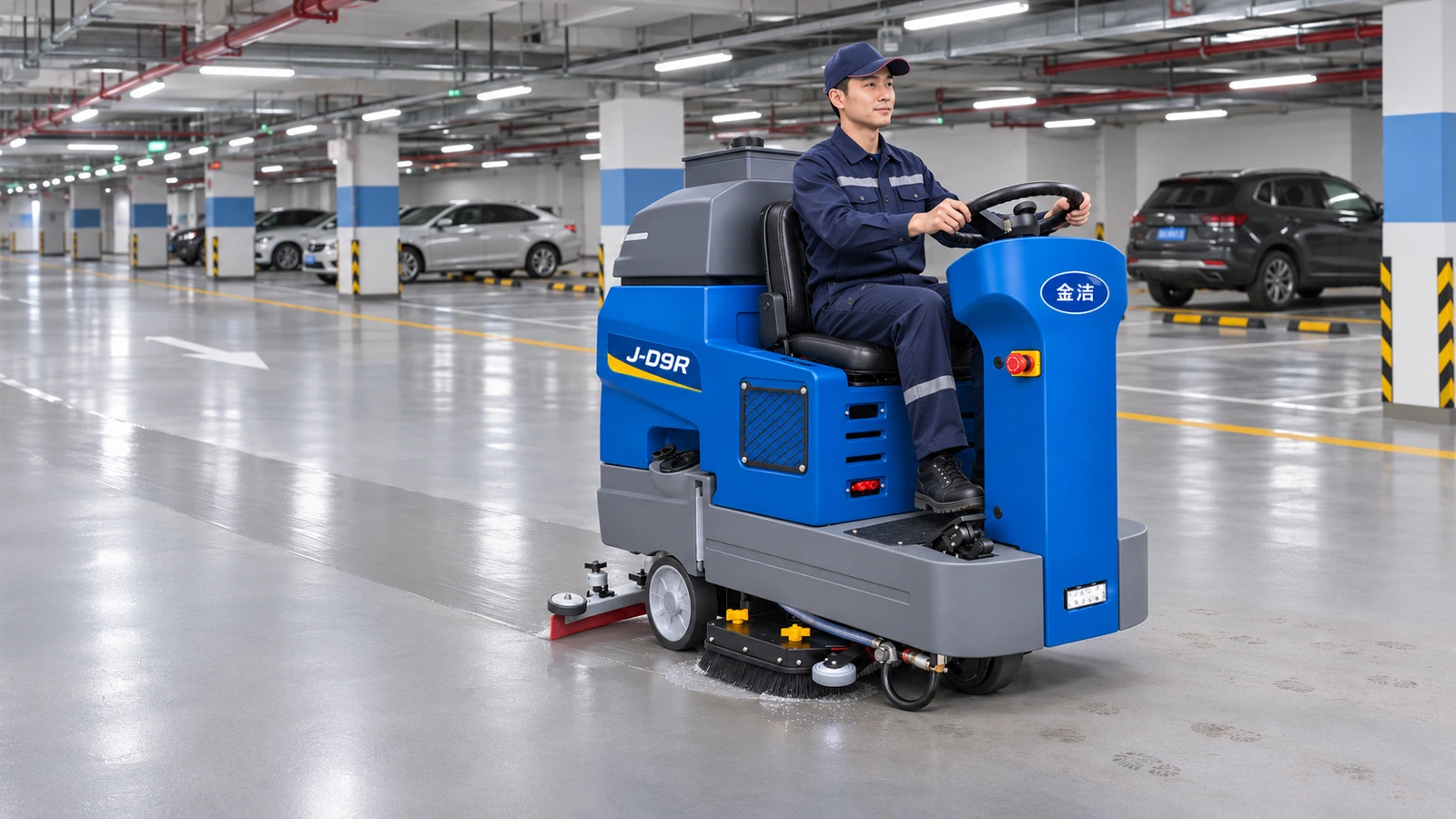
Jinjie J-D9R Ride-on Floor Scrubber · Typical application
Parking-garage aisles
Check floor coating, turns and vehicle separation; assess ramps separately.
View application guidance →Technical specifications
View full technical specifications
| Model | J-D9R |
|---|---|
| Work efficiency (supplied figure) | 5500 m²/h |
| Cleaning width | 860mm |
| Solution tank | 140L |
| Recovery tank | 150L |
| Brush motors | 2×500W |
| Vacuum motor | 600W |
| Drive motor | 1000W |
| Squeegee width | 1200mm |
| Battery | 24V / 200Ah |
| Dimensions (L×W×H) | 160×90×132cm |
5500 m²/h is the supplied efficiency figure; test conditions were not supplied. Actual output depends on routes, soil, turns and water servicing.
Structure and functions
01 Body and tanks
Separate 140L solution and 150L recovery tanks; drain and clean after work.
02 Cleaning process
Two 500W brush motors perform scrubbing, coordinated with water supply and recovery.
03 Recovery system
1200mm squeegee width and 600W vacuum motor; inspect blade contact and recovery hose.
04 Water supply
Adjust water use to the task without assuming an unconfirmed valve-control design.
05 Brush configuration
860mm cleaning width with twin discs. Check wear and entanglement only after shutdown.
06 Driving and controls
1000W drive motor with an operator responsible for travel and cleaning; not autonomous.
Supply, scrub and recover along the route
1. Supply
Solution reaches the scrubbing area according to the task.
2. Scrub
Twin discs work on floor soil using brushes suitable for the material.
3. Recover
The trailing squeegee and vacuum system collect wastewater.
4. Drain and inspect
Wastewater enters the recovery tank; inspect the floor and clean the machine after work.
Plan work around the confirmed configuration
A 24V/200Ah battery is specified with a 1000W drive motor, 2×500W brush motors and 600W vacuum motor. Check the floor, route and water-servicing arrangements before selecting brushes and support equipment.
Compare nearby models
J-D7SL is a smaller-width reference; J-D9BF is a configuration peer, not an assumed performance upgrade.
| Comparison |  J-D7SL → | J-D9R → |  J-D9BF → |
|---|---|---|---|
| Configuration summary | Cleaning width 710mm / Theoretical output 5680㎡/h / Ride-on | 860mm / 140L / 150L / 24V 200Ah | 860mmCleaning width / 1100mm Squeegee width / 120LSolution tank / 140LRecovery tank / Front-wheelDrive750W / 375kg |
| Selection focus | Aisles and turning space | 860mm twin discs, 140/150L tanks and continuous routes | Check this model’s own drive and configuration |
Compare costs for the same task
People and routes
Record cleaning, transfer and water-servicing time; do not calculate staffing from 5500m²/h.
Energy and support
Use actual charging, battery-care and site-support records.
Consumables and maintenance
Include brushes, squeegee blades, daily cleaning and maintenance arrangements.
Care for scrubbing and recovery
Brushes and blades
After shutdown and power isolation, check wear and entanglement. Keep hands clear during operation.
Tanks and hoses
Drain wastewater, rinse the recovery tank and inspect hose blockage and seals.
Battery and charging
Use a matched charger and follow the battery and machine manuals; isolate power before servicing.
Service support
Delivery inspection
Scope and arrangements follow the delivery and service agreement.
Operator training
Scope and arrangements follow the delivery and service agreement.
Usage guidance
Scope and arrangements follow the delivery and service agreement.
Parts supply
Scope and arrangements follow the delivery and service agreement.
On-site fault repair
Scope and arrangements follow the delivery and service agreement.
Scheduled on-site maintenance
Scope and arrangements follow the delivery and service agreement.
Jinjie J-D9R Twin-Brush Ride-On Floor Scrubber — selection and operation questions
Which factory and warehouse tasks suit the J-D9R ride-on scrubber?
Consider daily scrubbing and recovery on relatively continuous hard floors. Distinguish light routine soil from metal chips, entangling material and heavy deposits. Arrange appropriate pre-cleaning for material unsuitable for direct scrubbing.
How should brushes and procedures be selected for J-D9R on epoxy, concrete and dry-shake floors?
For factory work with J-D9R, assess both flooring and soil. On epoxy, check coating condition and brush, pad and chemical compatibility. On concrete, inspect dusting, absorption and damage and collect loose particles first. On dry-shake floors, check texture, sealing and wear and trial brushes. Oily soil needs compatible low-foam chemistry and pretreatment rather than motor power alone. Check scrubbing, blade contact and recovery along the actual route before setting the process.
How should access be checked against J-D9R's 860 mm scrub and 1200 mm squeegee widths?
They describe different coverage functions, not independent access guarantees. Measure rack ends, doors, pillars and parking points using the full machine and actual turns, with appropriate operating clearance.
How should J-D9R's 140 L and 150 L tanks support continuous-route planning?
Locate permitted filling and disposal points and record replenishment under actual water settings and soil. Capacity is not runtime or a guaranteed cleaning area. Include cross-zone travel in shift planning.
How should brush and drive configuration be assessed against factory soil and floors?
The 2 × 500 W brush motors and 1000 W drive describe J-D9R’s scrubbing and travel configuration. Assess floor tolerance, soil, brushes and compatible low-foam chemistry together and trial removal and recovery. Motor ratings do not replace surface compatibility checks or establish ramp capability.
What should be compared between J-D9R and J-D9BF factory ride-on scrubbers?
Both list an 860 mm cleaning direction, but tanks, batteries, drive arrangement, envelope and supplied accessories must be checked independently. Similar coverage is not a reason to exchange specifications or images. Compare the same route and each delivery list.
How should cleaning, recovery and finishing be checked in a J-D9R factory trial?
Observe residual water on straight sections, joints and turns, and check the tank, seals and squeegee safely. Confirm handling conditions for special or hazardous soil first. Clean tanks and recovery paths as instructed; do not inspect energized assemblies.
What factory information does Wanshenglong need to specify J-D9R?
Provide surfaces, soil, rack and pillar layouts, narrow points, water points and shifts. Discuss trials, brushes and operator training against the Jinjie equipment version, delivery list and agreed service scope.
Tell us about your route and floor
Share aisle, turn, floor and water-servicing details to assess J-D9R suitability.
0755-25621811