
01 Intended use
Dry waste maintenance.
For general-purpose garbage in factories, warehouses, and public areas, first check the floor and vehicle and personnel activity.

The MT1 intelligent sweeping robot combines approximately 700 mm coverage, a 35 L hopper and side brushes, a main brush and suction for suitable indoor routes and patrol tasks. Wanshenglong supports site, task and staffing discussions.
Dry waste maintenance.
For general-purpose garbage in factories, warehouses, and public areas, first check the floor and vehicle and personnel activity.
Brushing and dust collection
Dual brush, main brush, and dust collection system work together to cover approximately 700 mm, with the dust box being 35 L.
AI task and automatic return to charging dock
The data supports AI patrol sweeping, automatic recharging, and resume sweeping after interruption, with task modes and manual exception handling implemented separately.
AI sweeping and standard sweeping are distinct, balancing waste recognition and dry collection
The area data for different task modes cannot be interchangeable or used as the actual output for a full day.
Inspection of waste removal, entanglement, and collection components requires personnel to be assigned, not only focusing on the sweeping width.
Temporary changes in cargo, vehicles, and personnel routes require deployment management and abnormal handover.
Distinguish standard full-coverage sweeping from AI patrol tasks, then assess doorways, people, racks and moving obstacles. Trial collection, disposal, charging and staff care as one workflow that fits existing cleaning management.
Waste type, vehicle and pedestrian activity, and area isolation.
Clear width, temporary cargo, and turning.
Garbage distribution, cleaning time, and task mode.
Return the hose, clean the hopper, and assign the hose handler.
| Field or task | Configuration and operating conditions to check | MT1 selection judgment |
|---|---|---|
| Factory perimeter access route | Waste type, vehicle and pedestrian activity, and area isolation. | First, exclude hazardous media or special materials. Even ordinary garbage collection should clearly define the boundary between personnel and vehicles. |
| Warehouse rack route | Clear width, temporary cargo, and turning. | Trays, coiled materials, and temporary stockpiles should be included in management, not just based on the nominal through width. |
| Dry maintenance in commercial settings | Garbage distribution, cleaning time, and task mode. | Standard sweeping and AI patrol sweeping are separately set for acceptance points, and the patrol sweeping area is not considered as full coverage cleaning capability. |
| Charging and disposal point | Return the hose, clean the hopper, and assign the hose handler. | Automatic hose retraction does not equate to automatic waste discharge; waste collection and routine inspections still need to be carried out. |
Prepare a floor plan or road photo, the floor material and contaminants, the narrowest passage and corners, and the traffic and vehicle activity periods. Then verify the charging, waste collection, or water replenishment points, as well as the responsible person for abnormal hose connections.

Collect ordinary loose debris and dust around production areas, routing clear of equipment and staff.
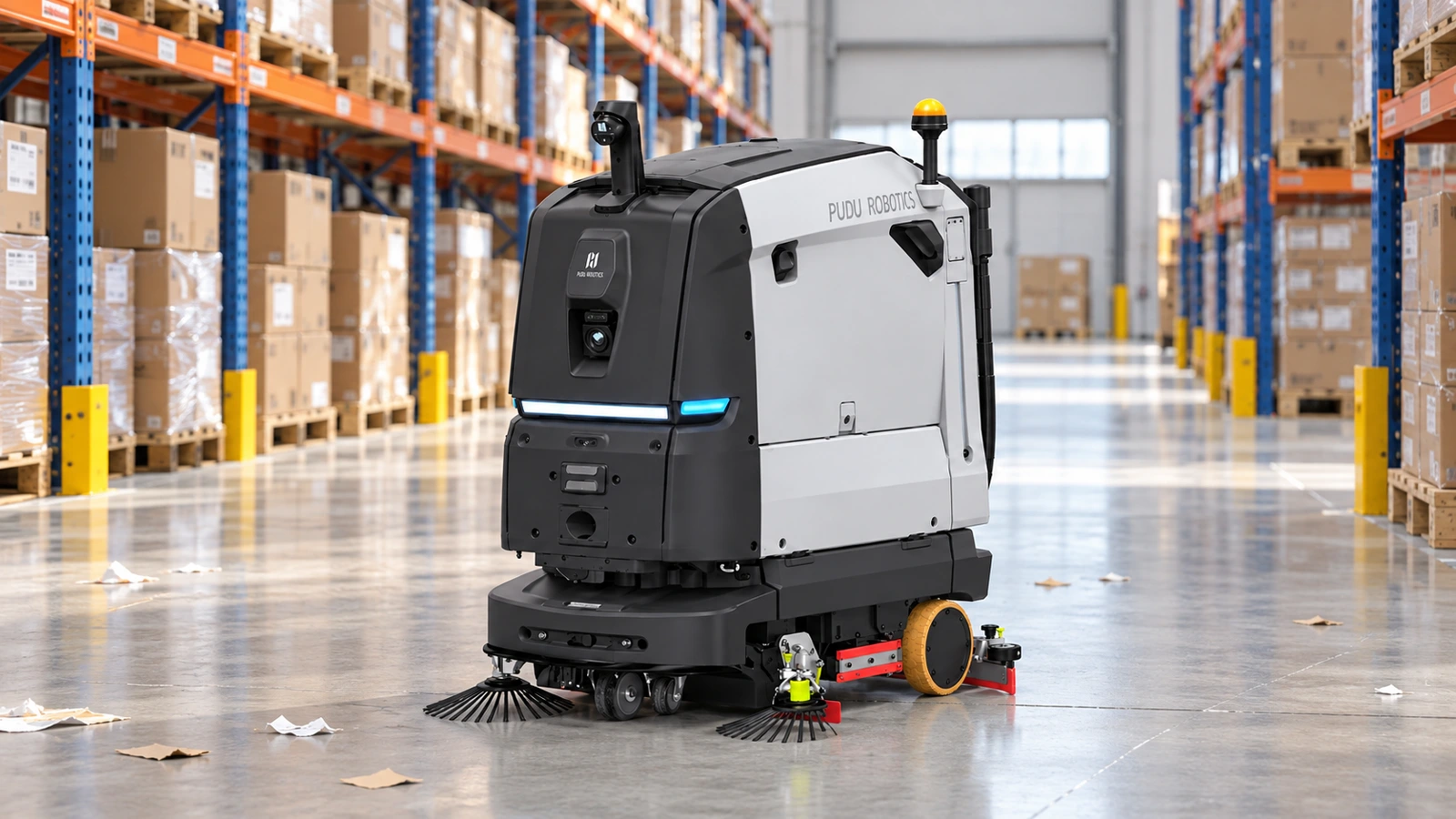
Route sweeping around racks and logistics traffic, avoiding forklift loading and peak access periods.
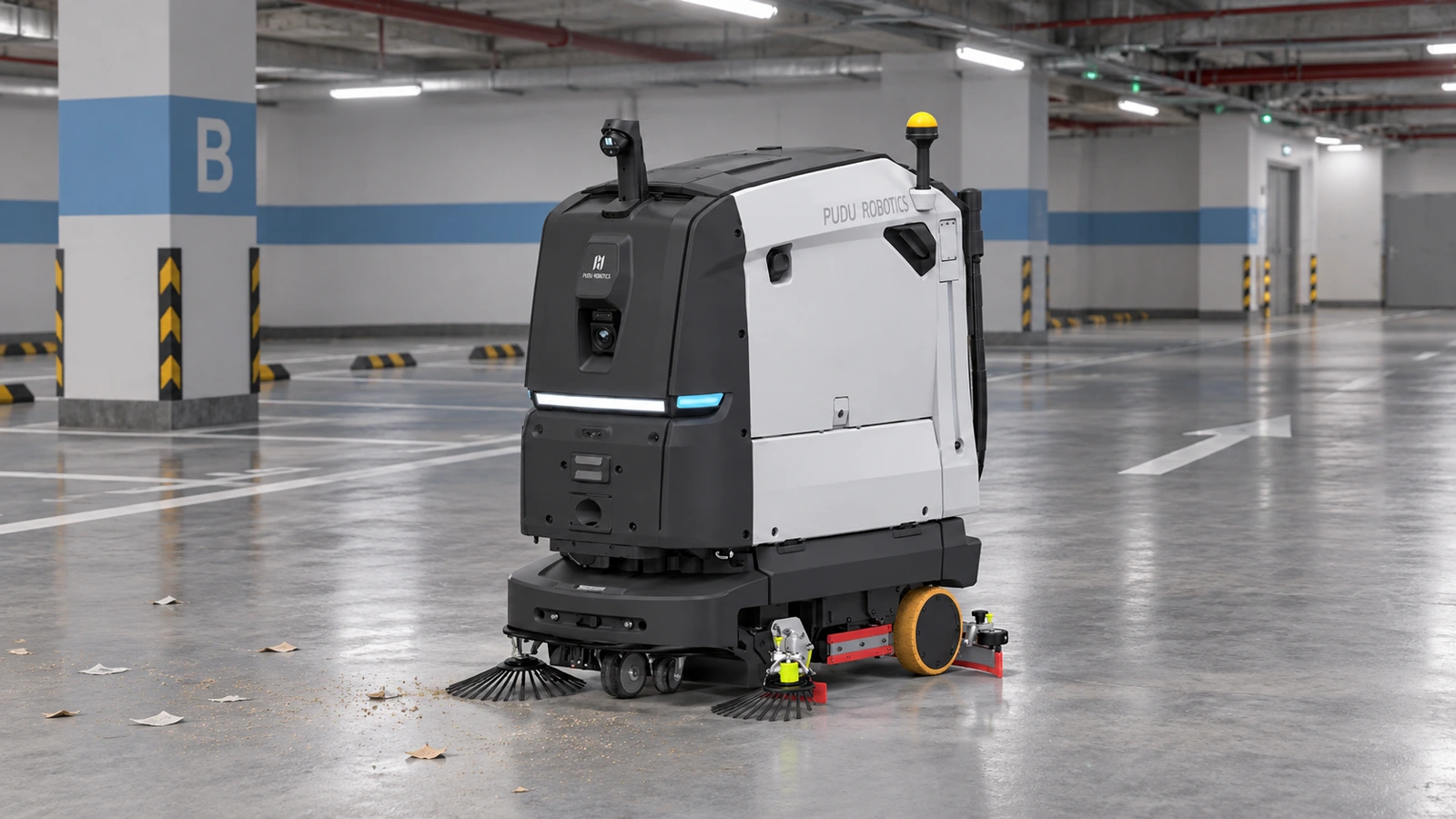
Plan sweeping on level garage aisles after checking parking boundaries, obstacles and vehicle movement.
Review day-to-day configuration first. Expand the full specifications for more detail.
| Key operating figures | |||
|---|---|---|---|
| Product category | AI Smart Sweeper Robot | Main functions | Sweeping, dusting, and AI navigation. |
| Sweeping width | About 700 mm | hopper capacity | 35L |
| Standard cleaning efficiency | Highest about 1800㎡/h | AI Sweeping Efficiency | Highest about 6000㎡/h |
| Battery life | Approximately 4–8 hours | Minimum access width | About 750 mm |
| Perception system | Laser radar, visual camera, and 3D perception device | Sweeping arrangement | Dual brush + main brush + dust collection system |
| Automatic return for charging | Supported | Interrupted sweeping | Supported |
| Digital management | Supported | ||
| Drive and electrical system | |||
| Charge-time reference | Less than about 3 hours | Drive or power supply | Battery-powered; automatic return for charging |
| Machine configuration | |||
| Product model | MT1 | Dimensions | About 840 × 600 × 700 mm |
| Navigation method | Laser SLAM + Visual SLAM | ||
The data on battery life, operating speed, mode efficiency, and actual task completion should be understood separately. The routes, supply, waste removal, and manual finishing are all counted as actual tasks.
Use the complete machine diagram for the corresponding model; the following numbers are function description indices, and unverified internal component locations are not marked

Check the outer dimensions against approximately 840×600×700 mm, and verify the route, cargo, and turning conditions in practice.
Double-sided brush gathering, main brush sweeping, check for wear and entanglement, do not arbitrarily modify the mechanism.
The suction system is compatible with a 35 L hopper. The nature of the waste and dust conditions should be confirmed first.
AI waste recognition and sweeping based on deployment mode, not equivalent to full coverage continuous sweeping
The data includes laser, visual, and 3D sensing. Temporary obstacles and shared areas still require management.
Support automatic return to charging and resume sweeping at breakpoints; personnel are responsible for garbage collection, inspection, and abnormal handling.
The following is a task flow description, which does not replace internal mechanical diagrams or specific operation manuals; it is executed according to the machine's delivered training.
Record the distribution of ordinary garbage, temporary cargo, and personnel and vehicle activities, and define the areas allowed for operation.
Set the standard cleaning or AI patrol cleaning mode according to actual needs, and separately determine the acceptance requirements for coverage and residue.
Dual brush, main brush, and dust collection system work together to collect suitable waste; personnel should observe residual and entanglement.
Return to the charging dock and organize the garbage bins according to the deployment process, record the reasons for interruption, and then arrange for continued tasks or manual handling.
The standard cleaning rate is approximately 1800 m²/h, and the AI patrol cleaning rate is approximately 6000 m²/h; due to differences in mode and conditions, these cannot be considered as the actual output for a full day.
Suction, filtration, and cabinet status collectively affect performance. No claims are made about explosion-proof, hazardous dust, or specific filtration grades without evidence.
Coordinate task management, automatic charging and resumption with inspection, waste removal and manual takeover.
CC1 as a multi-task cleaning reference, J-S130 as a reference for park road sweeping; suitable for directions around waste, routes, and manual management.
| Comparison criteria |  CC1 | MT1 |  J-S130 |
|---|---|---|---|
| Work direction | Sweeping, scrubbing, vacuuming and dust mopping | Dry sweeping and AI patrol sweeping. | Controlled area road sweeping |
| Clean or sweep area | Floor scrubber clearance: 400 mm; Sweeper clearance: 500 mm. | About 700 mm | 1300mm |
| Water tank or waste collection | Clear water about 15 L / dirty water about 17 L; garbage about 6 L; | 35 L hopper | 130 L hopper / 40 L water tank |
| Navigation or control | Visual SLAM + LiDAR SLAM | Laser SLAM + Visual SLAM | LiDAR + IMU + camera |
| Supplemental supply and personnel arrangement. | Automatic hose retraction; drainage required with workstation. | Automatic hose retraction; garbage collection is arranged by personnel. | Check the supply and removal according to the machine configuration. |
| Selection focus | Multi-mode and consumable switching schedule | Standard sweep and patrol diameter | What should be focused on during road facility cleaning? |
Check the machine, charging point, network and accessories required on site. List any workstation separately to avoid counting it twice.
Standard sweeping and AI patrol sweeping separately record task time, collection, recharging, and abnormal takeover, without using the peak of patrol sweeping to calculate a fixed person-saving ratio.
Record consumables, maintenance, and energy usage based on the actual brush, collection, or recovery configuration of the machine; no fixed person-saving ratio is committed without data of the same diameter.
Check for wear and entanglement according to the actual cleaning configuration of the machine, without using the disassembly steps for a driver-type machine.
Clean the collection chamber and visible collection areas in accordance with the amount of waste, and stop the machine as instructed before cleaning
Maintenance should focus on actual existing filtration, suction, or sealing components, and it is not acceptable to speculate on filter materials, cleaning, and spray configuration.
Check for visible window dirt or obstruction; clean according to the machine's instructions, do not arbitrarily change the installation position.
Arrange charging, parking, and replenishment according to the delivery configuration; unclarified interlocks are not assumed to be present by default.
Record route changes, residues, obstructions, or task interruptions, and have the designated personnel handle them according to the procedure.
Service scope, costs, and on-site arrangements are confirmed based on the actual project and agreement.
Check together the machine version, configuration, random documents, and accompanying conditions.
Understand the operation by combining the machine's task mode, deployment boundary, maintenance, and manual takeover.
Bring the model number, route conditions, and equipment prompts for communication of tasks and usage issues.
Check the actual consumables, replaceable parts, and compatible configurations against the machine version.
Service scope, fees, and arrival arrangements should be confirmed in advance, and will be executed according to the actual agreement.
Combine usage frequency, location, and actual agreed maintenance arrangements.
Assess loose debris on suitable indoor surfaces with defined routes and manageable traffic. Check approximately 700 mm coverage, racks and doors, then trial obstacle recognition and collection.
This page MT1 is for sweeping, dusting, and AI navigation, focusing on handling loose debris. For areas requiring brushing and washing of adhered dirt and wastewater recovery, additional comparison of floor scrubbers or organizing a cleaning and scrubbing process after cleaning is needed.
Define full-area coverage versus patrol tasks first. Their efficiency references differ; trial the actual task and assess completion, missed areas, obstacles and staff management rather than numbers alone.
Plan tasks and staff disposal around debris distribution and volume and record loading. Charging and disposal are separate steps; assign unloading and maintenance responsibilities.
The approximately 750 mm minimum passage is a reference. Check frames, turns, protrusions and people and trial access and recognition before defining clearance, stops and takeover.
Use the listed approximately 4–8 hours alongside mode, debris, routes and charging. Include staff disposal and brush and filter care in the task plan and observe the complete daily workflow.
Follow shutdown instructions, inspect brush wear and entanglement, empty the hopper and service filtration and sensing areas. Record faults and route changes and match consumables to the original machine.
Share routes, surfaces, debris and pedestrian activity and define standard or patrol tasks. Trial collection, obstacles, disposal and takeover, then confirm configuration, training and maintenance.
Tell us about the roads, garbage, and daily sweep schedule, and let's see if MT1 is suitable.
Phone consultation: 0755-25621811
Bring a route plan, photographs of the floor or debris, and details of pedestrian and vehicle movements. Identify refill points, network coverage and who will inspect the machine or take over. We can then assess which tasks suit the configuration.