
01 Intended use
Rule Road Sweeping
For controlled routes in parks, industrial areas, and campuses, first verify the road conditions, vehicle and garbage conditions.

The Jinjie J-S130 autonomous sweeper combines 1300 mm coverage, a 130 L hopper and LiDAR, IMU and camera sensing for suitable fixed campus routes, with mapping, tasks and staff disposal coordinated.
Rule Road Sweeping
For controlled routes in parks, industrial areas, and campuses, first verify the road conditions, vehicle and garbage conditions.
Wide sweep and collection
Compare the 1300 mm sweeping width with the usable road width. Check the 130 L hopper against the amount of waste on the route.
Fusion of perception and task management.
The data includes LiDAR, IMU, and cameras. The operating area, disposal, and abnormal takeover must be clearly defined during deployment.
1300 mm sweeping coverage with 130 L hopper, facing controlled park roads for sweeping.
Vehicles and pedestrians crossing, curb edges, and temporary obstacles require controlled management. Navigation names are not a guarantee of safety.
The completeness of the task is determined by the garbage density, the disposal location, and the personnel arrangement, and cannot be solely estimated based on capacity.
The slope, water accumulation, weather, and public road qualifications cannot be automatically determined from the machine model name.
Start with representative roads with defined boundaries and manageable traffic. Check turns, obstacles, supplies and takeover locations against the 1660 × 1300 × 1410 mm machine, then trial sweeping, disposal and station arrangements separately.
Road clear width, corners, and personnel activity.
Waste type, vehicle crossing and isolation.
Pedestrian hours, curb, and drop height.
Hopper cleaning, power supply, and hose management responsibilities.
| Field or task | Configuration and operating conditions to check | J-S130 Selection Judgment |
|---|---|---|
| Enclosed park roads | Road clear width, corners, and personnel activity. | First, define the allowed area for sweeping, and if no person is named, it can be used on public roads. |
| Factory perimeter route | Waste type, vehicle crossing and isolation. | Confirm ordinary garbage and ground conditions, and implement management plans in areas with frequent vehicle activity. |
| Public walkways in the campus. | Pedestrian hours, curb, and drop height. | First, confirm the shared human and machine area and the no-entry boundary, and avoid unverified steps and elevation differences. |
| Waste collection and parking point. | Hopper cleaning, power supply, and hose management responsibilities. | The 130 L housing also needs to be combined with the disposal of waste, and it is not assumed to have automatic unloading, recharging, or site coordination. |
Prepare a floor plan or road photo, the floor material and contaminants, the narrowest passage and corners, and the traffic and vehicle activity periods. Then verify the charging, waste collection, or water replenishment points, as well as the responsible person for abnormal hose connections.
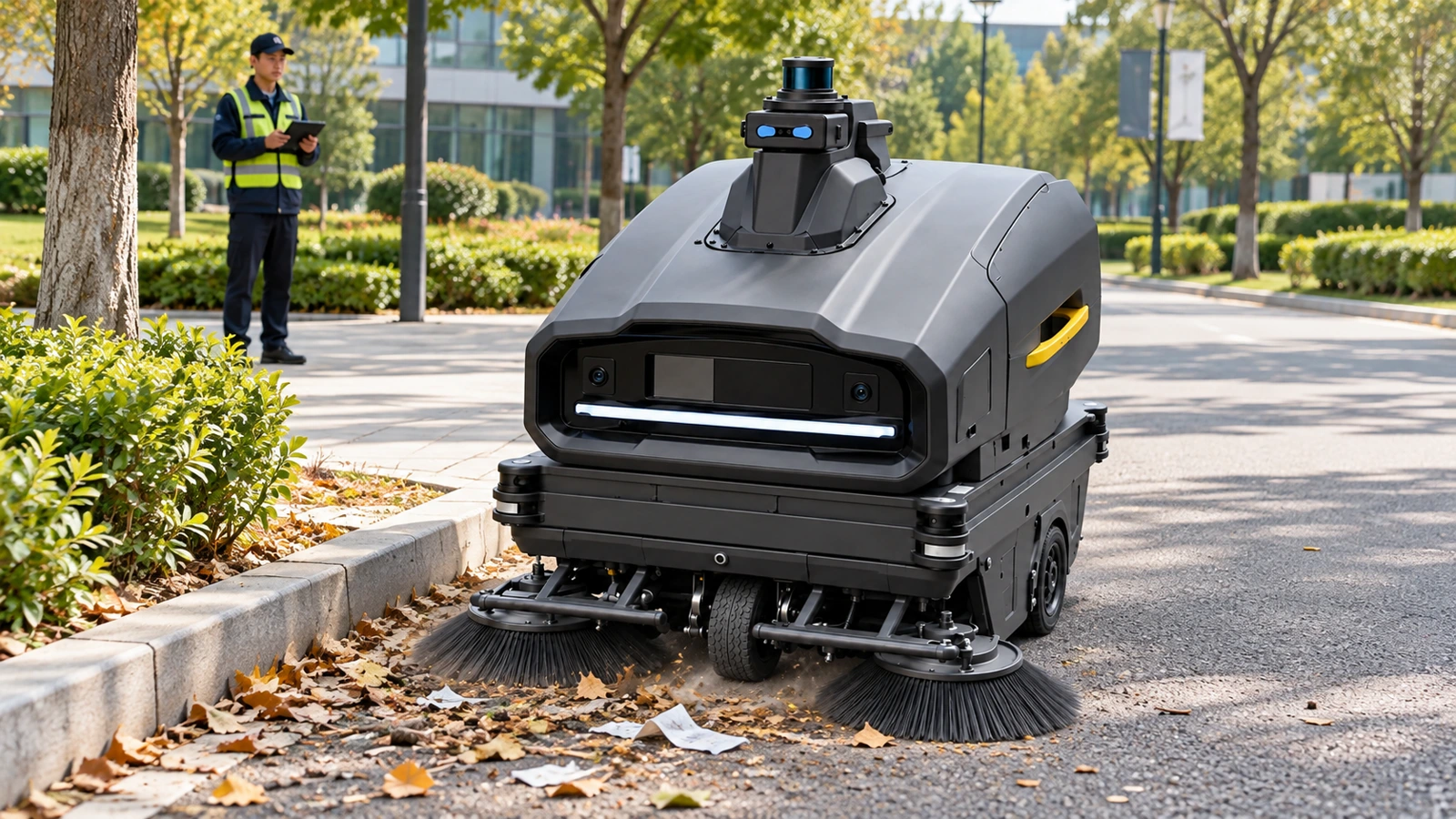
For off-peak estate/property perimeter and fixed-route sweeping of leaves, dust and light debris.
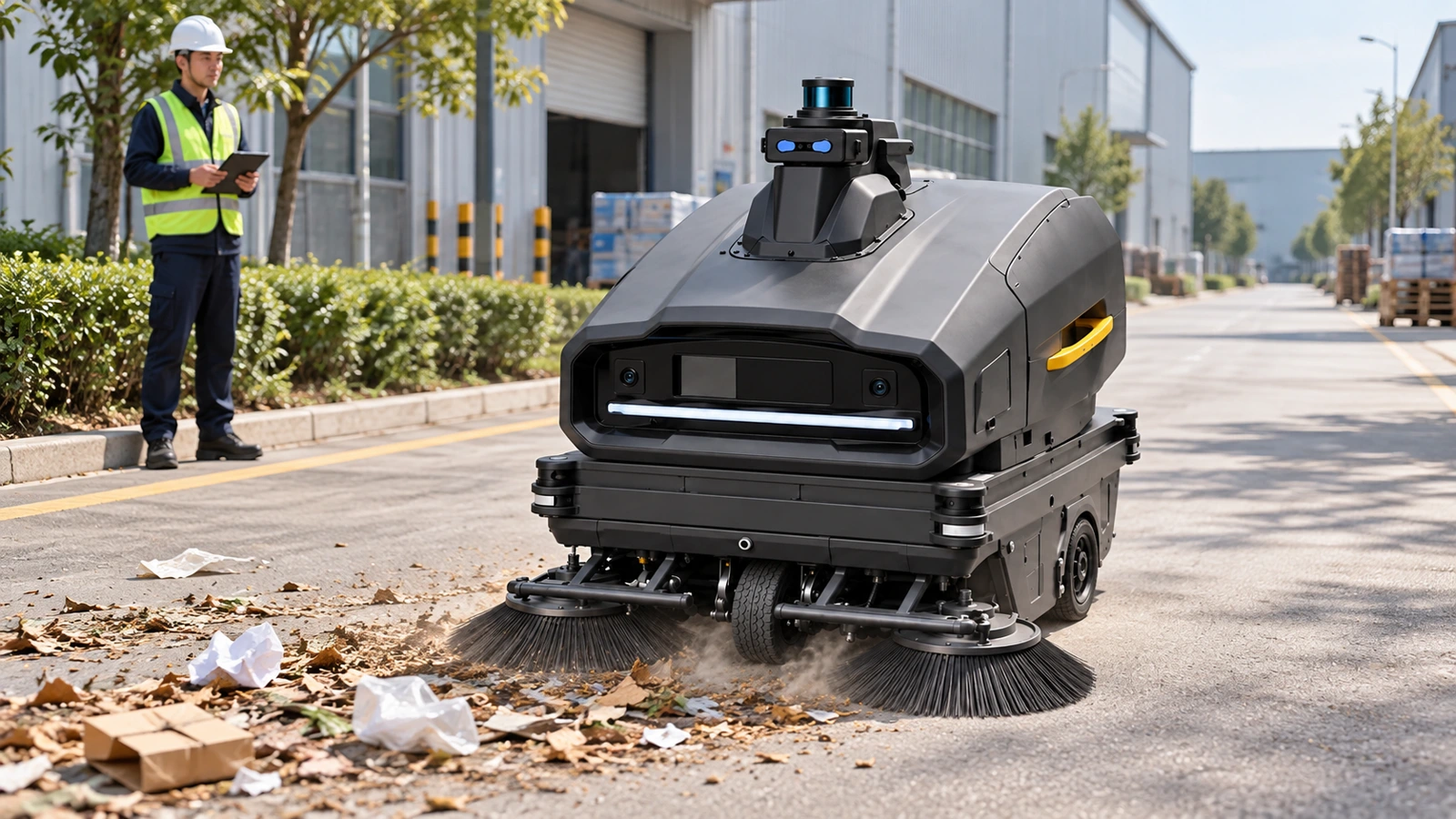
For defined factory and industrial-estate perimeter roads, after checking routes, dust, obstacles and management boundaries.
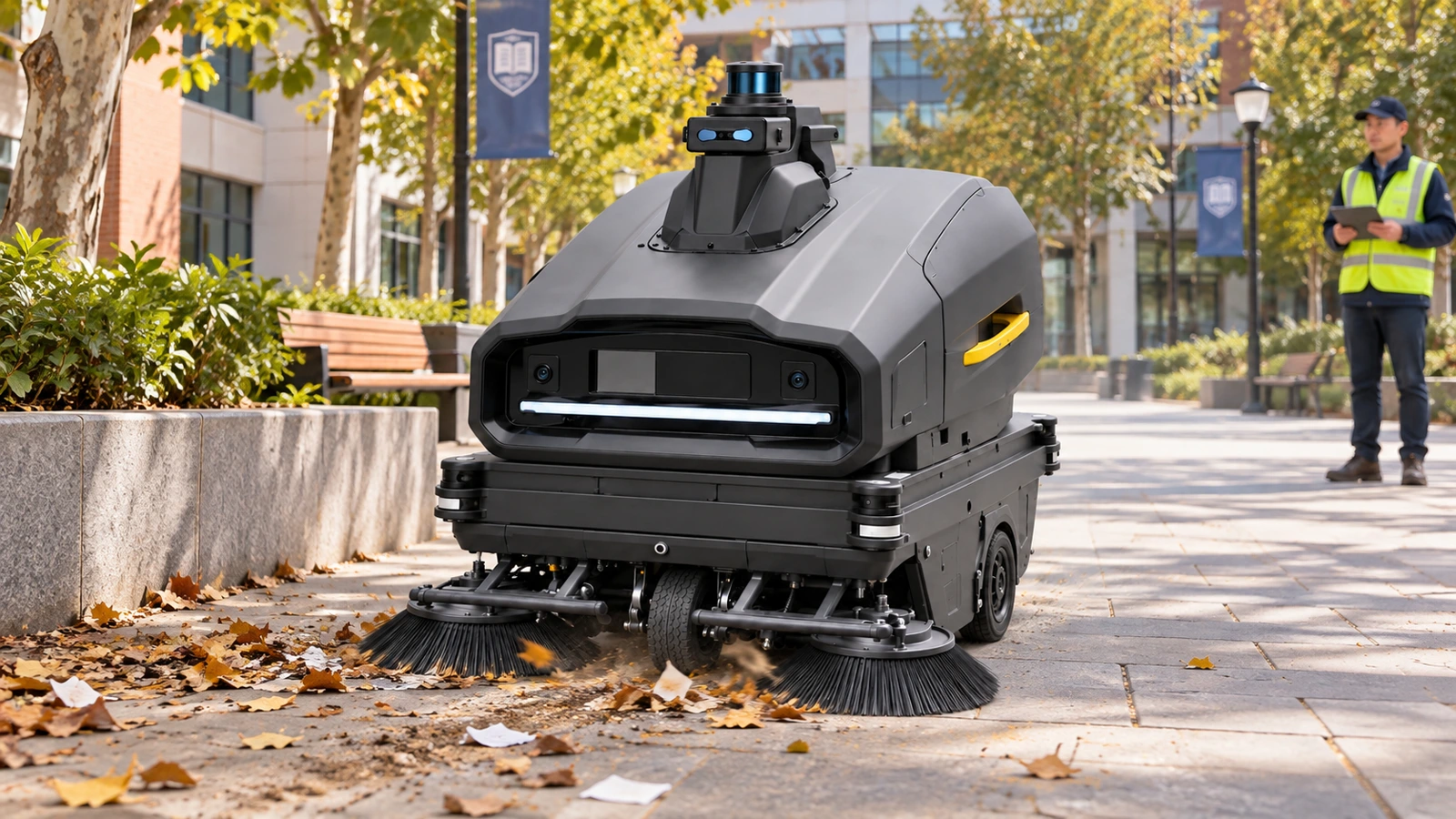
For repetitive off-peak campus, public-path and commercial-perimeter sweeping with site supervision and maintenance.
Review day-to-day configuration first. Expand the full specifications for more detail.
| J-S130 Main unit parameters | |||
|---|---|---|---|
| Overall dimensions (length × width × height) | 1660×1300×1410mm | Sweeping width | 1300mm |
| Turn radius | 1034mm | Sweeping efficiency (data column value) | 6500㎡/h |
| Maximum power | 1500W | Waterproof rating | IPX5 |
| Slope climbing ability. | 20% | hopper capacity | 130L |
| Battery life. | 4-6 hours | Water tank capacity | 40L |
| Overall weight | 500kg | Maximum operating speed | 5km/h |
| Computing power. | 254TOPS | Applicable ambient temperature | -15℃~40℃ |
| Sensor | Laser radar LiDAR, inertial measurement unit IMU, camera. | ||
| WS1 workstation parameters (companion information) | |||
| Workstation model | WS1 | Dimensions (length × width × height) | 651×520×1380mm |
| Weight | 60kg | Maximum power | 2400W |
| Socket requirements | 16A socket | Rated voltage | 220V±22V |
| Working temperature | -10℃~45℃ | Working humidity | 20%~75%RH |
| Storage temperature | -40℃~45℃ | ||
The data on battery life, operating speed, mode efficiency, and actual task completion should be understood separately. The routes, supply, waste removal, and manual finishing are all counted as actual tasks.
The data on battery life, operating speed, mode efficiency, and actual task completion should be understood separately. The routes, supply, waste removal, and manual finishing are all counted as actual tasks.
The machine and WS1 workstation have separate specifications. The listed rate is 6500 m²/h. The route, debris, waste disposal and replenishment affect actual output. IPX5 does not permit immersion. Check the delivery list for the workstation and its included functions.
Use the complete machine diagram for the corresponding model; the following numbers are function description indices, and unverified internal component locations are not marked

Verify the clear width, corner clearance, and parking area against the actual outer dimensions, and do not use the sweeping width as a substitute for the passage dimensions.
1300 mm sweeping coverage is used for route determination, and the actual configuration and maintenance of the brush are confirmed according to the delivery documents.
Plan emptying of the 130 L hopper around the debris load. Check the unloading mechanism supplied.
The data includes LiDAR, IMU, and cameras. The operating area and no-entry boundary are deployed first.
The route is deployed according to the project, and personnel are responsible for observing environmental changes and taking over any anomalies.
Battery life: 4–6 hours, water tank: 40 L; check refilling, charging methods, and workstation configuration according to the delivered configuration.
The following is a task flow description, which does not replace internal mechanical diagrams or specific operation manuals; it is executed according to the machine's delivered training.
Record the clear width, corners, pedestrian and vehicle activity, and waste collection points, and first define the controlled sweeping area.
Arrange the route and operating period according to this project deployment plan. Do not default to public roads or cross-regional coordination.
Clean along the agreed route for the applicable waste, check for residual, box body, and surrounding environmental changes.
Staff clean the box body according to the amount of garbage, ensure supply and maintenance; abnormalities are handled according to the delivery process.
On-site deployment experience cannot be used as qualification for public road operation; the road management and usage boundaries shall be verified on a project-by-project basis.
The 40 L water tank is already listed; the filter area, filter cleaning, and spray form are still to be checked against the machine's data, and the parameters of the driver's type sweeper are not to be borrowed.
The documented sensors are LiDAR, an IMU and cameras. Verify charging, discharge, lift and door integration separately.
Compare the MT1 for autonomous dry sweeping with the operator-driven J-XS1300. Assess the two operating modes separately. A ride-on configuration alone does not establish autonomous capability.
| Comparison criteria |  MT1 | J-S130 |  J-XS1300 |
|---|---|---|---|
| Work direction | Dry sweeping and AI patrol sweeping. | Controlled area road sweeping | Comparison with operator-driven sweeping |
| Clean or sweep area | About 700 mm | 1300mm | 1300mm |
| Water tank or waste collection | 35 L hopper | 130 L hopper / 40 L water tank | Collecting and configuration are as per the specifications of this model. |
| Navigation or control | Laser SLAM + Visual SLAM | LiDAR + IMU + camera | On-site operation by the operator. |
| Supplemental supply and personnel arrangement. | Automatic hose retraction; garbage collection is arranged by personnel. | Check the supply and removal according to the machine configuration. | Staff responsible for driving, supply, and waste removal. |
| Selection focus | Standard sweep and patrol diameter | What should be focused on during road facility cleaning? | Staff operation plan for similar roads |
Check the machine, charging point, network and accessories required on site. List any workstation separately to avoid counting it twice.
Include road management, garbage collection, parking for refueling, inspections, and abnormal takeover in the tasks, without directly converting them to zero human labor by name.
Record consumables, maintenance, and energy usage based on the actual brush, collection, or recovery configuration of the machine; no fixed person-saving ratio is committed without data of the same diameter.
Check for wear and entanglement according to the actual cleaning configuration of the machine, without using the disassembly steps for a driver-type machine.
Clean the collection chamber and visible collection areas in accordance with the amount of waste, and stop the machine as instructed before cleaning
Check the actual filtration, sealing, and 40 L water tank related areas of the machine, and verify the spray pattern and maintenance requirements according to the machine's instructions.
Check for visible window dirt or obstruction; clean according to the machine's instructions, do not arbitrarily change the installation position.
Arrange charging, parking, and replenishment according to the delivery configuration; unclarified interlocks are not assumed to be present by default.
Record route changes, residues, obstructions, or task interruptions, and have the designated personnel handle them according to the procedure.
Service scope, costs, and on-site arrangements are confirmed based on the actual project and agreement.
Check together the machine version, configuration, random documents, and accompanying conditions.
Understand the operation by combining the machine's task mode, deployment boundary, maintenance, and manual takeover.
Bring the model number, route conditions, and equipment prompts for communication of tasks and usage issues.
Check the actual consumables, replaceable parts, and compatible configurations against the machine version.
Service scope, fees, and arrival arrangements should be confirmed in advance, and will be executed according to the actual agreement.
Combine usage frequency, location, and actual agreed maintenance arrangements.
A clear evaluation boundary, suitable road conditions, and the ability to manage vehicle and pedestrian activities on a fixed route. First, confirm that 1300 mm coverage is compatible with the entire machine's passage. Then, combine this with obstacles, turns, and stops for trial operation, ensuring that the automatic tasks are coordinated with on-site management.
Translate debris distribution and frequency into tasks and observe collection, missed areas and waiting. Coordinate disposal of the 130 L hopper with staff and handle long, large or special material separately.
They support sensing and operation, while suitability depends on site recognition and route trials. Observe vehicles, pedestrians, glass and changing boundaries and define staff takeover.
Use it initially, then record mode, routes, waiting, disposal and supplies. Include staff checks and charging and trial complete tasks rather than converting runtime directly into daily area.
Check the dimensions, power supply, placement, and actual functions of the main unit and work station separately. The WS1 documentation specifies 220 V±22 V and requires a 16A socket; confirm before delivery whether the work station is configured and the specific accessories, to avoid assuming that all automatic functions are fully automated.
Follow instructions for disposal, brushes, filters, sensor cleaning and charging checks and record route changes and faults. Include takeover and maintenance responsibilities in task planning.
J-S130 and MT1 should be compared in terms of deployment site, coverage, waste collection, and task mode; for manned models, attention should be paid to driving route, power supply, and waste transportation. First determine whether it is suitable for automation, then compare how the equipment and personnel should be divided.
Share maps, traffic, debris and tasks to define assessment routes. Record completion, takeover and disposal, then confirm configuration, training and care for manageable daily operation.
Tell us about the roads, garbage, and daily sweep schedule, and let's see if J-S130 is suitable.
Phone consultation: 0755-25621811
Bring a route plan, photographs of the floor or debris, and details of pedestrian and vehicle movements. Identify refill points, network coverage and who will inspect the machine or take over. We can then assess which tasks suit the configuration.
Bring a route plan, photographs of the floor or debris, and details of pedestrian and vehicle movements. Identify refill points, network coverage and who will inspect the machine or take over. We can then assess which tasks suit the configuration.