
01 Residential estate / internal road sweeping
- Typical site
- Residential estate / internal road sweeping
- Why it fits
- For regular residential and estate-road sweeping of leaves, paper and ordinary road debris.

The Jinjie J-XS1250 ride-on sweeper serves factory aisles, property roads and warehouse surroundings. Its 1250 mm coverage, 120 L hopper and 7 m² filter area support assessment of access, waste collection and dust management together.
Compare routes by access, debris load and collection arrangements.
Map leaf accumulation, pedestrian hours and disposal points so collection and sweeping fit the same route.
Map roads between workshops. Separate ordinary dry litter, heavy objects and sticky contamination.
Work around class changes and pedestrian traffic. Allow space to yield and turn.
Check bay corners, columns and headroom, using the complete machine dimensions to establish clearance.
Plan sweeping, kerbs and disposal as one route before assessing 1250 mm coverage. Trial leaves, paper and ordinary dust and observe loading, edges and filtration. Check the 65 L tank, 48 V supply and charging separately to fit staff shifts.
| Site | Key checks | Selection guidance |
|---|---|---|
| Property estates | Leaf volume, narrow sections, pedestrians and disposal points | Assess ordinary dry sweeping where the route is clear and traffic can pass safely. |
| Factory perimeter | Debris type, crossing traffic and route length | Remove heavy objects, tangles and sticky waste before testing on ordinary dry litter. |
| Campuses and public spaces | Pedestrian hours, turns, parking and charging | Schedule rounds during quieter periods and check safety arrangements and storage. |
| Parking aisles | Overhead clearance, columns, bends and gradients | Check overall clearance and turning space. The 1250 mm sweeping width alone cannot establish whether the machine will fit. |
Plan the equipment, route, waste collection and crew together.
Schedule rounds around litter accumulation, especially at kerbs and under trees. Remove bulky items separately.
Connect accessible road sections into a continuous route. Drive only where safe and measure working coverage during a trial.
The 120 L hopper collects debris. Plan emptying around its volume, weight and the disposal point.
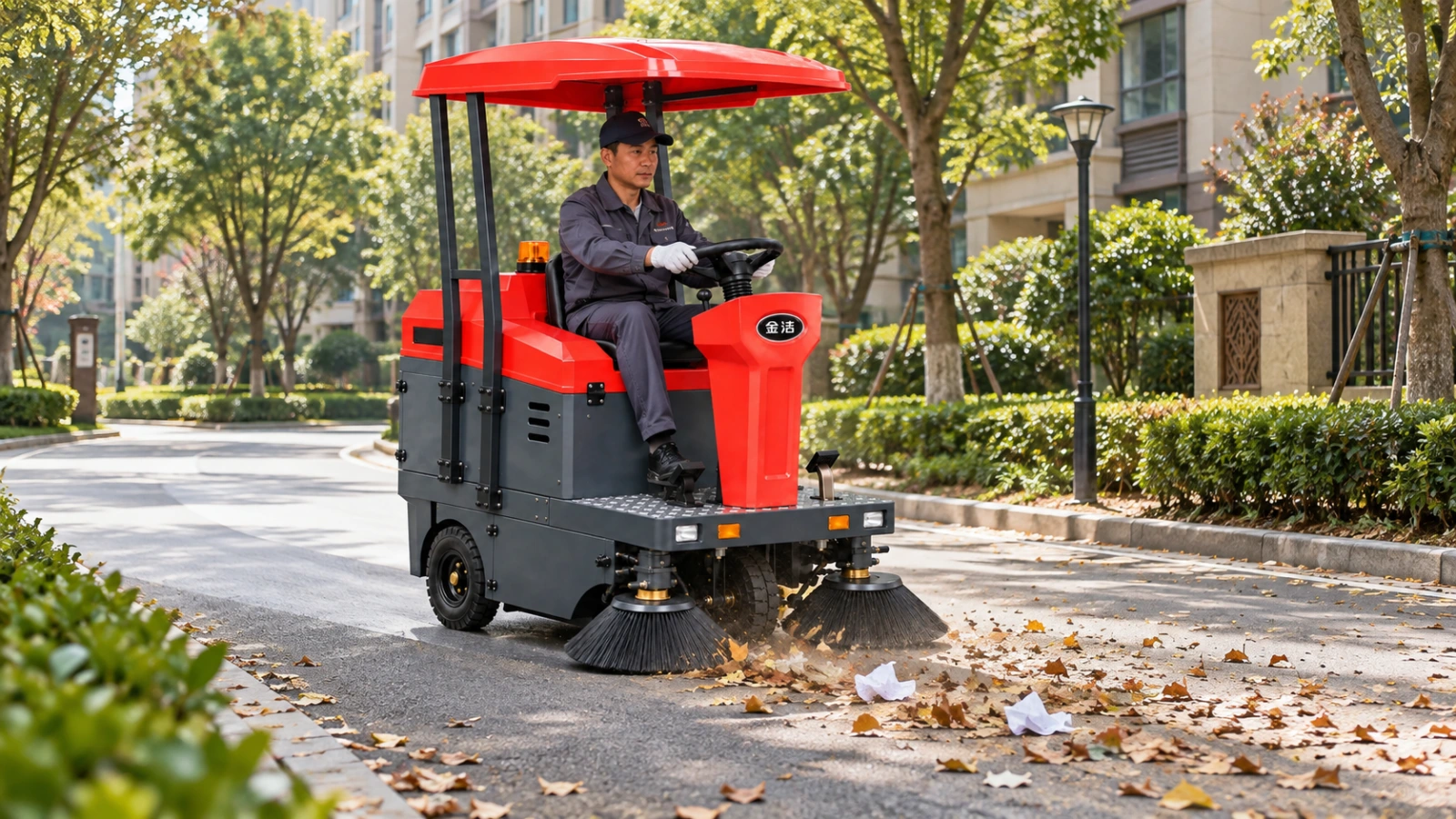
For regular residential and estate-road sweeping of leaves, paper and ordinary road debris.
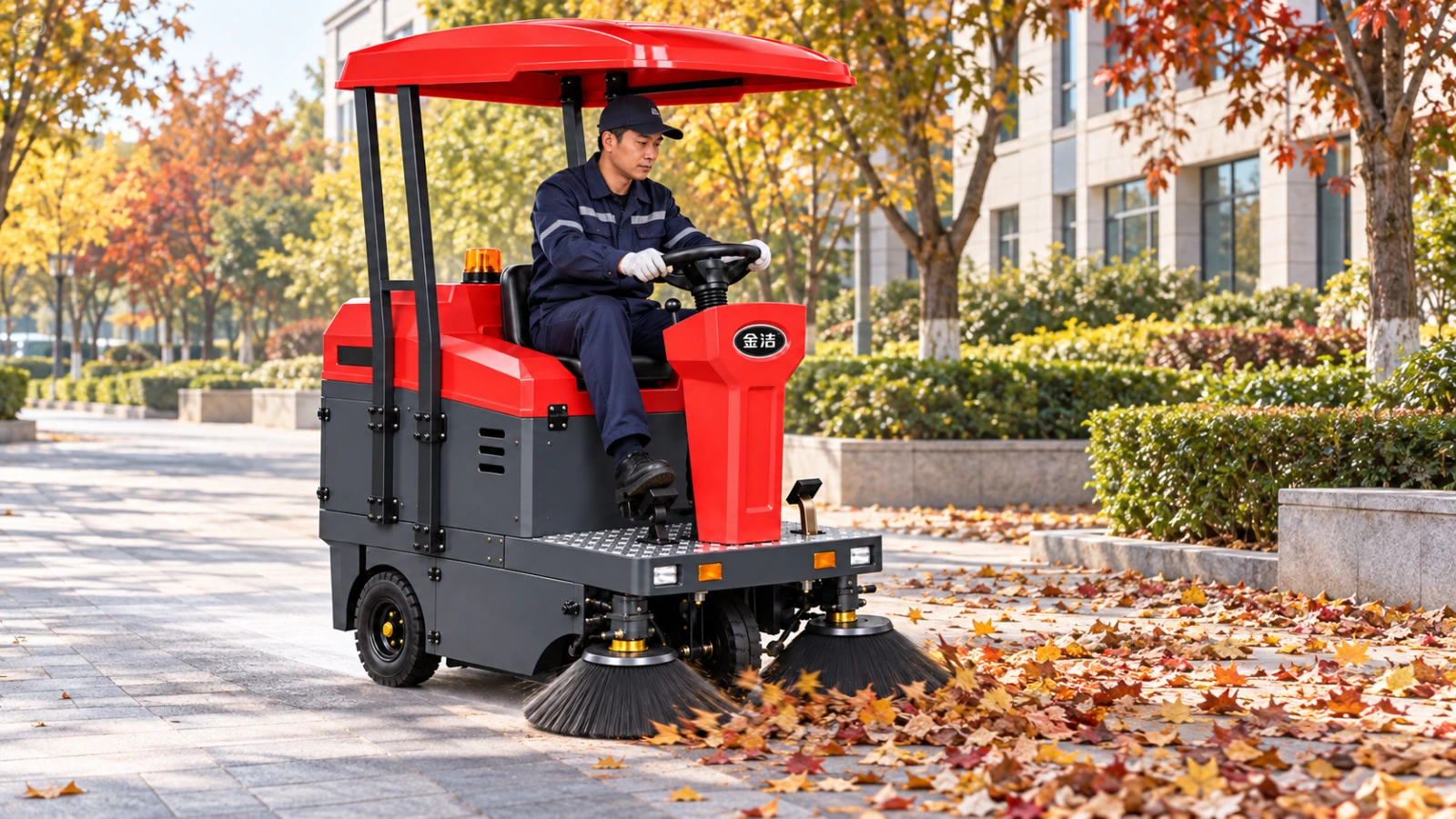
For regular campus and estate paths, particularly seasonal leaves and scattered light debris.
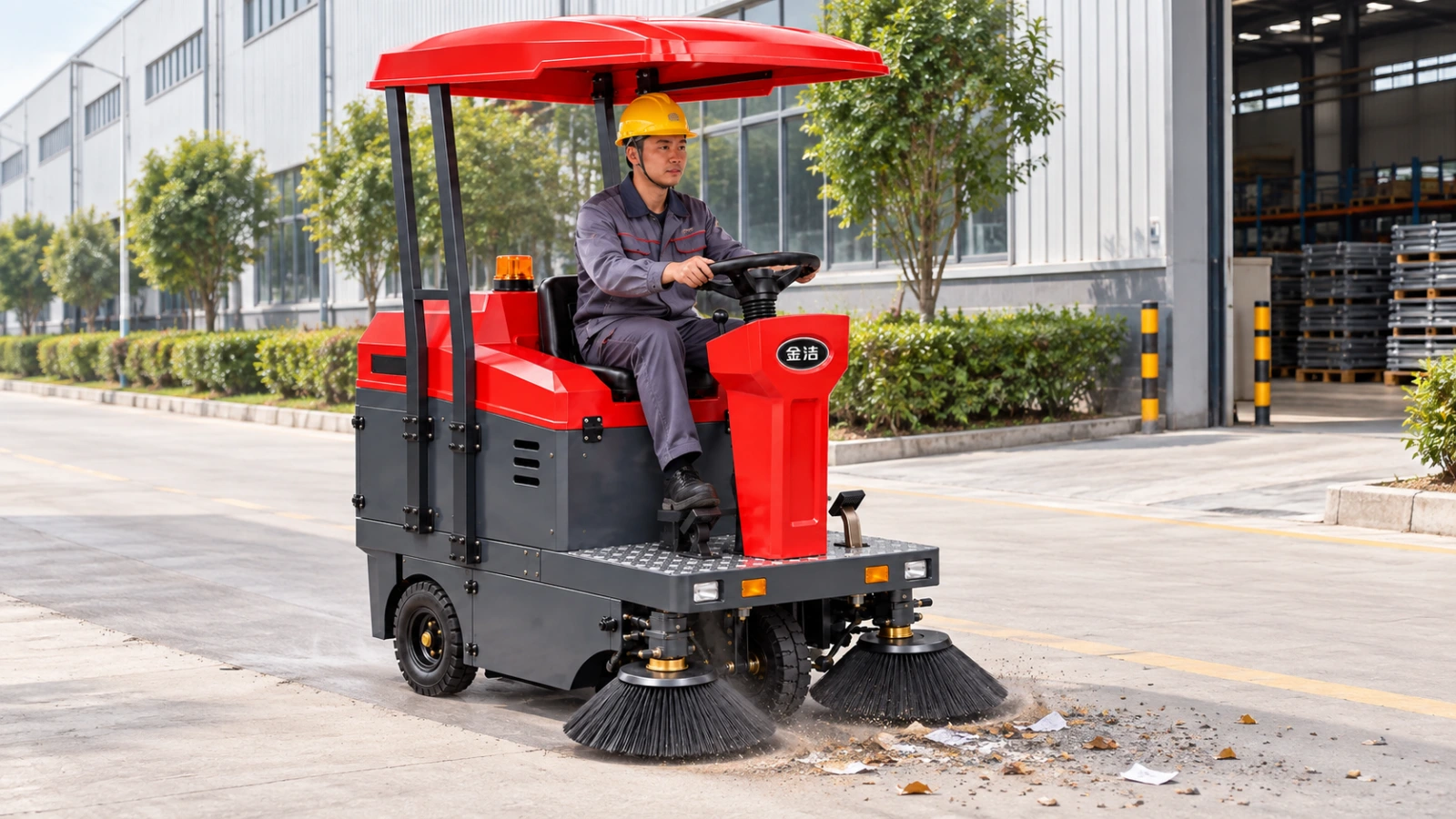
For routine factory surroundings, warehouse yards and industrial roads, helping reduce repeated manual route sweeping.
Consider sweeping width, collection, power supply and physical access together.
1250mmCheck sweeping width and machine clearance separately.
120LEmpty according to the debris load.
65LPlan water use and refilling around the installed equipment.
7㎡Filtration also depends on dust conditions and maintenance.
48VCheck battery capacity and chemistry against the supplied specification.
3–4hOperating time depends on the battery, load and duty cycle.
| Configuration item | Specifications | Operating instructions |
|---|---|---|
| Product model | J-XS1250 | Compact ride-on sweeper |
| Sweeping width | 1250mm | Sweeping width. Check access and turning dimensions separately. |
| hopper capacity | 120L | Empty according to debris volume and weight. |
| Water tank capacity | 65L | Water use depends on the equipment and surface conditions. |
| Filter area | 7㎡ | Assess alongside filter condition and debris type. |
| Operating voltage | 48V | Use a charger matched to the battery. |
| Operating power | 1510W | Published figure for the specified version |
| Travel motor | 1200W | Published figure for the specified version. Measure site output separately. |
| Indicative operating time | 3–4h | Indicative range. Duration depends on the supplied battery, load and maintenance condition. |
| Battery configuration | Lead-acid / lithium | Confirm the supplied configuration during selection. |
| Overall dimensions (length × width × height) | 1550×1250×1860mm | Allow additional room for passing, turning and overhead clearance. |
Assess the 48 V supply and 7 m² filter area against the daily route. Record sweeping, turning and disposal time during a trial to plan the shift.
Use the exterior view for operating and maintenance orientation. Consult component documentation for internal locations.

Check the machine footprint and turning envelope on compact estate routes.
The main brush sweeps the floor. After shutdown, inspect it for wear and entanglement.
The side brush guides loose debris towards the sweeping path. Keep clearance from edges.
Schedule emptying of the 120 L hopper according to the amount collected.
7 m² filter area and 65 L water tank. Set the maintenance schedule for the operating conditions.
The operator steers and yields to traffic. Maintain the power system according to the handover instructions.
The diagram shows how the sweeping functions work together. It describes the process at floor level.
Guide loose side debris into the sweeping path. Remove bulky or entangling objects first.
The main brush picks up debris. Adjust the pace to the road conditions.
Check the load as debris enters the collection area and empty as instructed.
The filter captures dust. Maintain the media and seals according to the machine instructions.
Assess the 7 m² filter area against the material and route. Inspect the media and check actual pickup on a trial pass.
Observe dust, pickup and maintenance frequency during a trial. Assess wet, sticky or special dust separately.
After shutdown, check for dust loading, damage and leaks. Wash a filter only if the manufacturer specifies that it is washable.
Before using water from the 65 L tank, check the surface, spray locations and operating and maintenance instructions for the supplied configuration.
To compare machines, consider road layout, debris load and turning room alongside sweeping width.
| Comparison criteria | No smaller comparable model is currently listed. | Current modelJ-XS1250 → | Wider-coverage option J-XS1280 → |
|---|---|---|---|
| Sweeping width | — | 1250mm | 1280mm |
| Hopper | — | 120L | 80L |
| Water tank | — | 65L | Ask about this option when specifying the machine. |
| Selection checks | No comparable product is currently listed in this category. | Check clear road width, debris, turning room and supply points. | Check clear road width, debris, turning room and supply points. |
Compare the same route and cleaning standard using actual working time.
Crew size × hours per person × hourly rate. Include collection and transport time.
Count actual operator time, charging, brushes, filter media and maintenance.
Allocate the purchase price over the expected service life and avoid counting the same cost twice.
Switch off and isolate as instructed before inspection. Keep hands out of the sweeping mechanism during operation.
Remove entanglements safely and check bristle wear and abnormal resistance. Follow the model’s replacement criteria.
Check bristles, fixings and signs of impact. Use the specified side-brush height.
Inspect dust loading, damage and seals. Clean the filter as instructed. Verify washability before using water.
Empty in good time and inspect the collection area to prevent overloading or spillage.
After use, inspect the outlets for blockages as instructed and use only compatible cleaning agents.
Use a compatible charger. Check connectors, cables and the charging area, and follow the maintenance instructions for the battery type.
Assess loose dry debris on factory aisles, property roads and warehouse surroundings. Plan passes around 1250 mm coverage and collection with the 120 L hopper, after checking road width, turns, debris and frequency.
Plan sweeping zones with disposal points to avoid unplanned searches for unloading access. Trial leaves, paper and grit, recording volume and density while respecting permitted loads to establish practical disposal stops.
It is one configuration reference alongside media, sealing, moisture and filter care. Observing residual debris and airborne dust in a trial is more informative than comparing filter area alone.
Use it with the specified suppression configuration and plan water around dust and supply access. Suppression is distinct from scrubbing and recovery; discuss separate processes with Wanshenglong for oil, adhered dirt or standing water.
Include sweeping, disposal, filter care, water and charging separately. Use the listed 3–4 hour reference alongside the actual 48 V battery and route trial so machine operation and staff waste handling work together.
After shutdown, remove entanglement and inspect wear, then clean filters and collection areas as instructed. Washing permission and replacement intervals depend on the original parts and their condition.
Listed coverage is 1250 and 1280 mm, with hoppers of 120 and 80 L. Compare machine access, power, filtration and disposal arrangements rather than assuming a larger model number is better.
Share route dimensions, waste samples, dust conditions and shifts to review configuration and trial requirements. Confirm brushes, filters, power, operation and care at handover so procurement translates into daily use.
The agreed service terms specify scope, charges and timing.
Confirm the model, accessories and operating conditions before delivery.
View service support →Training covers driving, sweeping, emptying and daily checks.
View service support →Describe the road surface, debris and maintenance history when seeking support.
View service support →Match main brushes, side brushes and filters to the model and supplied specification.
View service support →Confirm service area, charges and attendance arrangements in advance.
View service support →Agree on maintenance arrangements based on usage, location and condition.
View service support →Tell us about the roads, debris and daily rounds so we can check the suitability of J-XS1250.
Phone consultation: 0755-25621811
Provide area, narrowest road, debris and dust details, indoor/outdoor conditions, gradients, daily hours and suppression needs to assess J-XS1250.