
01 Property estates
- Typical site
- Estate roads and property perimeters
- Why it fits
- Leaves and paper are scattered along roads; organize routine collection after checking turns, mixed traffic and emptying points.

The Jinjie J-XS1460 ride-on sweeper serves daily campus-road, factory-perimeter and parking tasks. Its 1460 mm coverage, 150 L hopper and 60 L tank support coordinated sweeping, waste collection and water planning.
1460 mm sweeping coverage supports organized routine debris collection on estate roads.
Recurring leaves, paper, grit and dust on estate, campus and factory-perimeter roads can require repeated manual work.
Scattered locations require fixed routes for organized daily debris collection.
Hopper capacity, distance to emptying points, narrowest roads and turning space all affect sweeping rhythm.
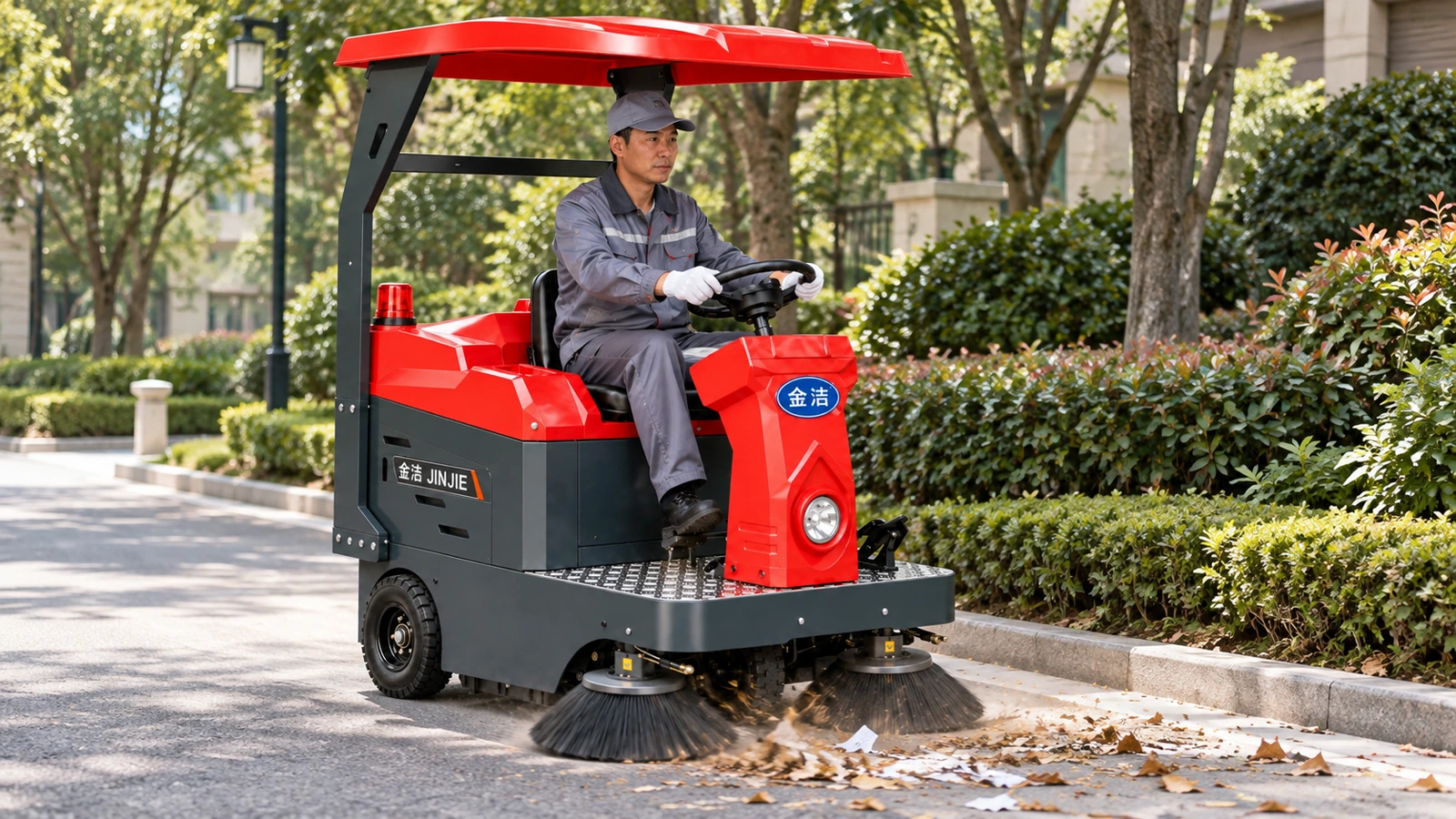
On medium-width roads with scattered debris, 1460 mm coverage supports routine collection of leaves, paper and grit.
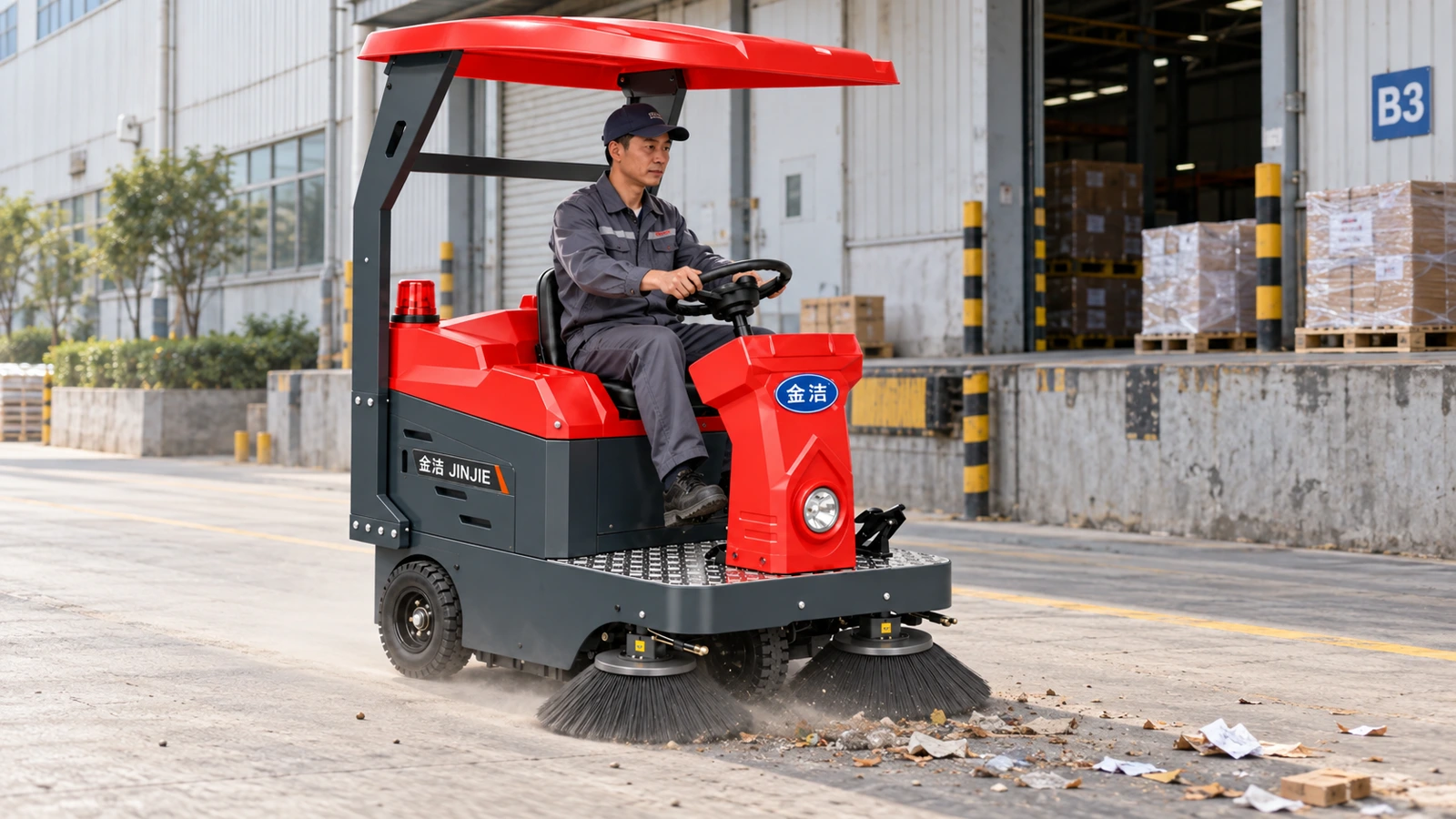
For grit, packaging fragments and ordinary dust around factories, J-XS1460 supports fixed-route sweeping to reduce manual follow-up sections.
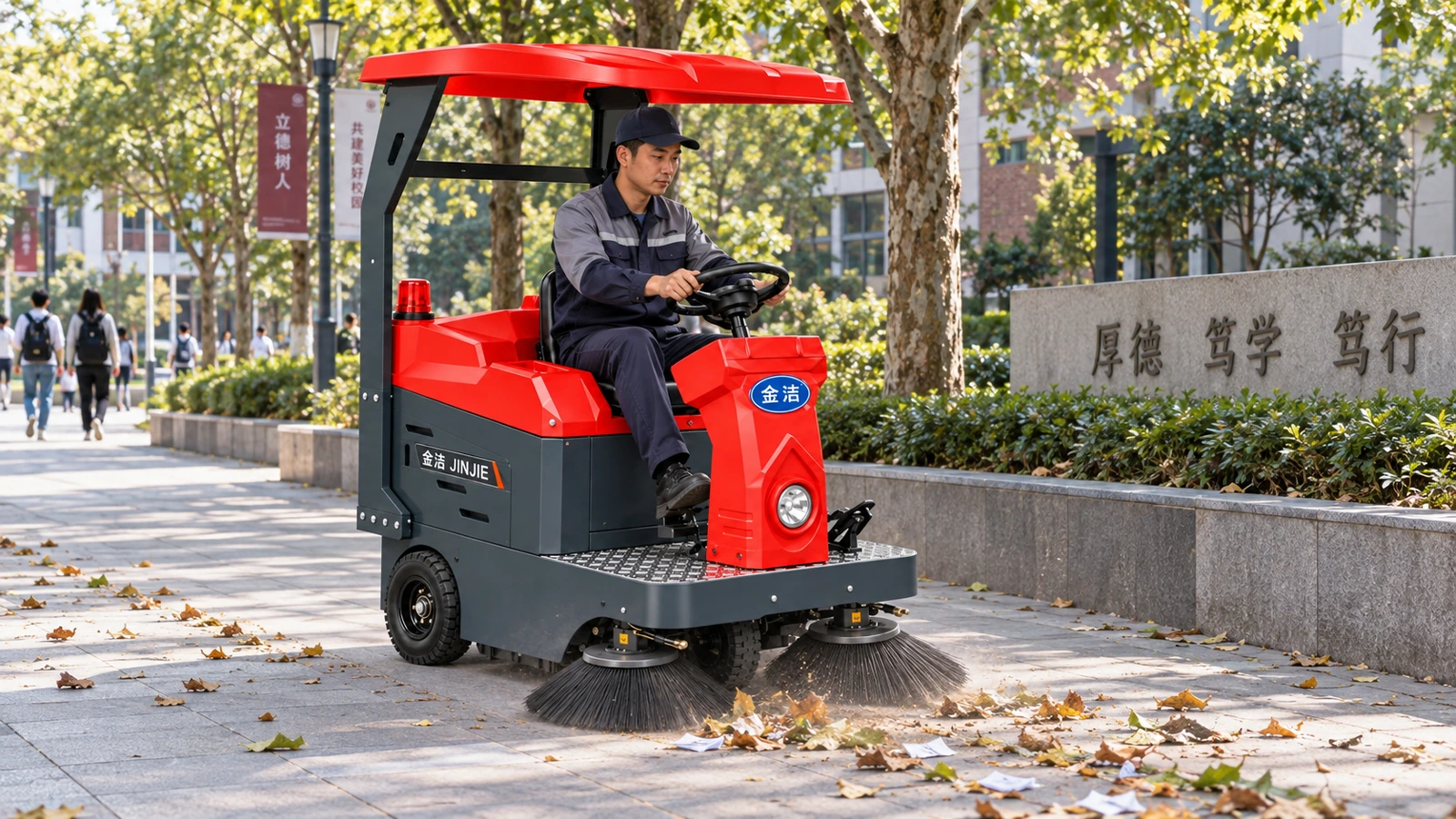
Campus and visitor-attraction debris varies by time. The 150 L hopper supports shift planning for regular public-road upkeep.
Start with the key features, then check the full specification.
| Key operating figures | |||
|---|---|---|---|
| Sweeping width | 1460mm | Clean water tank | 60L |
| Hopper | 150L | Main brush length | 690mm |
| Main brush diameter | 300mm | Side brush diameter | 500mm |
| Theoretical calculation speed | 12 km/h | Theoretical sweeping coverage (calculated) | 17520㎡/h |
| Drive and electrical system | |||
| Drive power | 1000W | Main brush power | 850W |
| Vacuum motor power | 400W | ||
| Machine configuration | |||
| Model | J-XS1460 | ||
Theoretical coverage is calculated only from effective sweeping width × the confirmed theoretical calculation speed. It is not actual productivity, and maximum travel speed is not used in the formula.
Consider it when organising scattered manual sweeping into regular routes. Check roads, kerbs and turns and trial representative debris. Include manual filter cleaning and unloading in shifts, comparing access, waste and disposal alongside coverage.
Start with the key features, then check the full specification.
| Key operating figures | |||
|---|---|---|---|
| Sweeping width | 1460 mm: for medium-width outdoor roads; check narrowest sections and turning space on site. | Theoretical sweeping coverage (calculated) | 17520㎡/h |
| Hopper | 150 L: affects collection volume and emptying frequency; assess debris volume and distance to emptying points. | Main / side brushes | 690 mm main brush and 500 mm side brushes: collect road and edge debris together. |
| Clean water tank | 60 L: auxiliary dust control during sweeping; not a substitute for flushing or floor scrubbing. | Road conditions | Check road width, turns, gradients, mixed traffic and parking. |
| Debris conditions | Check leaves, grit, dust, packaging fragments, emptying points and work windows. | ||
| Drive and electrical system | |||
| Drive power | 1000 W: a travel and route-assessment reference, not a stand-alone gradient-capability promise. | ||
Assess how coverage, collection, driving arrangements, dust control, emptying points and access affect actual work, rather than comparing numbers alone.
First assess this model on its own merits, then compare alternatives by road width, driving arrangement, debris volume and protection needs.
| Item | J-XS1450 | J-XS1460 | J-XS1500 |
|---|---|---|---|
| Sweeping width | 1450mm | 1460mm | 1500mm |
| Hopper | 160L | 150L | 180L |
| Theoretical reference coverage | 14000㎡/h | 14000㎡/h | 14000㎡/h |
| Selection focus | Routine medium-width road sweeping | Continuous estate-road sweeping | Dry-debris collection on longer routes |
Assess J-XS1460 for medium-width roads requiring daily dry-debris collection where the 150 L hopper fits emptying arrangements.
Compare neighbouring ride-on models for longer routes, greater hopper requirements or more open roads.
Assess loose dry debris on campus roads, factory perimeters and parking areas. Match 1460 mm coverage to the route and plan disposal for the 150 L hopper and edge finishing.
Side brushes guide debris towards the main-brush path. Keep suitable kerb clearance, plan disposal around bulky litter and remove straps and large objects first.
The 150 L hopper collects debris while the 60 L tank supports specified suppression. Plan unloading and water separately and mark both locations before longer routes.
Keep the 690 mm main-brush length, 300 mm main-brush diameter and 500 mm side-brush diameter separate. Check mounts and original parts to maintain collection and appropriate wear.
Assess dust, filters, sealing and manual filter cleaning together. Observe airborne dust and residue to set maintenance intervals; confirm suitability separately for hazardous materials.
Use actual roads, debris and cleaning windows. MAX 10150 m²/h is a listed rating; include overlap, turns, traffic, filter cleaning and unloading in practical shift planning.
Listed coverage is 1460, 1450 and 1500 mm, with hoppers of 150, 160 and 180 L respectively. Compare access first, then disposal, supplies, filtration, power and driving conditions.
Share routes, debris and shifts to discuss trials, configuration and training. Confirm brushes, battery, filters, manual cleaning and unloading so operators understand daily use and care.
Provide road width, debris types, dust levels, emptying points and daily sweeping windows to assess J-XS1460.