
01 Intended use
Road dust and water sweeping assistance.


This machine suits loose dust on residential and business-park roads, using water-assisted sweeping and local washing for routine upkeep. When comparing it with a wash vehicle, check the working attachment, refill points and drainage.
Road dust and water sweeping assistance.
Integrate water suppression dusting and localized rinsing into mobile operations.
Water sweeping process and replenishment and drainage conditions, power and attachments should be checked according to the current machine version.
Road dust and water sweeping require separate clarification of the target and the operational procedures, and cannot be directly applied from similar equipment.
Plan mobile routes for water-assisted dust control and spot washing. Include the sweeping sequence, refill points, drainage and staff availability.
First, check the floating dust together with the road and return field cleaning and inspection, to avoid only completing the intermediate process.
Dust, road, and water compatibility.
Corner space and working attachment configuration.
Human and vehicle traffic periods and road drainage.
Watering points, routes, and shifts.
| Field or task | Conditions that require verification | Selection check |
|---|---|---|
| Removing loose road dust | Dust, road, and water compatibility. | First confirm the floating dust, road surface and water suitability, then determine if the road floating dust maintenance is suitable. |
| Local cleaning along the road edge | Corner space and working attachment configuration. | Based on the edge space and working attachment configuration, verify the tools, working methods, and risk boundaries. |
| Park entrance cleaning | Human and vehicle traffic periods and road drainage. | Include the pedestrian and vehicle traffic periods and road drainage into the on-site plan, not just compare individual specifications. |
| Property management perimeter water sweeping | Watering points, routes, and shifts. | Combine water supply points, routes, and shift arrangements for closing and handover, and test the machine or verify on-site in complex conditions. |
Water scrubbing and spraying do not equate to having the capability for dry waste absorption; the pump, end, and road qualifications must be verified against this machine's data.
The scenario is for illustrating the applicable conditions and is not a case of a completed customer or actual test results.
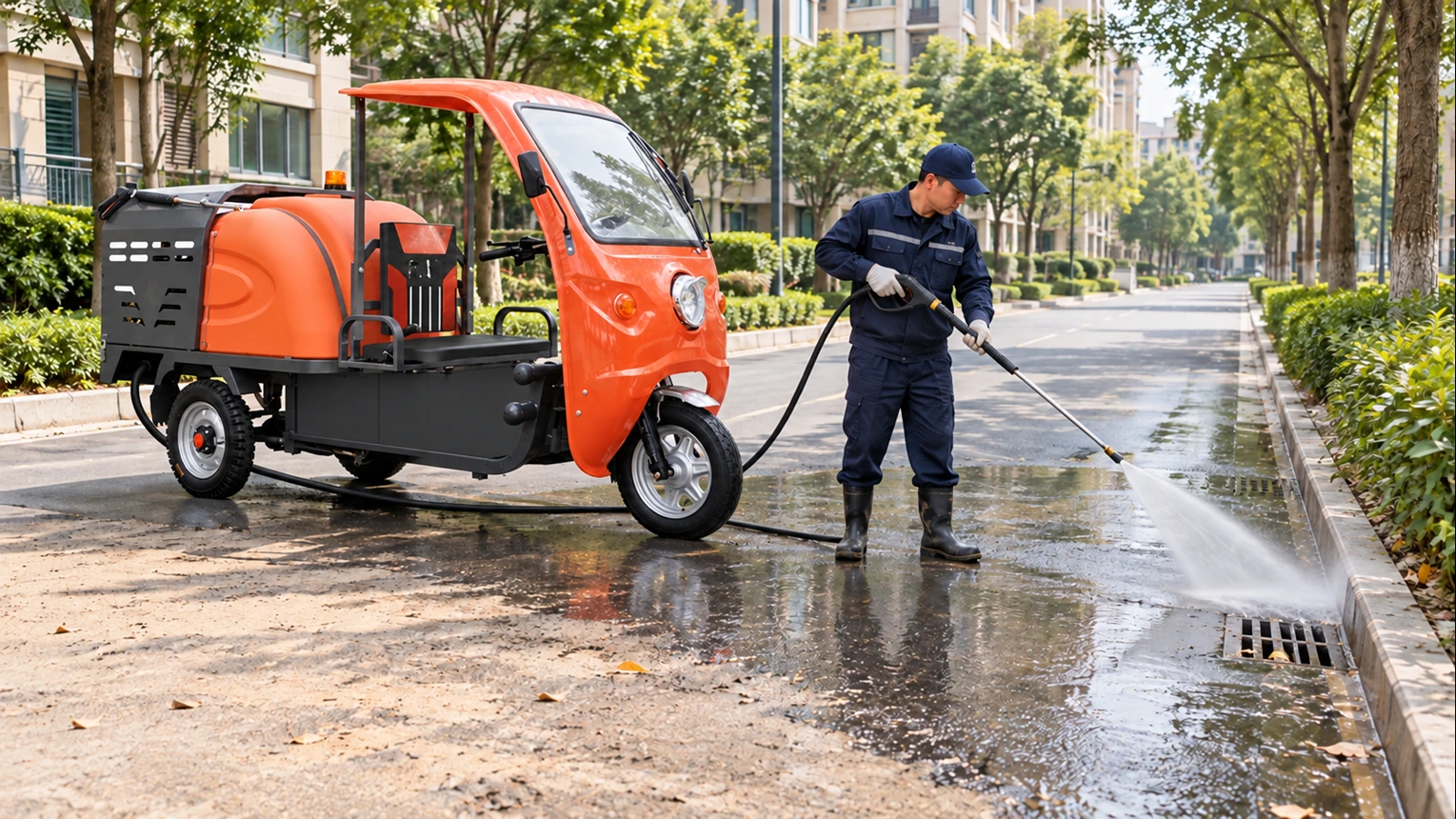
Wash loose dust and sand along property-road sections, coordinating routes, drainage and refilling.
View the corresponding scene description →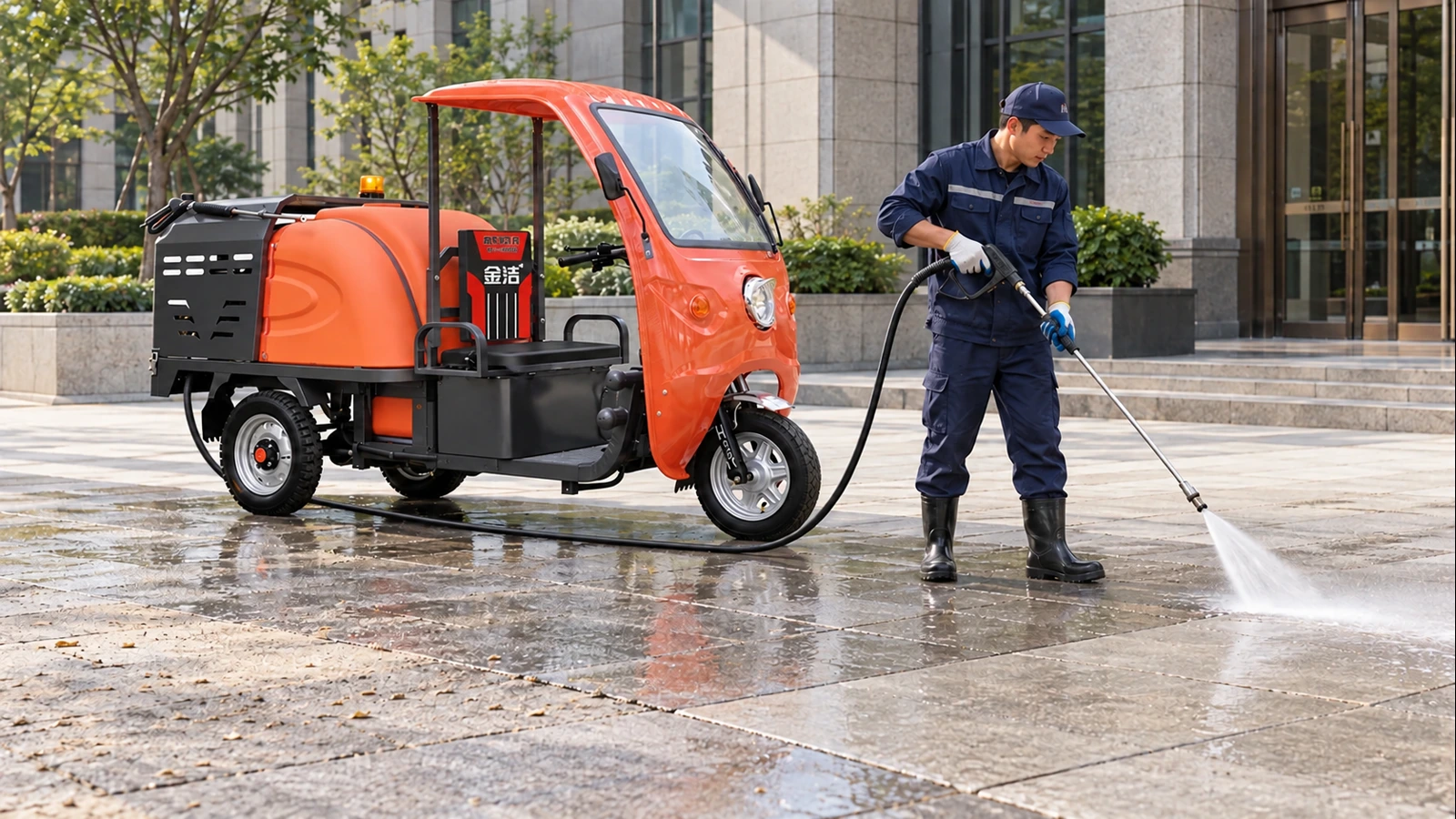
Wash outdoor plazas and corners off peak; control distance for the surface and segregate pedestrian routes.
View the corresponding scene description →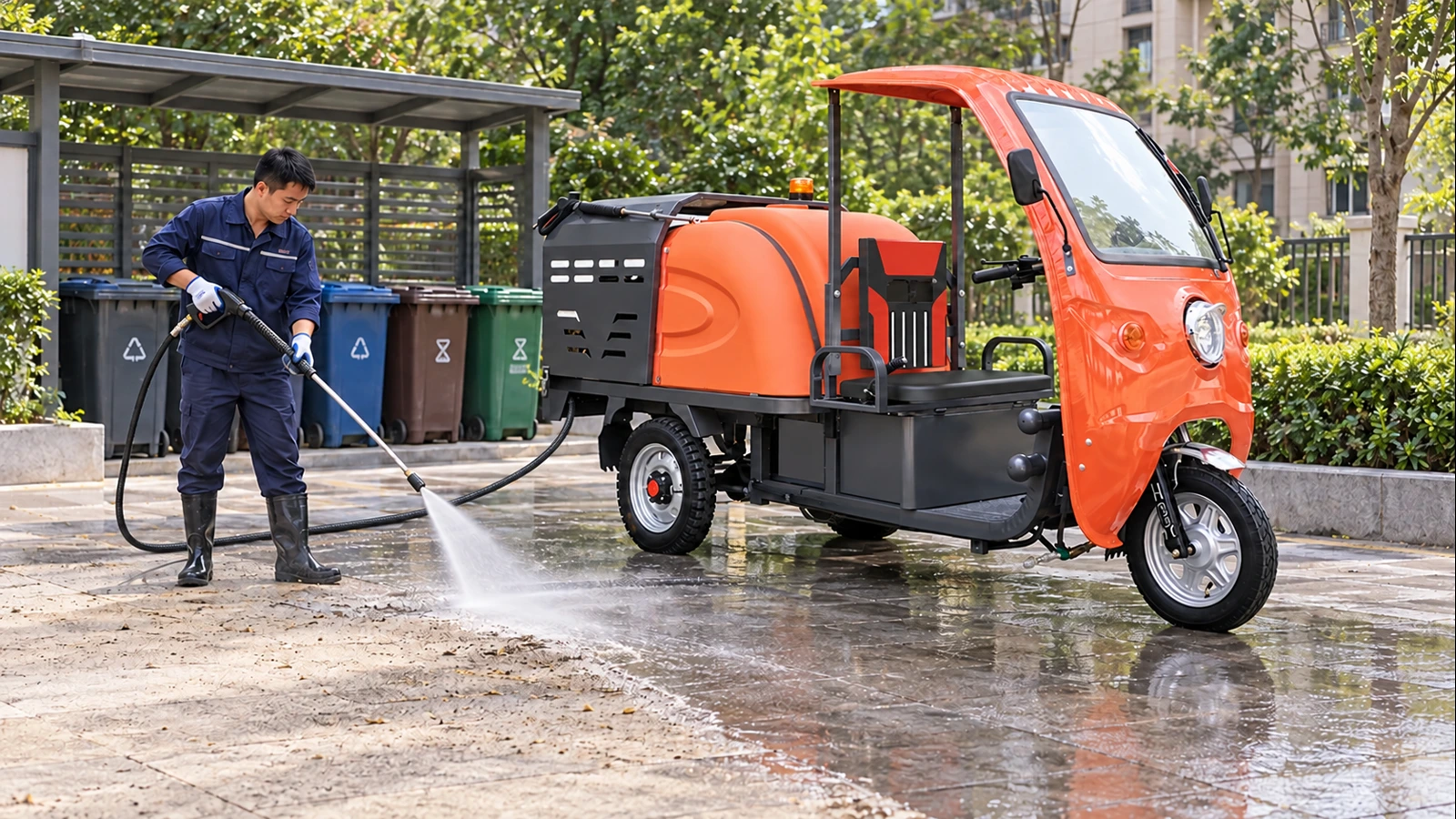
After waste removal, wash ordinary outdoor collection-point dirt and arrange wastewater collection/treatment as required.
View the corresponding scene description →The first screen is for positioning; the complete specifications should be verified against the original data of the machine and the corresponding delivery version.
| Configuration item | Original page registration content |
|---|---|
| Pressure | Car-mounted high-pressure water sweeper configuration, confirm by pump group. |
| Flow | Confirm based on the number of nozzles and rinsing width |
| High-pressure hose configuration | Choose the vehicle pipework and hand-held wash hose to suit the working distance on site. |
| Drive or power supply | Three-wheel vehicle powered, pump group configured according to the plan. |
Overall appearance of the machine and function explanation; 01-06 are explanatory indexes, and are not marked for unverified internal coordinates.
Organize machine operations based on the channel, corners, and parking position.
Verify the water storage, make-up, and drainage arrangements, avoiding comparison only with the water tank.
With the actual delivery end of this machine as the standard, do not add fictional suction structures.
Pressure flow, interface, and protection are confirmed according to the actual pump set and accessories.
Use confirmed tools and processes for corner stains.
Turn off the machine and release the pressure according to the vehicle instructions, then check the water lines and the working attachment.
The work process is used to explain the process and personnel coordination, and does not replace the machine operation instructions and internal structure documents.
Adapt to floating dust, road surfaces, and water usage, and carry out operations according to the machine's instructions and on-site conditions.
Corner space and working attachment configuration, and execute according to the machine's instructions and on-site conditions.
Person and vehicle traffic and road drainage, and carry out operations according to the machine instructions and on-site conditions.
Provide water supply points, routes, and shifts, and carry out operations according to the machine's instructions and on-site conditions.
Integrate water-based dust suppression and localized rinsing into mobile operations; assess the floating dust, road surface, and water compatibility with water supply points, routes, and shifts together.
Water scrubbing and spraying do not equate to having the capability for dry waste absorption; the pump, end, and road qualifications must be verified against this machine's data.
Check against the actual attachments, interfaces, materials, or control requirements of the machine, and do not list optional components as standard configurations.
This model is centered. Left and right are real configurations or process references; different tasks are not simply high or low settings, and cannot be judged solely by the model number.
| Comparison criteria |  JC-500S | JC-500JY |  JC-1800 |
|---|---|---|---|
| Main tasks | Dispersed point washing for medium to small roads | Road dust and water sweeping assistance. | Longer route and wider site rinsing |
| Configuration function. | Three-wheel platform combined with hand-held rinsing to treat dispersed stains. | Integrate water suppression dusting and localized rinsing into mobile operations. | Planning water supplies for a four-wheel wash vehicle on longer routes |
| Selection focus | Route stop and water source connection | Water sweeping process and replenishment and drainage conditions. | Water tank refilling and road isolation. |
The main unit, actual attachments, tools, or consumables are compared according to the same list; optional accessories are not considered as standard fittings.
Include the preparation of roads with floating dust and water sweeping assistance operations, turnfield, and water sweeping procedures related to water and drainage conditions, without using nominal numbers to estimate actual output.
Record the return field cleaning and inspection, as well as the maintenance and disposal of consumables, together, without setting a fixed cost-saving ratio or break-even cycle.
Organize machine operations based on the passage, corners, and parking position. Specifically, check the disassembly and maintenance cycles as well as the accompanying materials according to the machine manual.
Check the water storage, make-up, and drainage arrangements, avoiding comparison only with the water tank. Specific disassembly and maintenance cycles, as well as accompanying materials, should be verified according to the machine's manual.
With the actual delivery end of this machine as the standard, do not add fictional suction structures. Specifically, the disassembly and maintenance cycles, as well as the accompanying materials, should be checked against the machine's instructions.
Confirm pressure, flow, connection types and protection for the actual pump unit and attachments. Follow the model manual for removal, refitting, service intervals and compatible materials.
The edges and corners should be cleaned using confirmed tools and processes. Specific disassembly, maintenance cycles, and accompanying materials should be checked against the machine's manual.
Turn off the machine and release the pressure according to the vehicle instructions, and check the water lines and working attachment. Specifically, refer to the machine instructions for disassembly, maintenance cycles, and compatible materials.
Verify the model number, nameplate, random accessories, and delivery documents.
Check the floating dust against the road and safety start-stop according to the machine instructions.
Combine road dust with water sweeping assistance and on-site process communication for usage conditions.
Check the parts according to the interface, material, and delivery version.
Please provide the fault symptoms and inspection records; service scope and schedule are according to the agreement.
Inspection content, service location, cost, and cycle are subject to actual agreement.
This machine suits loose dust on residential and business-park roads, using water-assisted sweeping and local washing for routine upkeep. When comparing it with a wash vehicle, check the working attachment, refill points and drainage.
Integrate water-based dust suppression and localized rinsing into mobile operations; need to check the floating dust, road surface, water compatibility and refilling points, as well as the route and shift schedule together.
Water scrubbing and spraying do not equate to having the capability for dry waste absorption; the pump, end, and road qualifications must be verified against this machine's data.
The reference model focuses on dispersed point cleaning for small and medium roads, while this model emphasizes assistance with road dust and water sweeping. First, divide the processes and accompanying equipment, then compare the corresponding original specifications, without judging by the model number.
Verify the suitability of dust, road surface, and water for the task, as well as the configuration of corner spaces and the working attachment. Assess the timing and road drainage, water replenishment points, route, and shifts. For complex conditions, combine small-scale tests with on-site evaluations.
Organize the task according to "Check floating dust and road surface → Organize water supply and isolation → Divide responsibilities for water sweeping and localized rinsing → Return to the field for cleaning and inspection"; the specific operations are determined jointly by the on-site conditions and the machine's instructions.
First, focus on the three-wheel platform, the water cleaning operation end, and the control and maintenance. Before servicing or disassembly, isolate the power as directed in the manual. Use the service interval specified for the model.
Provide photos of road dust maintenance and other site conditions, explaining the task, existing equipment, and specific conditions of the water sweeping process and water supply and drainage, and then determine whether this machine is suitable.
Please describe your road dust and water sweeping auxiliary task, including dust, road surface, and water compatibility, as well as water refill points, route, and shift. We will compare the on-site solution with the configuration of this machine.
Phone consultation: 0755-25621811