
01 Intended use
- Manual push cleaning, first check the passage conditions.
- It is suitable to arrange daily floor cleaning by area, and can be combined with other tools in areas near edges and obstacles.

The Jinjie J-D3S is a compact walk-behind scrubber for shops, canteens and public corridors. Assess its 530 mm cleaning width and 60 L/65 L tanks alongside surfaces, turns and operator replenishment routes.
Understand the steps for adding water, installation of accessories, cleaning operations, maintenance, and charging.
Combine the tutorial to understand the usage process. Specific operations should be carried out according to the manual of this machine.
Starting from your question.
For multi-area cleaning, first mark the areas around the entrance, furniture, or equipment, as well as the sump and drainage locations, then test walk and wash with J-D3S. Record the brushing time, pushing time, and cleaning time separately; if the route is long or requires continuous pushing, compare the operating burden with self-propelled assist equipment, not just based on the water tank capacity.
First, check the on-site conditions, then determine the appropriate equipment configuration together.
Shelf spacing, business hours, and floor surface material
Corridor width, elevator dimensions, floor area.
Public passages, water replenishment and drainage, equipment transfer
Actual area, obstacles, equipment storage.
| Site type | The on-site conditions for joint checking | J-D3S Selection Recommendation |
|---|---|---|
| Commercial supermarkets and commercial stores. | Shelf spacing, business hours, and floor surface material | First measure the narrowest shelf passage and turning positions, and schedule cleaning times to avoid customer traffic. |
| Office buildings | Corridor width, elevator dimensions, floor area. | Check the elevator and entrance passage, and arrange cleaning and charging by floor. |
| Property floor and public area | Public passages, water replenishment and drainage, equipment transfer | First confirm the water source, drainage point and transfer route, then match the daily cleaning frequency. |
| Small and medium commercial spaces | Actual area, obstacles, equipment storage. | Configure based on the actual cleanable area and working time, with additional supplementary treatment for corners. |
Customer Cleaning Challenges
Compare the type of ground dirt with the brushing and wastewater recovery method. For stubborn stains, try washing first, and do not only arrange personnel based on theoretical efficiency.
Measure the narrowest passage, doorways, and turns, and arrange the cleaning route separately from on-site traffic. In narrow areas, supplement with other tools.
Arrange the tasks based on the cleaning area, available time, and replenishment and drainage location. The working time should be verified according to the actual battery, load, and ground conditions.

Schedule scrubbing and water pickup around shopping-centre footfall. Check residual water before reopening.
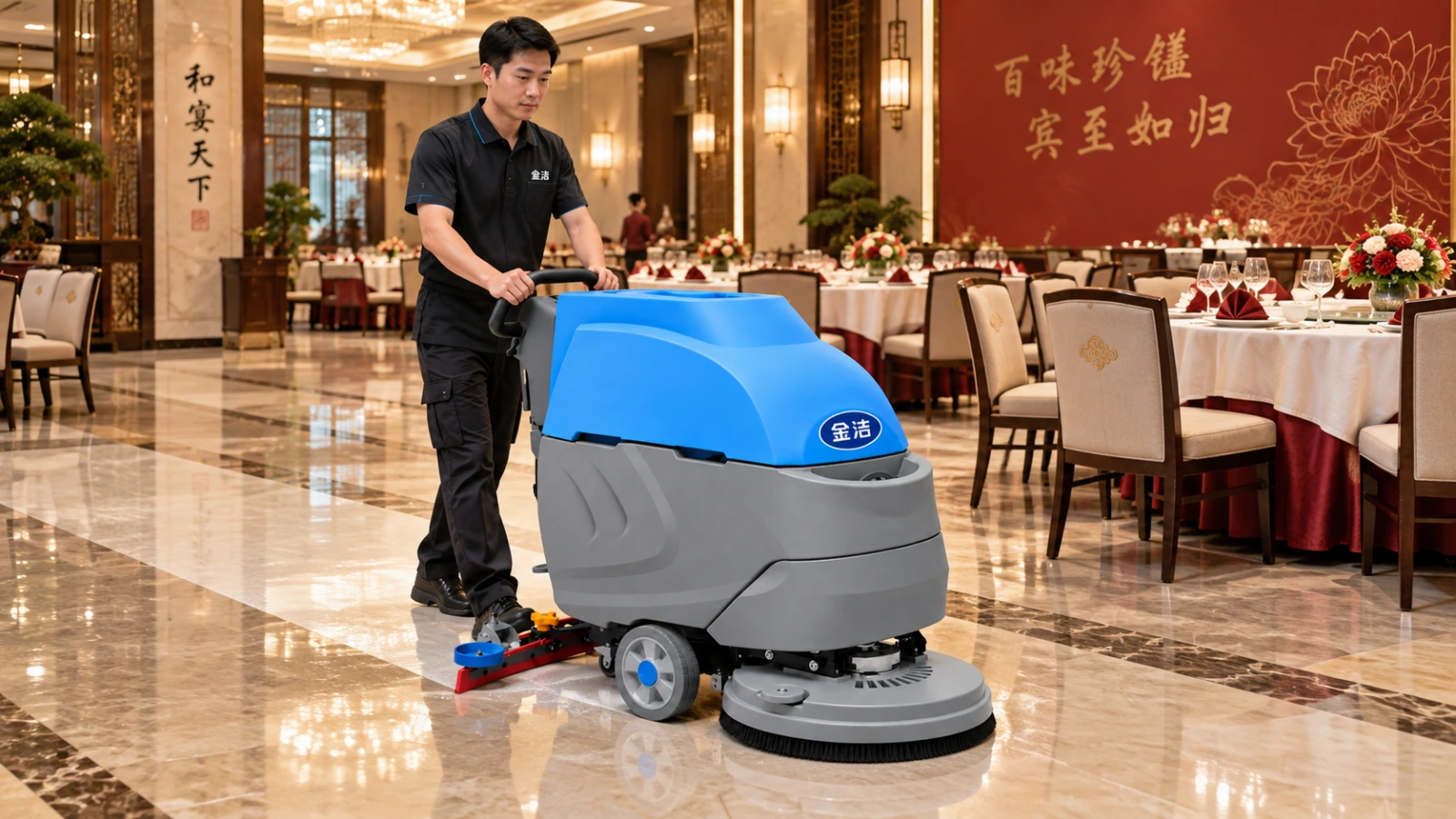
Clean hard floors around dining halls, tables and chairs. Remove larger debris first and check furniture spacing.
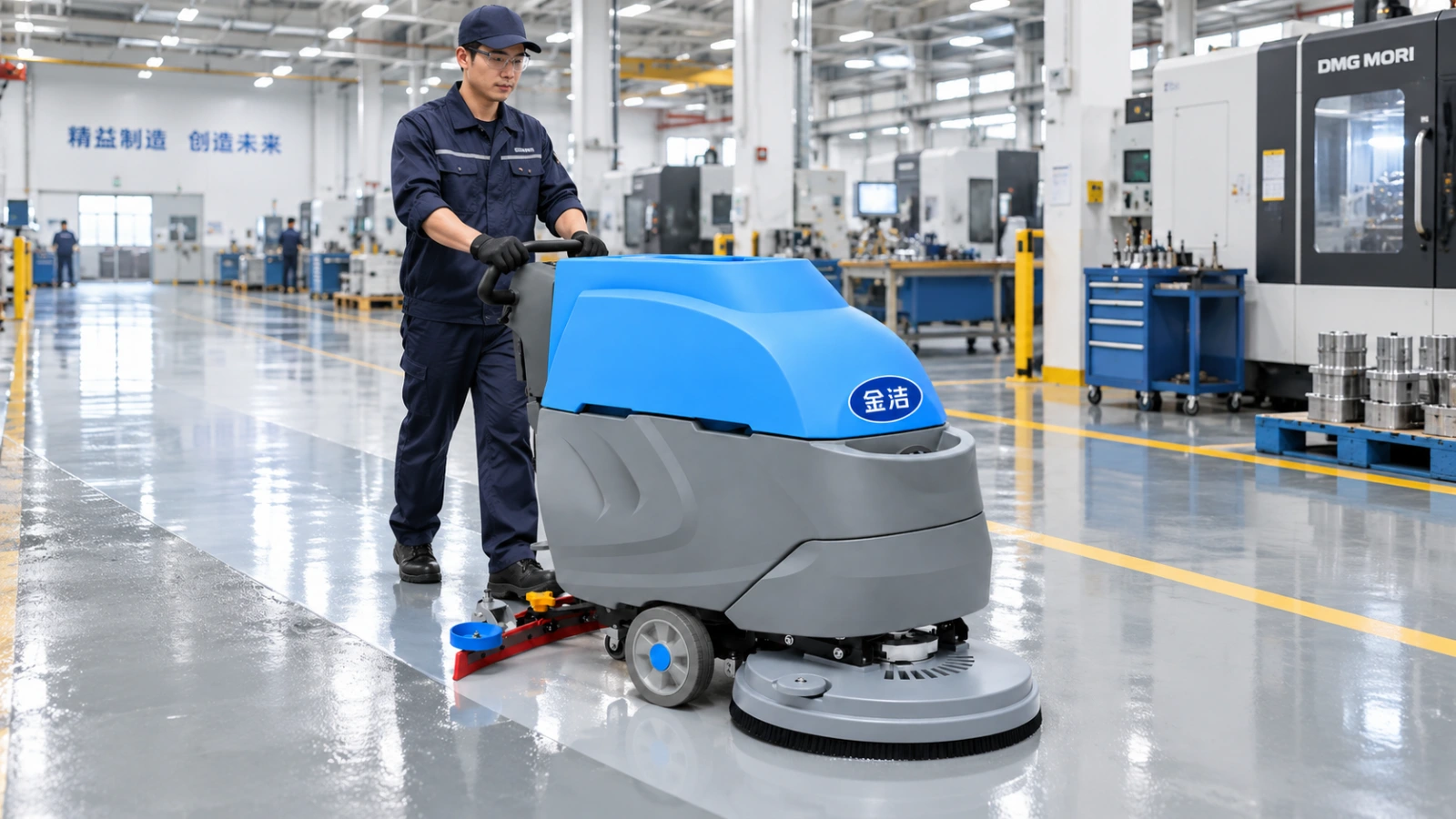
For daily scrubbing and water pickup on workshop hard floors. Confirm contamination, equipment aisles and safe cleaning windows first.
First, check the settings related to daily use. The complete specifications can be viewed in detail.
| Key operating figures | |||
|---|---|---|---|
| Cleaning width | 530mm | Squeegee width | 780mm |
| Clean water tank | 60L | sewage tank | 65L |
| Theoretical cleaning coverage (calculated) | 2650㎡/h | Theoretical calculation speed | 5 km/h |
| Drive and electrical system | |||
| Operating voltage | 24V | ||
| Machine configuration | |||
| Product model | J-D3S | Work method | Walk-behind |
Note: The theoretical work efficiency of push-type and self-propelled push-type floor scrubbers is calculated uniformly as cleaning width × 5 km/h, and is only for theoretical area efficiency comparison, not representing actual operating efficiency.
The cleaning width affects the coverage of a single pass, and the relationship between the fresh water tank and the dirty water tank affects the convenience of continuous operation. The battery, drive, and water suction system affect the daily floor scrubbing schedule.
2650 m²/h is calculated from the confirmed cleaning width × the website theoretical calculation speed of 5 km/h. It is for theoretical coverage comparisons only, not actual or measured productivity.
Theoretical efficiency, documentation working time, and actual continuous operation performance should be understood separately. On-site conditions and final delivery configuration need to be verified together.
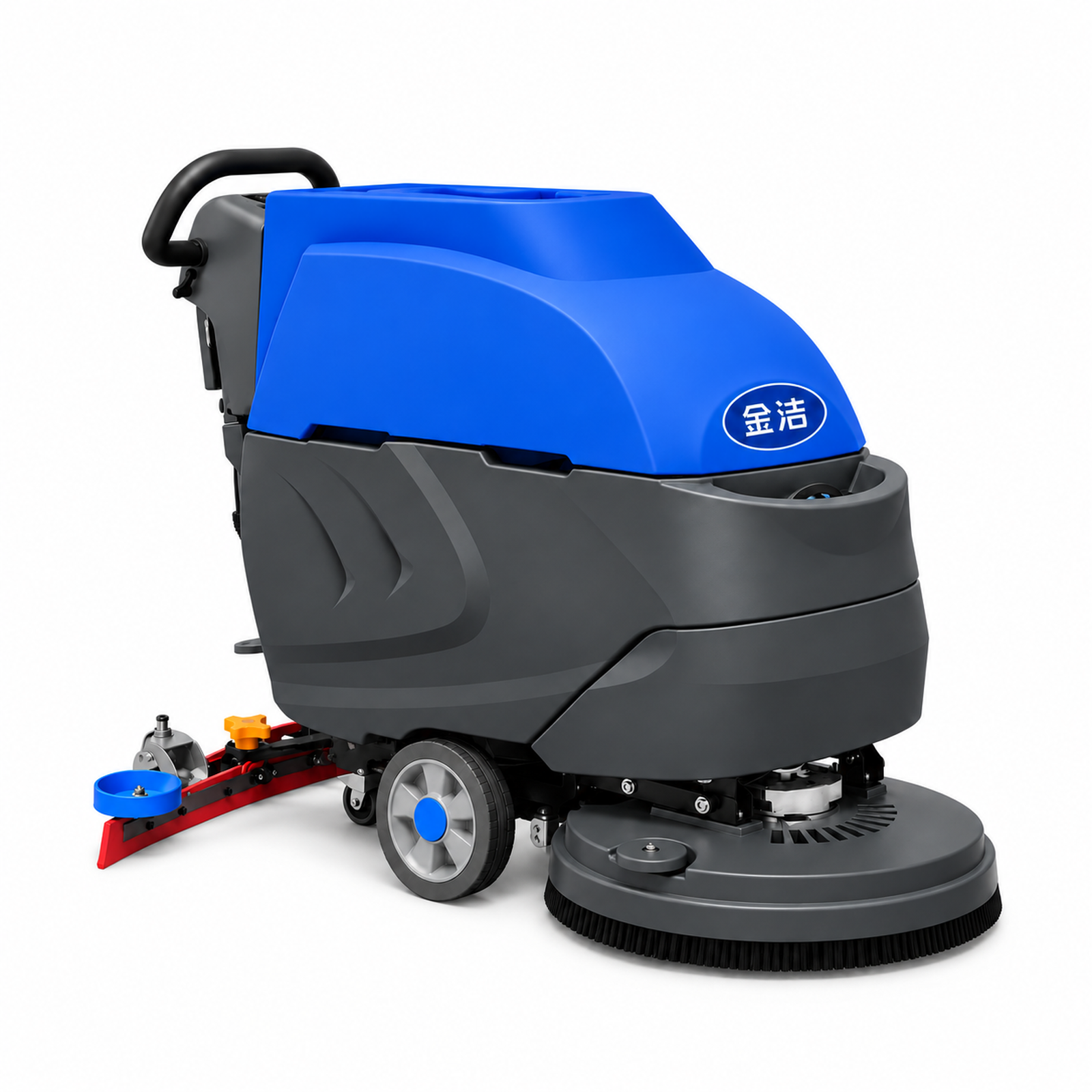
Tank information: 60 L / 65 L. Follow the manual to clean the wastewater tank and body.
Hand-pushed operation; power information: 24 V. Battery life is based on the data from the machine itself and is not considered as the actual test results in this round.
Working width: 530 mm; brush matching the floor material, special dirt should be tested first.
Check the condition of the water-absorbing rubber strip, sealing, and piping; actual water residue should be confirmed on-site based on the machine's structure.
Power information: 24 V; charging, maintenance, and usage periods are arranged according to the manual.
Check doors, lifts, turning space, gradients and parking. The machine needs clearance beyond its cleaning width.
Small areas often have many turns and require frequent cleaning, with the focus not being solely on high efficiency but rather on flexible entry, quick scrubbing, and wastewater recovery.
Repeated mopping in frequently cleaned areas adds labour and waiting time.
A closer fit for shops, floor-level areas and sites with many passages.
Water pickup follows scrubbing to reduce residual floor water.
Compare related models
Place the three models together and see the differences in configuration and operating method.
| Comparison criteria |  J-D3L → | J-D3S → |  J-56BF → |
|---|---|---|---|
| Cleaning width | 510mm | 530mm | 560mm |
| Squeegee width | 780mm | 780mm | 800mm |
| Clean water tank | 50L | 60L | 70L |
| sewage tank | 60L | 65L | 75L |
| Battery configuration | 12V100Ah×2 | Request the specification for this configuration. | 2 × 12V / 100Ah |
| Work time for the data. | 3-4h | Request the specification for this configuration. | 3–4h (reference value) |
| Operating method | Hand-pushed, personnel push. | Hand-pushed, personnel push. | Operator-controlled. |
First, check the passage and operation methods, then compare the water tank, working time, and maintenance schedule. The data in the table is based on the current technical specifications of each model. The working time in the documentation does not equal the actual runtime under all operating conditions.
Operating cost
Compare using the same floor, same cleaning requirements, and actual records.
Labor cost = number of people × actual working hours × hourly labor cost.
Record actual expenditure on tools, detergent and clean-up.
Single-use cost = operator labor + water and electricity with cleaning agent + consumable maintenance allocation + equipment investment allocation.
Turns, water replenishment, sewage discharge, and cleaning conclusion should all be counted as actual working time.
First, check the application scenario of this page. Combine it with your floor type, route, and work schedule to make a judgment. Real customer projects are only displayed according to the verified model, and the scenario images are not used as proof of customer results.
Understand customer applications → Talk about the site and trial run →Check the equipment and configuration list together before delivery.
Understand service arrangements →Communicate startup, brushing, replenishment of water, and daily cleaning.
Understand service arrangements →In case of operational issues, communicate with the model and usage conditions.
Understand service arrangements →Check the brush roll, rubber strip, and other parts against the model.
Understand service arrangements →Service scope, costs, and arrival arrangements need to be confirmed first.
Understand service arrangements →Coordinate maintenance plans with the frequency of use and the location.
Understand service arrangements →Consider daily scrubbing of hard floors in shops, canteens and corridors. Check water resistance, soil and pedestrian movement. Carpet, loose waste and special chemical contamination need their own assessment rather than a standard hard-floor configuration.
Remove unsuitable loose debris first and test suitable brushes and detergent on a small area. Inspect soil removal, surface changes and recovery, including joints and drains. A scrubber does not repair damaged floors.
The 530 mm figure describes scrubbing coverage. Also check the 780 mm squeegee and complete envelope. Measure doors, turns, operator space and transfer routes and verify the narrowest sections with the actual machine.
Tank volume does not determine battery runtime. Replenishment depends on water setting, soil and route; battery capacity, condition and load determine a separate limit. Do not infer working hours from the stated 24 V supply alone.
It is a theoretical comparison using 0.53 m × a uniform 5 km/h, not a site promise. Record turns, replenishment, repeat passes and finishing work during a trial before planning shift output.
Both are walk-behind options. Compare coverage, tanks, actual access, loaded handling and replenishment on the same surface and route. Model numbers or cleaning width alone do not establish an appropriate area range.
First, turn off the machine and disconnect the power according to the instructions. Check if the wastewater tank needs to be emptied, if the seal and suction hose are abnormal, and if the rubber strip has foreign objects or wear. Do not perform disassembly while powered on; take a photo of the fault location and the conditions under which the fault occurred to help Wanshenglong after-sales service determine the issue.
Select a typical route for testing, record the floor material, dirt type, configuration, total time, and operational feel, and provide the narrowest passage and sump points to Wanshenglong. If there is no project basis for this model, use the test results for verification and do not refer to cases from other models.
Discuss the floor, routes, and daily cleaning schedule, and together see if J-D3S is suitable.
Phone consultation: 0755-25621811 View other contact information →
Product enquiryTell us about the usage area and the issues you hope to improve, and the equipment consultant will combine with the passage, ground and work arrangement, communicate the suitable configuration with you. The area is temporarily unclear, you can contact us first.