
Typical application · Commercial floors
Residual water after cleaning commercial common areas? Assess J-D5SL scrubbing, recovery and access together
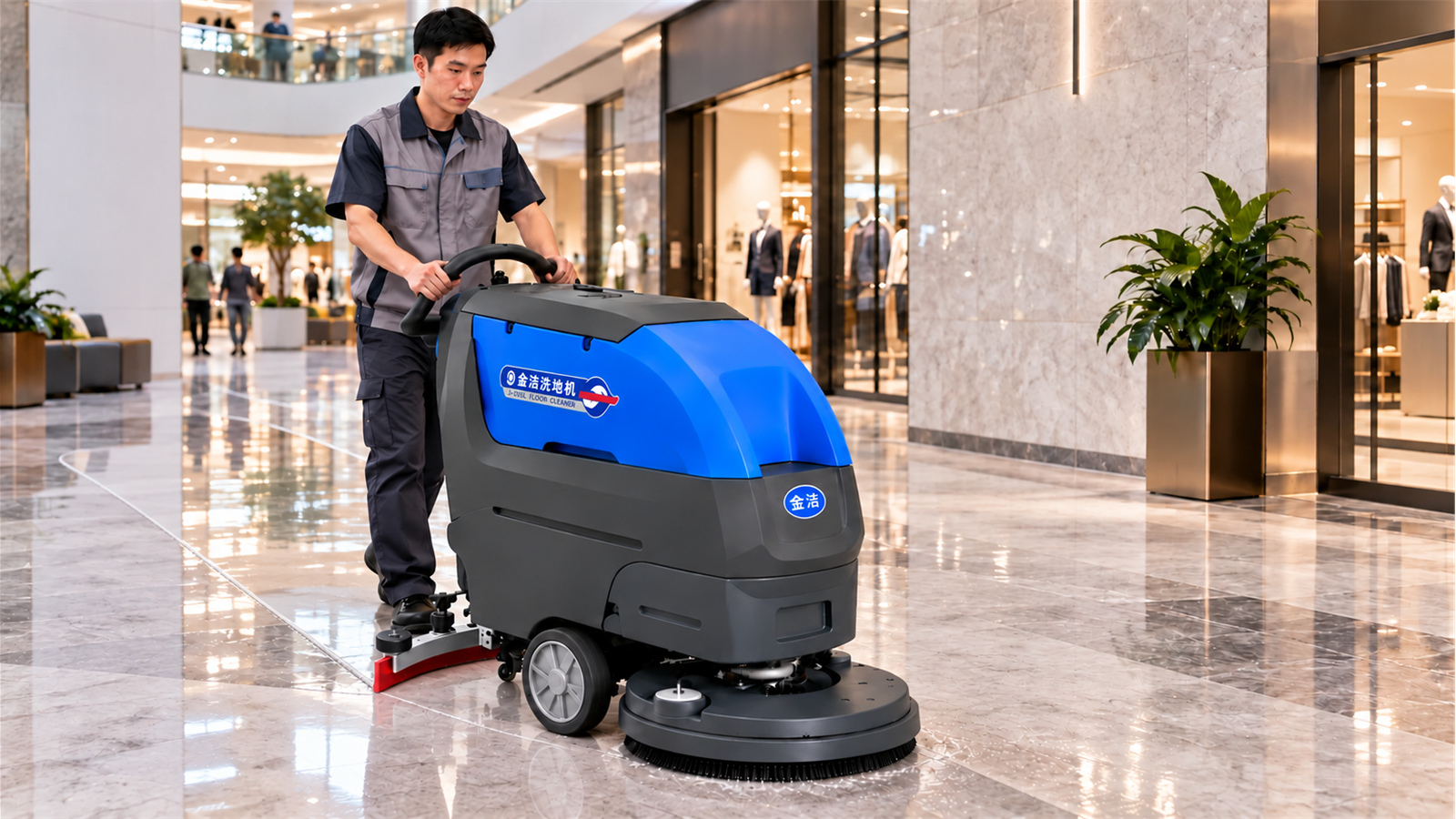
Typical operating reference for level, wet-cleanable hard surfaces in property-managed shopping-centre common areas and lobbies, with everyday dust, footprints and ordinary attached soil. The illustration shows commercial-common-area scrubbing, not a residential garage or a verified customer site.
J-D5SL coordinates powered travel, scrubbing and wastewater recovery for suitable continuous routes.
01 · The customer’s cleaning problem
Commercial shared areas need routine soil removal and orderly reopening. Long pushing routes, residual water and repeated service trips can disrupt cleaning and trading.
02 · Why this Jinjie machine?
J-D5SL coordinates powered travel, scrubbing and wastewater recovery for suitable continuous routes. Plan its current 50 L clean and 60 L recovery tanks around service points rather than treating capacity as a measured runtime.
03 · Cleaning results, workflow and customer value
Combining scrubbing, recovery and residual-water checks along one route can reduce repeated mopping and handover trips. Suitable pads, low-foam chemistry and a trial help protect compatible flooring; assess labour, consumables and overall cost against the actual area, shifts and maintenance.
The current page lists 510 mm cleaning width,24 V supply and a 780 mm squeegee. These are selection inputs, not a measured hourly completion rate. Confirm the exact model and configuration against the machine and order.
- Do not assume suitability for water-sensitive floors, debris-heavy areas, hazardous dust or ramps beyond the manual. No validated low-noise, disinfection or perfectly dry-floor claim is made.
- Self-propulsion and recovery do not guarantee one-pass removal of every stain or heavy oil. Trial local treatments for compatibility and investigate blades/recovery if water remains.
Problems, equipment and customer value
| Site problem | Equipment feature and selection basis | Working method | Potential value |
|---|---|---|---|
| Repeated pushing along long corridors | Self-propelled 24 V drive | Check access and turns before planning zoned routes | Support continuous-work planning and assessment of pushing effort without promising headcount savings |
| Residual water delays reopening | Scrubbing and suction recovery; listed squeegee width 780 mm | Remove large debris, inspect blades and recovery, and trial a small area | Include residual-water checks rather than relying on flushing alone |
| Refilling and emptying interrupt a shift | Listed clean-water 50 L and recovery 60 L tanks | Plan tasks around fill/empty points and shifts | Avoid unnecessary trips caused by overlooking servicing routes |
Equipment and configuration boundaries
The current page lists 510 mm cleaning width,24 V supply and a 780 mm squeegee. These are selection inputs, not a measured hourly completion rate. Confirm the exact model and configuration against the machine and order.
Compare J-D3C for smaller tight areas and ride-on equipment for larger open continuous routes. Squeegee width is not the machine access width; measure doors, lifts and turns separately. Match brushes, pads, blades and chemicals to the surface, machine and configuration list rather than assuming universal compatibility.
Site assessment and working method
Provide surface/coating details, photos, area, narrowest access, turns, ramps, foot traffic, frequency, fill/empty points and charging/storage arrangements.
Collect grit and large debris first, then confirm compatible brushes/pads and low-foam detergent. Isolate the area, work off-peak and trial a small patch before scrubbing and recovery. Check residual water, soil and slip risk before reopening; maintain tanks, brush and blades as instructed.
Limits and safety
Do not assume suitability for water-sensitive floors, debris-heavy areas, hazardous dust or ramps beyond the manual. No validated low-noise, disinfection or perfectly dry-floor claim is made.
Self-propulsion and recovery do not guarantee one-pass removal of every stain or heavy oil. Trial local treatments for compatibility and investigate blades/recovery if water remains.
Questions before selecting equipment
How does this differ from pressure washing?
This task combines brushing and wastewater recovery; pressure washing alone is not equivalent to scrub-and-recover operation.
Will a 780 mm squeegee fit a door of the same width?
That figure alone is insufficient. Measure the machine, clearance, turns and attachment positions.
Can heavy oil or grit be scrubbed immediately?
Collect particles first and assess compatible oil pre-treatment; no one-pass removal is promised.
Provide the site conditions
Provide surface/coating details, photos, area, narrowest access, turns, ramps, foot traffic, frequency, fill/empty points and charging/storage arrangements.
Rental is subject to actual availability and project assessment; no model, stock or price is promised.