
Typical application
Outdoor equipment mud washing: supply, recovery and sensitive-part protection
Floor washing and vehicle exterior care are different tasks. Confirm isolation, washable parts, mud properties and collection before comparing models and nozzles.
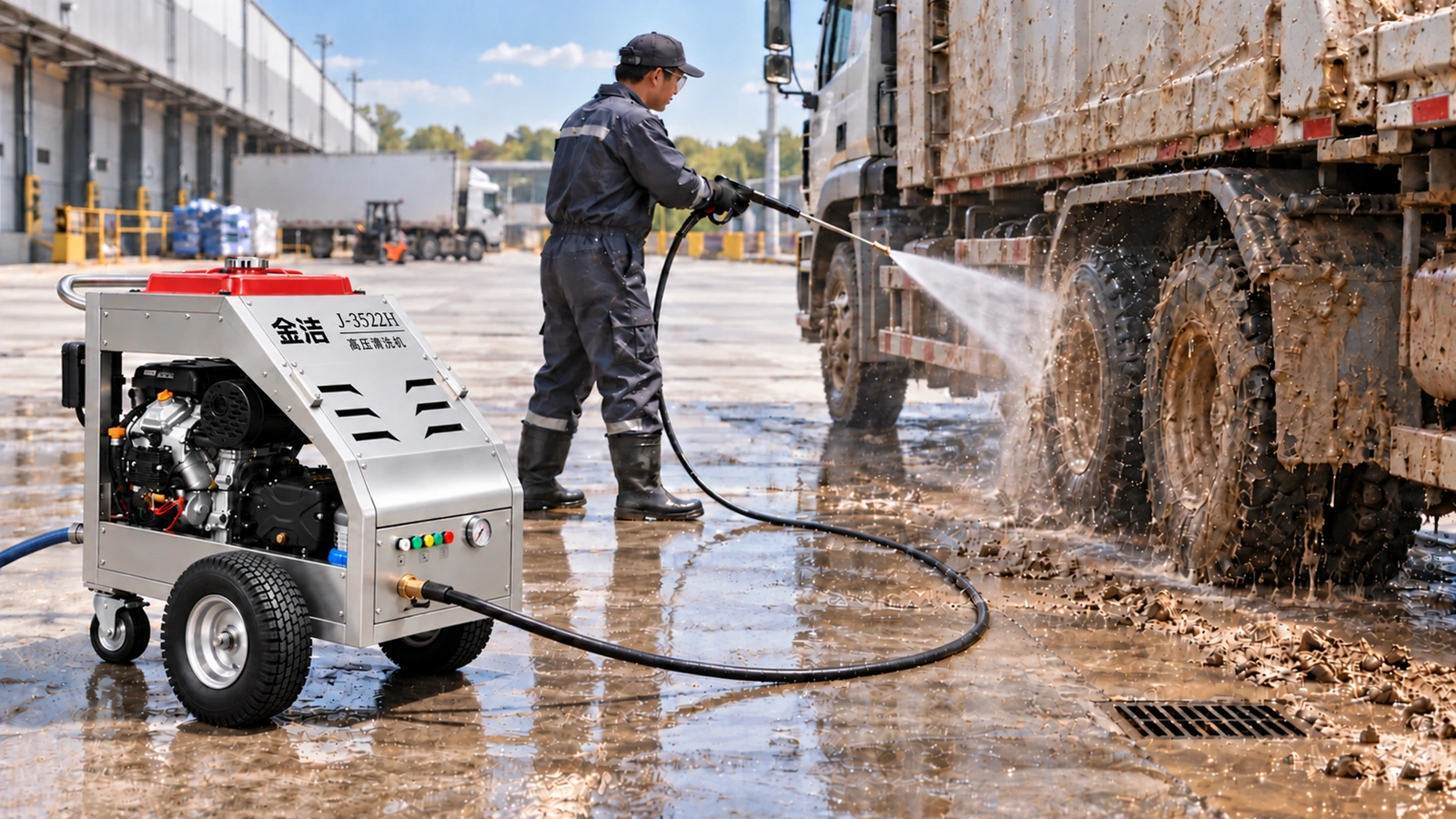
Assess 15 or 22 L/min directions against mud adhesion and water handling. Verify model pressure terminology/configuration separately; images promise no customer result.
- Only authorised exteriors of isolated equipment in open outdoor space.
- No petrol operation indoors, underground or where exhaust accumulates.
- Follow equipment-maker requirements for coatings, seals, electrics and hot surfaces.
- Collect oily/special wastewater separately, not into unauthorised drains.
Vehicle, track and bucket exteriors: wash only authorised muddy surfaces
J-3515H
Separate heavy-mud removal, exterior rinsing and wastewater collection to reduce tracking, repeated rinsing and finishing work. Suitable distance and trials manage damage risk; an image does not establish whole-vehicle washability.
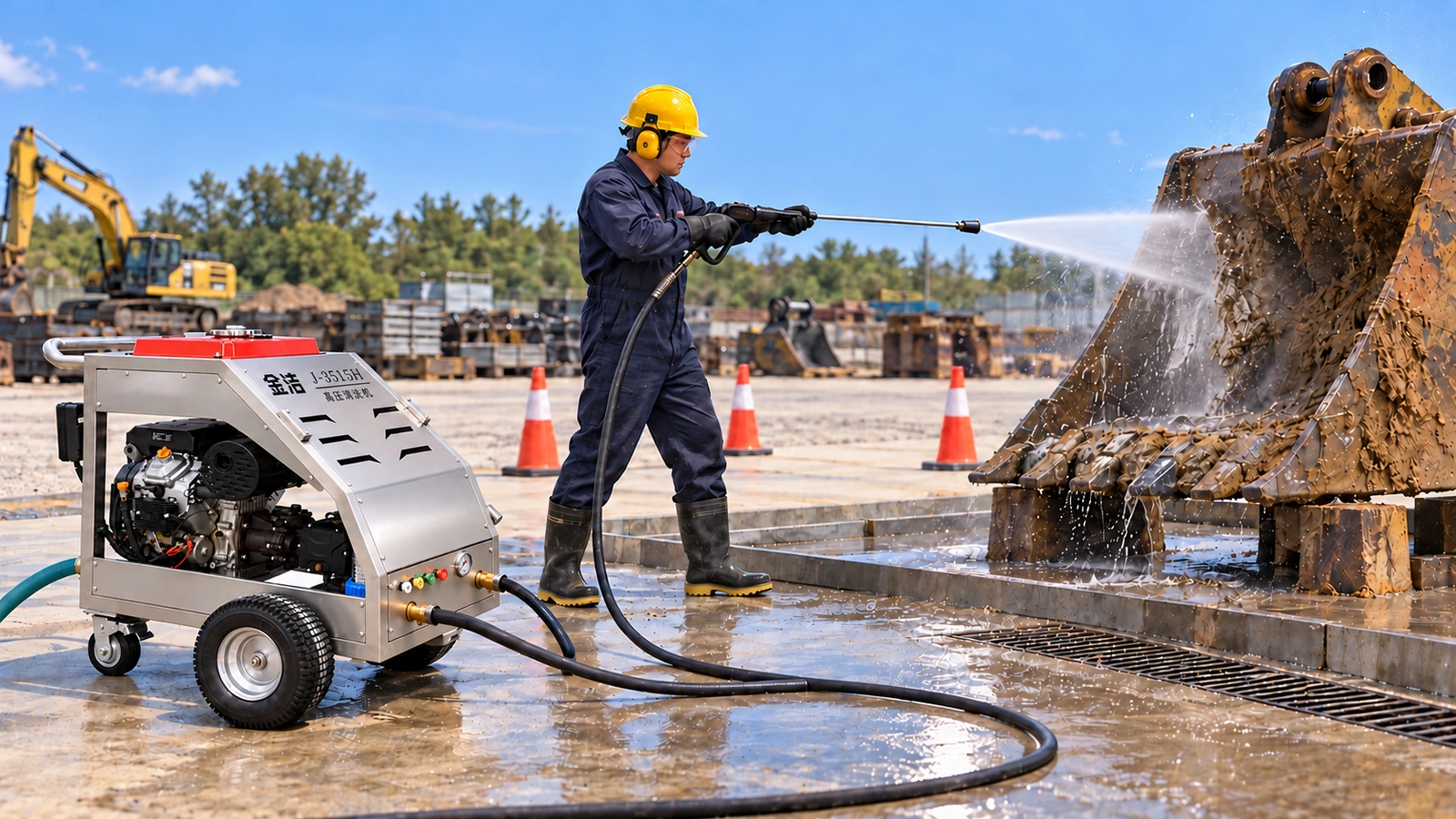
01 · What makes this task difficult?
Stopped outdoor vehicles, tracks and bucket exteriors carry attached mud and loose sediment. Loosening deposits and collecting wastewater/sediment are both required; tyres, seals, hoses, electrics, coatings and labels do not share one tolerance.
Heavy mud and local deposits need different treatment
Remove bulk mud before trial-rinsing approved surfaces
Vehicles contain sensitive electrical and sealed parts
Avoid prohibited areas, protect surroundings and collect runoff
02 · Why consider this Jinjie machine?
Work by approved exterior areas on tracks, buckets and body surfaces using the current model’s power, pressure, flow and nozzle. Remove heavy mud first and follow vehicle maintenance limits around electrics, seals and hydraulics.
Current machine and compatible nozzle
Remove bulk mud before trial-rinsing approved surfaces
Reduce ineffective rinsing and mud tracking
Sectional work under maintenance requirements
Avoid prohibited areas, protect surroundings and collect runoff
Reduce rework from unsuitable operation
J-3515H · Current information lists 15 L/min, a GX630 twin-cylinder petrol engine and AR pump. Verify the maximum/working basis of the 350bar(35MPa) entry; assess only open outdoor non-hazardous tasks.
03 · A better cleaning workflow and customer value
Separate heavy-mud removal, exterior rinsing and wastewater collection to reduce tracking, repeated rinsing and finishing work. Suitable distance and trials manage damage risk; an image does not establish whole-vehicle washability.
Reduce ineffective rinsing and mud tracking
Heavy mud and local deposits need different treatment · Remove bulk mud before trial-rinsing approved surfaces
Reduce rework from unsuitable operation
Vehicles contain sensitive electrical and sealed parts · Avoid prohibited areas, protect surroundings and collect runoff
Match tools, the material and the working route before comparing labour, time, consumables and maintenance costs. The potential value depends on suitable conditions and correct operation; no fixed saving or damage-free result is promised.
Only authorised exteriors of isolated equipment in open outdoor space. No petrol operation indoors, underground or where exhaust accumulates. Follow equipment-maker requirements for coatings, seals, electrics and hot surfaces. Collect oily/special wastewater separately, not into unauthorised drains.
Compare related applications and models (4)
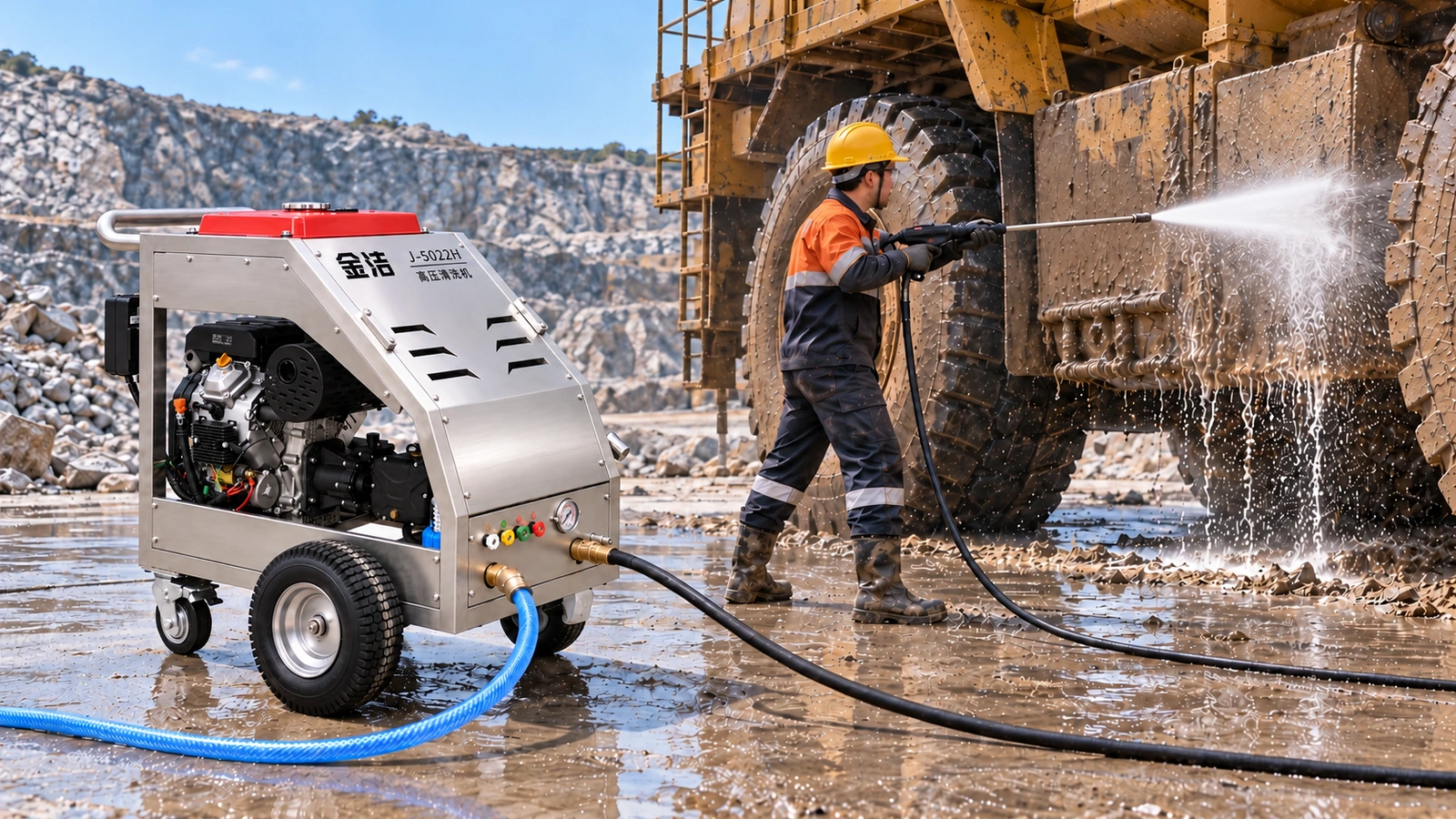
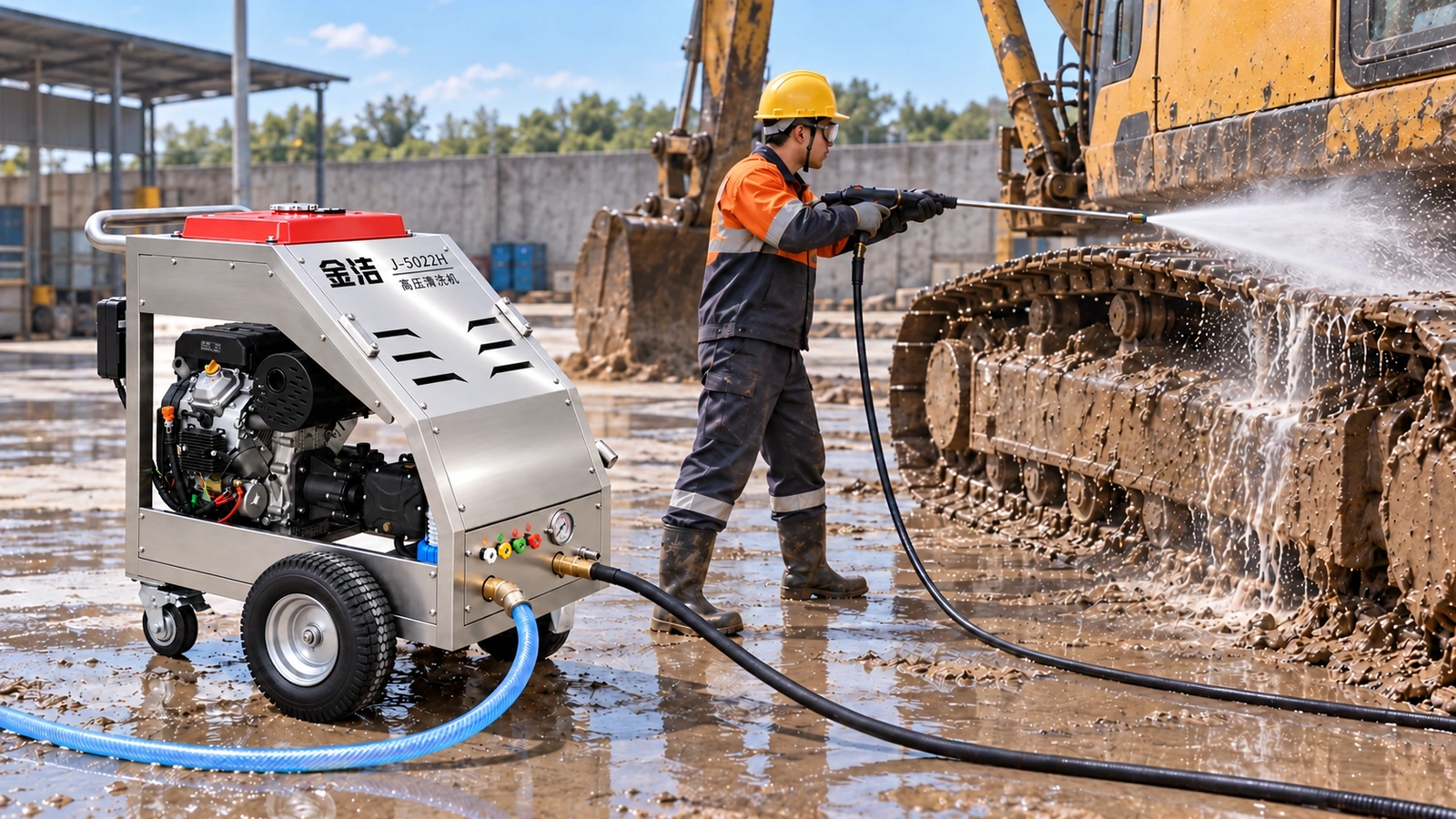
Compare each model’s actual drive, access, accessories and configuration on its own product page. Shared task guidance does not make the models interchangeable.
Working method, evidence and original professional analysis
Task-specific equipment selection
Vehicle, track and bucket exteriors: wash only authorised muddy surfaces
Site, material and contamination
Stopped outdoor vehicles, tracks and bucket exteriors carry attached mud and loose sediment. Loosening deposits and collecting wastewater/sediment are both required; tyres, seals, hoses, electrics, coatings and labels do not share one tolerance.
Equipment basis and model differences
Compare the current 15 L/min direction of J-3515H with 22 L/min of J-3522H and J-5022H. Flow informs transport and water planning, not single-pass, output or time-saving claims. Pressure terminology remains unresolved; model names and headline maxima are not operating settings. All three are currently petrol-positioned; confirm each pump from its own Chinese information. Assess only after open outdoor operation, non-hazardous contents, supply/disposal and equipment-maker cleaning boundaries are confirmed. This does not cover hulls, antifouling removal or petrochemical hazardous zones.
Model configuration and selection
Check model-specific configurations against the machine and order before purchase.
| Model | Current basis and limits |
|---|---|
| J-3515H | Current information lists 15 L/min, a GX630 twin-cylinder petrol engine and AR pump. Verify the maximum/working basis of the 350bar(35MPa) entry; assess only open outdoor non-hazardous tasks. |
| J-3522H | Current information lists 22 L/min, Honda twin-cylinder petrol power and AR pump. Pressure terminology remains unresolved; no parallel-operator or time-saving promise is made. |
| J-5022H | The current page lists 22 L/min, petrol power and AR pump. A maximum-500bar(50MPa) headline coexists with unresolved terminology; it is not certified working pressure. |
| Site problem | Equipment / conditions | Suggested method | Potential value |
|---|---|---|---|
| Heavy mud and local deposits need different treatment | Current machine and compatible nozzle | Remove bulk mud before trial-rinsing approved surfaces | Reduce ineffective rinsing and mud tracking |
| Vehicles contain sensitive electrical and sealed parts | Sectional work under maintenance requirements | Avoid prohibited areas, protect surroundings and collect runoff | Reduce rework from unsuitable operation |
Working method, accessories and site supply
- Permission and isolation · Have the equipment lead confirm isolation, stable support, protected parts and washable surfaces. Do not work beneath potentially moving tracks or buckets.
- Collect bulk mud first · Arrange removal of collectable clods, barriers, settlement and wastewater recovery; handle oil and special residues separately.
- Trial and avoid sensitive parts · Trained staff trial under the unit and vehicle-maker instructions, avoiding electrics, seals, hydraulic hoses, labels and sensitive coatings. No unverified pressure or distance is prescribed.
- Depressurise and inspect · Stop/depressurise before maintenance. Check surfaces, vehicle condition and waste destination; claim no measured result without evidence.
Limits and safety
Only authorised exteriors of isolated equipment in open outdoor space. No petrol operation indoors, underground or where exhaust accumulates. Follow equipment-maker requirements for coatings, seals, electrics and hot surfaces. Collect oily/special wastewater separately, not into unauthorised drains.
Questions for this task
Prepare site information
Provide vehicle/attachment model, authorised surfaces, mud/oil condition, isolation requirements, coating guidance, supply/recovery and outdoor engine location.
FAQ
Does 22 L/min necessarily clean faster than 15 L/min?
No. Adhesion, material, nozzle, supply and recovery all affect work.
Can engines, electrical boxes and hydraulic connections be sprayed directly?
Do not assume so. Manufacturer permission and component protection are required; only authorised exteriors are covered.
Does a machine pictured at a mine or port have hazardous-area approval?
No. Contents, dust, gas and zone classification need separate assessment; an ordinary petrol machine gains no explosion-protection approval from its setting.
What site information is needed for selection?
Provide vehicle/attachment model, authorised surfaces, mud/oil condition, isolation requirements, coating guidance, supply/recovery and outdoor engine location.
Select equipment for the actual site
Provide vehicle/attachment model, authorised surfaces, mud/oil condition, isolation requirements, coating guidance, supply/recovery and outdoor engine location.
J-3515H · Selection enquiryCompare application plansQuestions before selecting equipment
Does this topic authorise paint stripping or rust removal?
No. These are separate processes; sharing a machine does not make them the same task.
Does this topic establish customer delivery for its images?
No. The originals support typical task analysis; customer facts and machine configuration still need evidence.
Prepare the site details
Provide vehicle/attachment model, authorised surfaces, mud/oil condition, isolation requirements, coating guidance, supply/recovery and outdoor engine location.
Rental is subject to actual availability and project assessment; no model, stock or price is promised.