
Selected model: Jinjie J-2815H
Typical application
Outdoor guardrail washing
Jinjie J-2815H
Address ordinary dust and mud with a material trial, safe separation and sectional washing. Reduce repeated wiping while protecting finishes and coordinating nearby access.

01 | The site problem: many faces and corners beside public access
Posts, rails and bases require repeated repositioning during manual wiping. Poor spray direction can send dirty water towards pedestrians, vehicles or cleaned areas. Paint, galvanised finishes and joints also need protection; maximum pressure is not the answer to every mark.
02 | Why consider J-2815H or J-5015H
The existing product scope identifies both as petrol pressure washers for approved ordinary outdoor washing. Organise J-2815H around shorter rail sections; plan J-5015H around sectional routes with suitable water supply and separation. Match each machine’s actual flow, working pressure, nozzle and supply independently. Engine size, model numbers and static illustrations do not establish cleaning speed or reach.
03 | The method: separate, trial and work towards collection
Choose a stable position outdoors with ample natural ventilation. Separate traffic and people under site rules and direct engine exhaust away from windows and air intakes. Never run a petrol engine indoors, in enclosed garages or poorly ventilated areas. Check coatings and joints, trial a low-risk area, and use the actual compatible gun and nozzle at a suitable distance. Avoid prolonged concentrated jets at joints, vulnerable finishes and electrical parts. Work sectionally towards controlled collection.
04 | Customer value: coordinate cleaning, access and finishing
Suitable spray settings and sectional routes can improve ordinary dust and mud removal while reducing repositioning and repeated wiping. Trials and coating protection can limit damage from unsuitable operation. Coordinating separation, washing and runoff collection can reduce disruption and help organise staff and time. Benefits depend on soil, access and water supply; fixed efficiency or cost savings are not guaranteed.
Scope and site conditions
For authorised ordinary guardrail surface washing only: no suspended work, live electrical installations, rust-removal grades or paint-stripping claim. Match machine, hose and nozzle ratings, use suitable protection, avoid wind-driven spray and collect wastewater and sediment under site and local rules.
Frequently asked questions
Can this strip paint or heavy rust?
Ordinary washing does not establish stripping or rust-removal performance. Assess coating treatment and abrasive methods separately.
Can the petrol machines run in an underground garage?
Do not run them in enclosed or inadequately ventilated areas. Keep exhaust away from people and air intakes.
How can disturbance to access be reduced?
Separate the work area first, then coordinate spray direction, sectional routes and runoff collection. Stop if safe conditions cannot be established.
Models and original application images
Compare each model against its own configuration and the actual route, material and site services.
Jinjie J-2815H
Current model
Target railing surface soil to reduce repeated hand cleaning
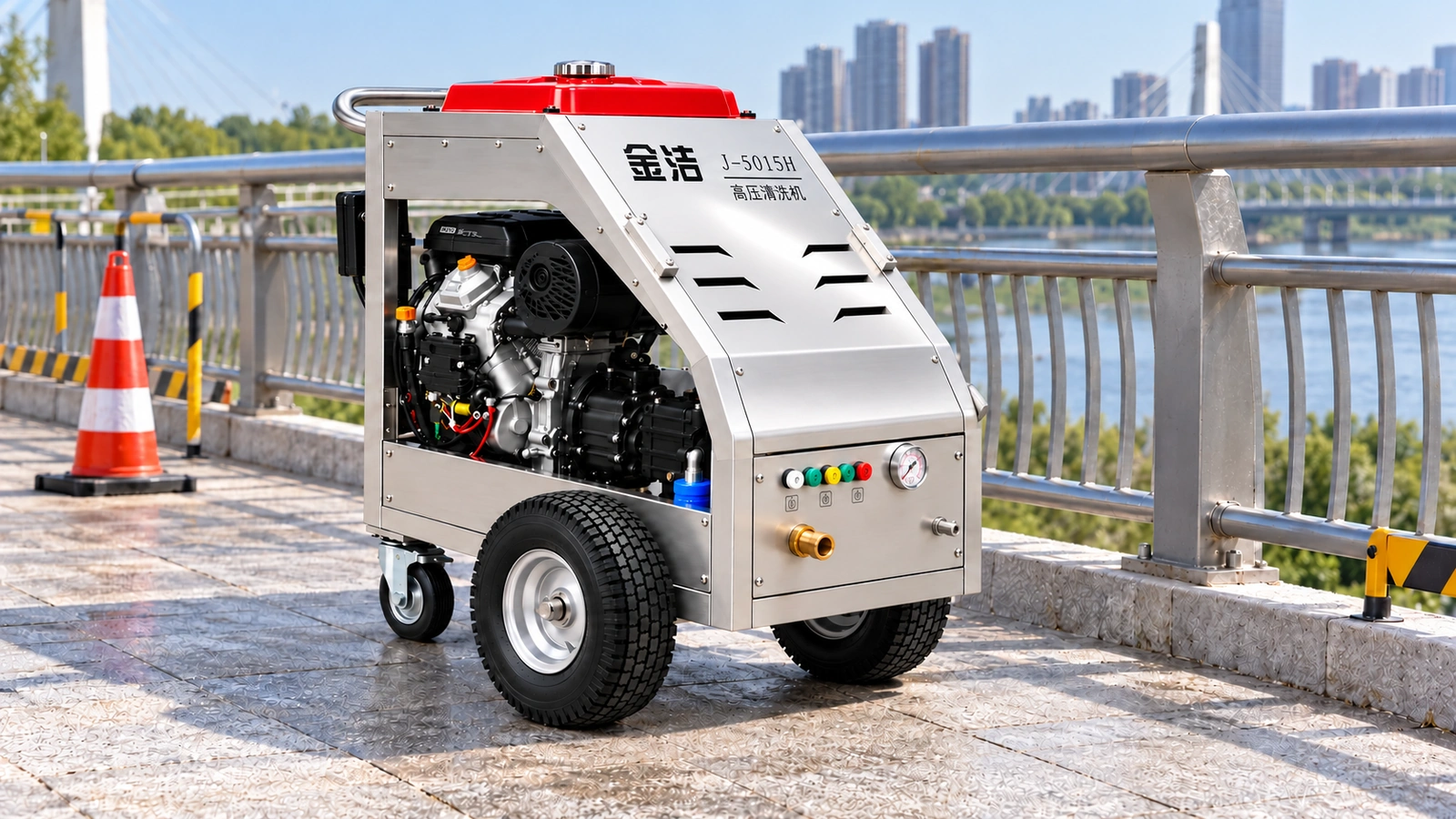
Jinjie J-5015H
Bridge-deck, railing and municipal-facility cleaning