
Typical application · Outdoor stone
Outdoor Stone Surface Pressure Washing: Equipment Selection and Cleaning Methods
If deposits remain after washing stone paving, more pressure is not automatically the answer. Separate removable surface material, absorbed stains and surface damage before selecting a method and equipment.
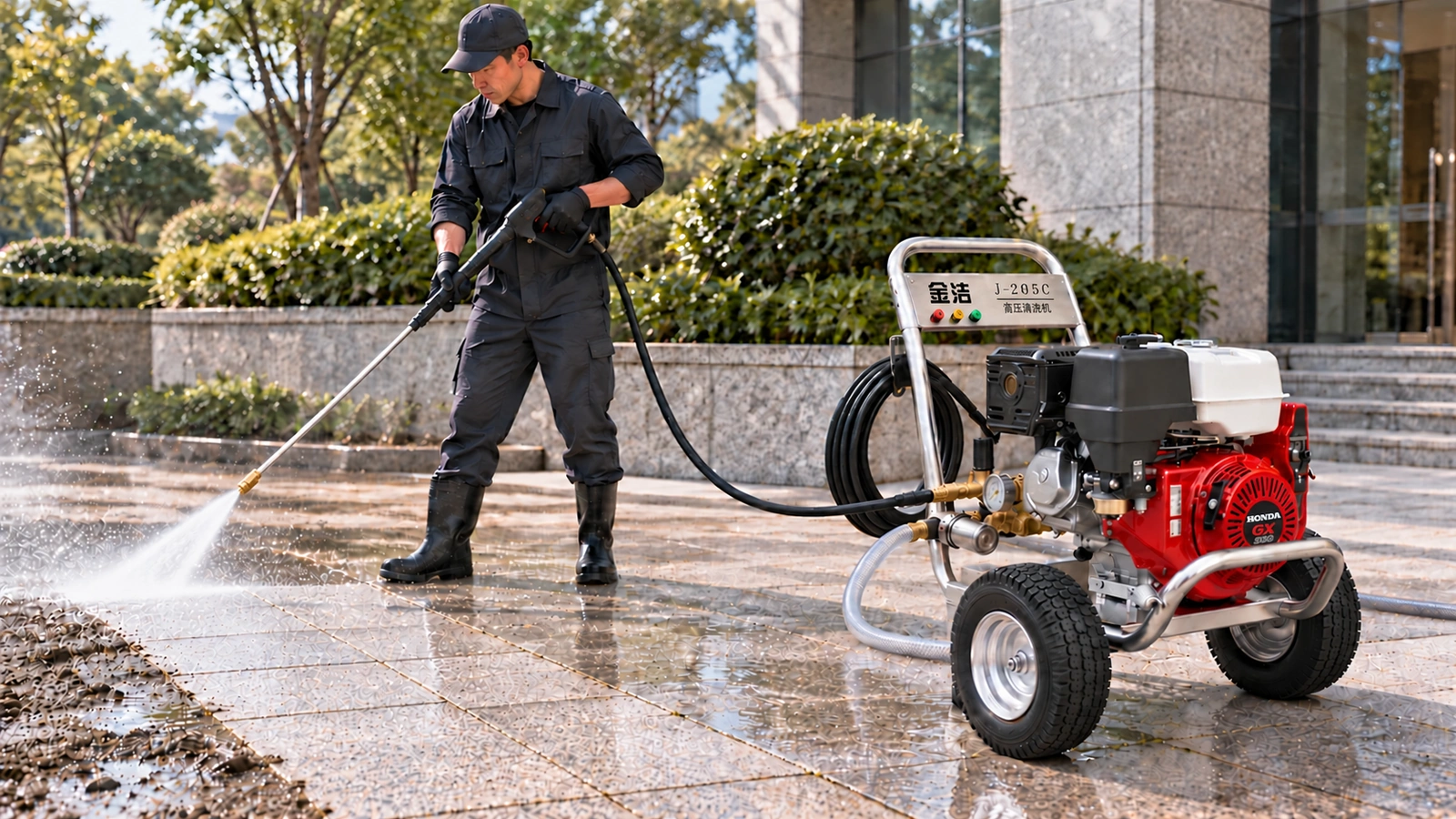
Consider J-2815C only for open outdoor work where the stone and joints tolerate wet cleaning, supply and wastewater collection are organised, and a representative trial is satisfactory. It is not a universal solution for every stone or stain.
- Open outdoor operation; prevent exhaust accumulation
- Stone, finish and joints identified
- Stable supply and a defined wastewater route
- Trial first; isolate and reopen in controlled zones
Identify the deposit and the material before treating damage as dirt
One paved area can contain several different problems. Stone type, finish, joints, repairs and contamination source provide more useful starting information than a pressure number alone.
| What you see | What to establish | Direction to assess |
|---|---|---|
| Loose dust, silt or leaf residue | Particle size, drainage openings and collection | Collect loose waste first; assess local washing only where the material allows it. |
| Attached surface soil, footprints or biological growth | Whether it is superficial and whether joints or material are loose | Trial a small area. Check material and label compatibility before any detergent; no one-pass water-jet result is promised. |
| Absorbed oil, rust colour or an old protective layer | Stain depth, coating and stone-care requirements | Do not simply increase pressure; assess appropriate stain treatment or maintenance. |
| Dulling, whitening, powdering, cracks or missing joints | Damage, installation or moisture-related causes | Establish the cause and repair boundary rather than calling it ordinary pressure washing. |
Surfaces that need assessment before jetting
Stone type, polished or textured finish, protective treatment and joint condition can change the method. Do not begin high-pressure work on water-sensitive, powdering, loosely jointed or fragile repaired surfaces without material-provider guidance and a site trial.
The Natural Stone Institute advises identifying the stone first; grit can abrade surfaces and acids can damage calcareous stone. Cleaner choice must follow compatibility, not cleaning strength alone. This guide gives no universal acid-cleaning recipe.
Why consider J-2815C rather than make an immediate purchase recommendation
Petrol power is a direction to assess for scattered outdoor points without convenient fixed electrical power. Water supply, fuel, wastewater and pedestrian isolation still need organising.
This model lists a 280bar(28MPa)-class pressure figure, 15 L/min flow, Honda GX390/13 HP and an AR plunger-pump configuration. The maximum-versus-working pressure definition retains its existing evidence boundary: 280bar(28MPa) is not a prescribed stone-cleaning setting. Configuration does not establish cleaning speed, service life or savings.
| Listed item | How it helps selection | Still to verify |
|---|---|---|
| Petrol power | Discuss mobile outdoor work points | Engine location, exhaust, fuel and site controls; indoor operation is excluded. |
| Current 15 L/min flow figure | Plan supply, loose-material transport and wastewater together | Confirm the actual supply against inlet requirements; do not derive a fixed area rate. |
| Long gun and basic accessories | Discuss targeted local washing | Nozzles, connectors, hose length and the actual order; an image is not a delivery list. |
Assess nozzle, pressure, flow and distance together
Start with the material supplier’s requirements and the equipment manual, then trial a discreet representative patch. Check gloss, powdering, joints and residue. Neither one nozzle angle nor one fixed distance establishes suitability for all stone.
The current basic list includes one each of 0°, 15°, 25° and 40° quick-connect nozzles, a long gun, a 10 m basic high-pressure hose and an inlet hose. Availability does not make every nozzle suitable for stone; a concentrated jet is not a default method. Confirm model-specific and additional hose lengths against the actual configuration.
Surface cleaners, rotary heads, multi-nozzle flushing attachments and additional hose are optional. Assess a surface cleaner only after verifying the actual attachment, material and water/drainage conditions; it is not scrub-and-recover equipment. Do not infer attachment model, size or nozzle count from an illustration. If acceptable operating conditions cannot be achieved, change the equipment or method rather than modifying the pump or nozzles.
Include trial cleaning, water supply and wastewater in the work plan
- Confirm the area and informationProvide photographs, stone/coating details, contamination, area, work windows, nearby doors and air intakes, fill points and wastewater route. Identify areas that must stay dry.
- Pre-clean and protectCollect leaves, grit and large debris. Protect joints, entrances and nearby electrical installations; isolate the area and avoid peak foot traffic.
- Trial a representative patchTrained personnel follow the manual and observe the material, joints and cleaning response. Stop and reassess dulling, powdering or unusual leakage.
- Work in zones and manage wastewaterMatch small zones to available supply and collection capacity, controlling spray and flow. Collect sediment-, oil- or detergent-bearing water under site arrangements; do not assume it can enter a storm drain.
- Check before reopeningCheck residual water, silt, slip risk, joints and adjoining areas before reopening. Do not apply a trial result automatically to different materials or damaged areas.
When pressure washing fits, and when to change the approach
| Site condition | Methods to compare | Selection boundary |
|---|---|---|
| Open outdoors; surface deposits; material and joints confirmed tolerant | A suitable mobile washer such as J-2815C | Trial, supply, drainage, nozzle and distance checks remain necessary; no universal result. |
| Suitable fixed power and relatively fixed work points | Appropriate electric equipment such as J-2515D | Reassess power, water and protection. Electric power does not make every stone suitable. |
| Indoor routine hard-floor scrubbing and wastewater recovery | A compatible scrubber, such as J-D5SL, with suitable pads | Check material, route, detergent and residual water; a petrol washer is not the indoor substitute. |
| Polished finish, absorbed stains, powdering, cracks or repairs | Stone care, local stain treatment or professional repair assessment | Pressure capability cannot replace a material or repair decision. |
Keep the engine outdoors; the illustration does not verify safety
Do not operate a petrol engine indoors, in underground garages or in semi-enclosed locations where exhaust can accumulate. Avoid engine positions near doorways or air intakes that could carry exhaust indoors. Additional hose does not remove the need for site assessment.
High-pressure jets, wet floors, spray and nearby electrical installations require trained operators, protective measures and isolation according to the manual. Follow the manual for stopping and depressurising before maintenance. No hazardous-area, explosion-proof or customer work-permit suitability is claimed.
Questions before selecting equipment
Can all stone be washed directly at 280bar(28MPa)?
No. A product figure is not a stone-cleaning setting. Assess material, finish and joints and trial as instructed; change method or equipment if acceptable conditions cannot be met.
What distance in centimetres is safe?
There is no universal distance for all stone. This guide invents no distance value; use the manual, material requirements and trial together.
Is a surface cleaner standard, and does it recover wastewater?
It is optional and requires actual compatibility and order checks. A surface-cleaning attachment is not equivalent to a scrubber’s wastewater recovery.
Will water remove oil, rust and dulling?
Not necessarily. Absorbed stains and damaged finishes need separate assessment and possibly care or repair, not simply greater jet intensity.
Can the petrol engine sit in a doorway for an indoor lobby task?
That does not establish safety. Do not operate it indoors or where exhaust can accumulate or enter the building; reassess the equipment and process.
What is needed for purchase or rental selection?
Provide photographs, stone and finish details, deposits, area, work windows, supply and collection arrangements. For rental add the city, start date and duration; availability is not promised.
Describe the stone and site before selecting equipment
Prepare material/coating information, close-up and overall photos, contamination source, area and route, work windows, supply, wastewater collection, nearby openings, previous cleaning products and the intended acceptance check. Discuss a trial first for sensitive or complex surfaces.
Rental is subject to actual availability and project assessment; no model, stock or price is promised.