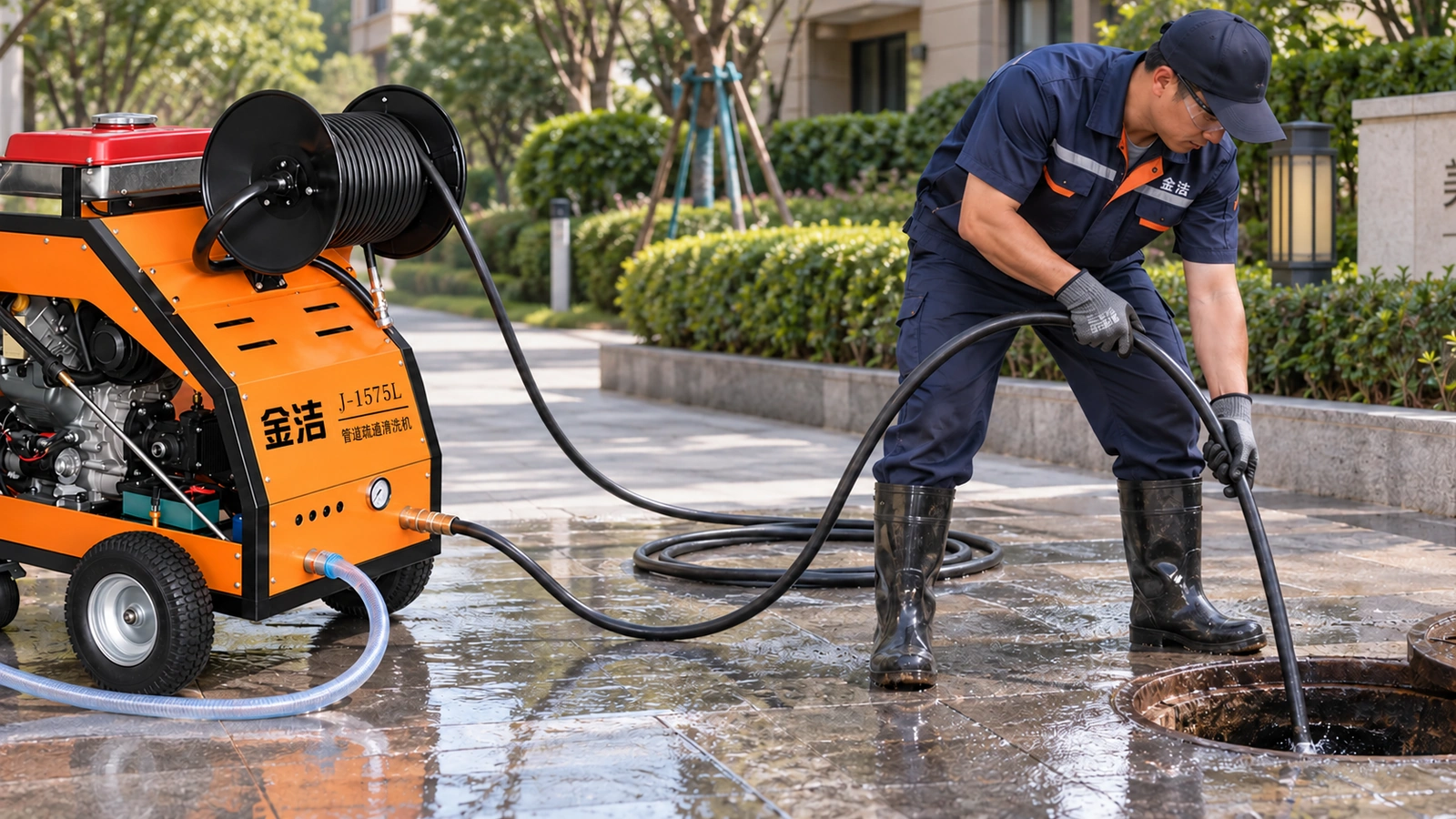
Typical application · Outdoor drainage
Outdoor property drain access-point jetting
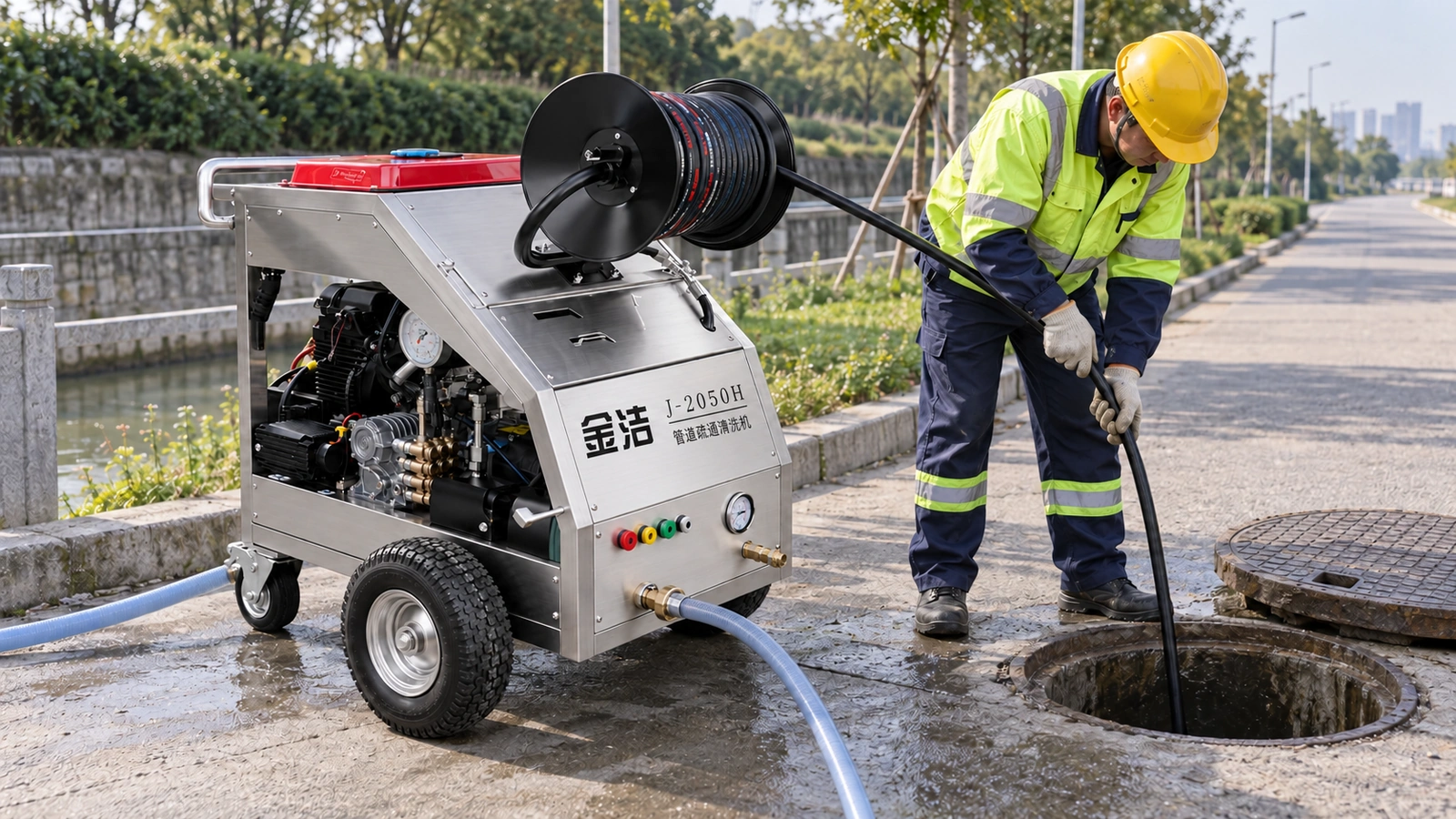
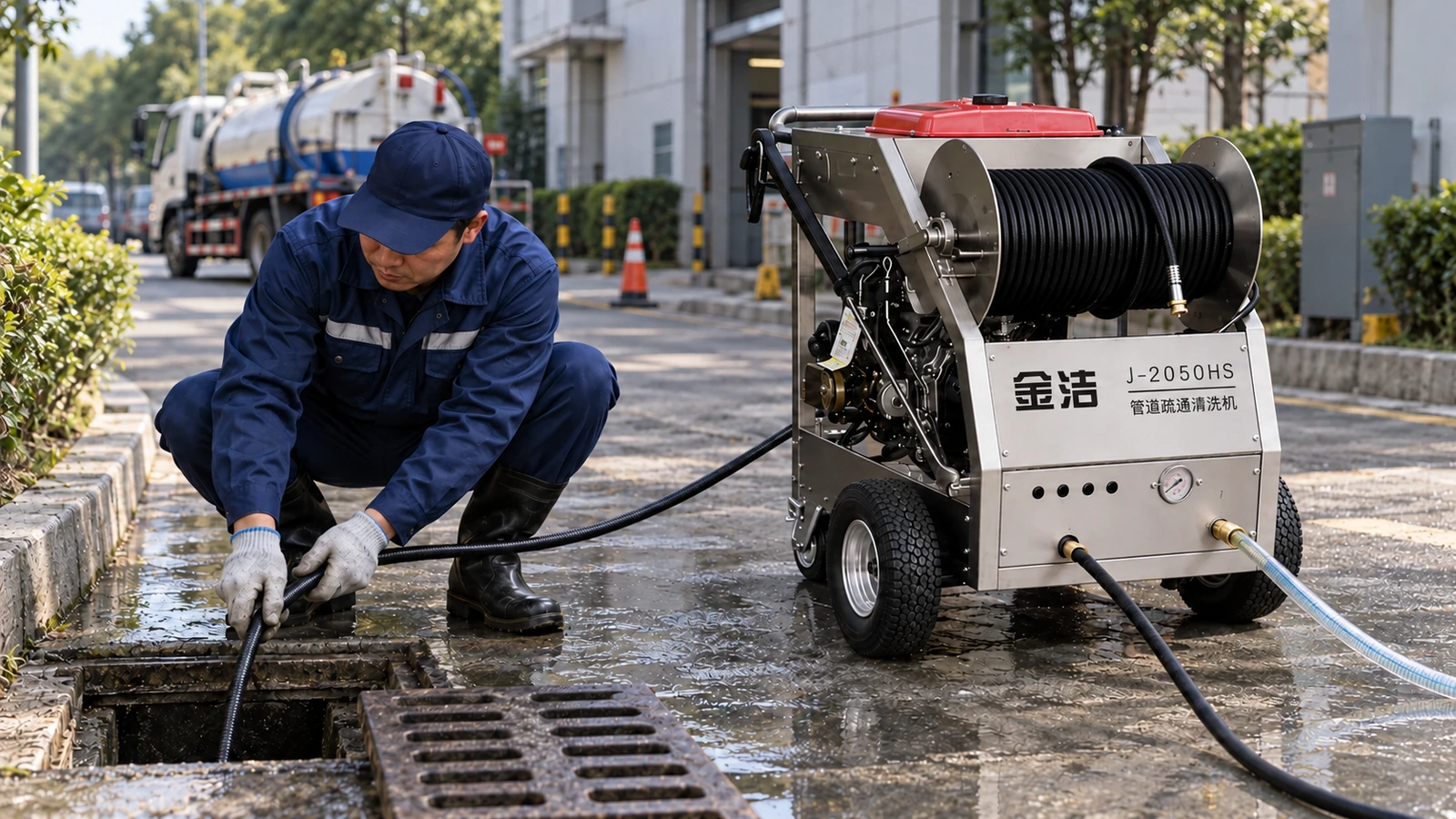
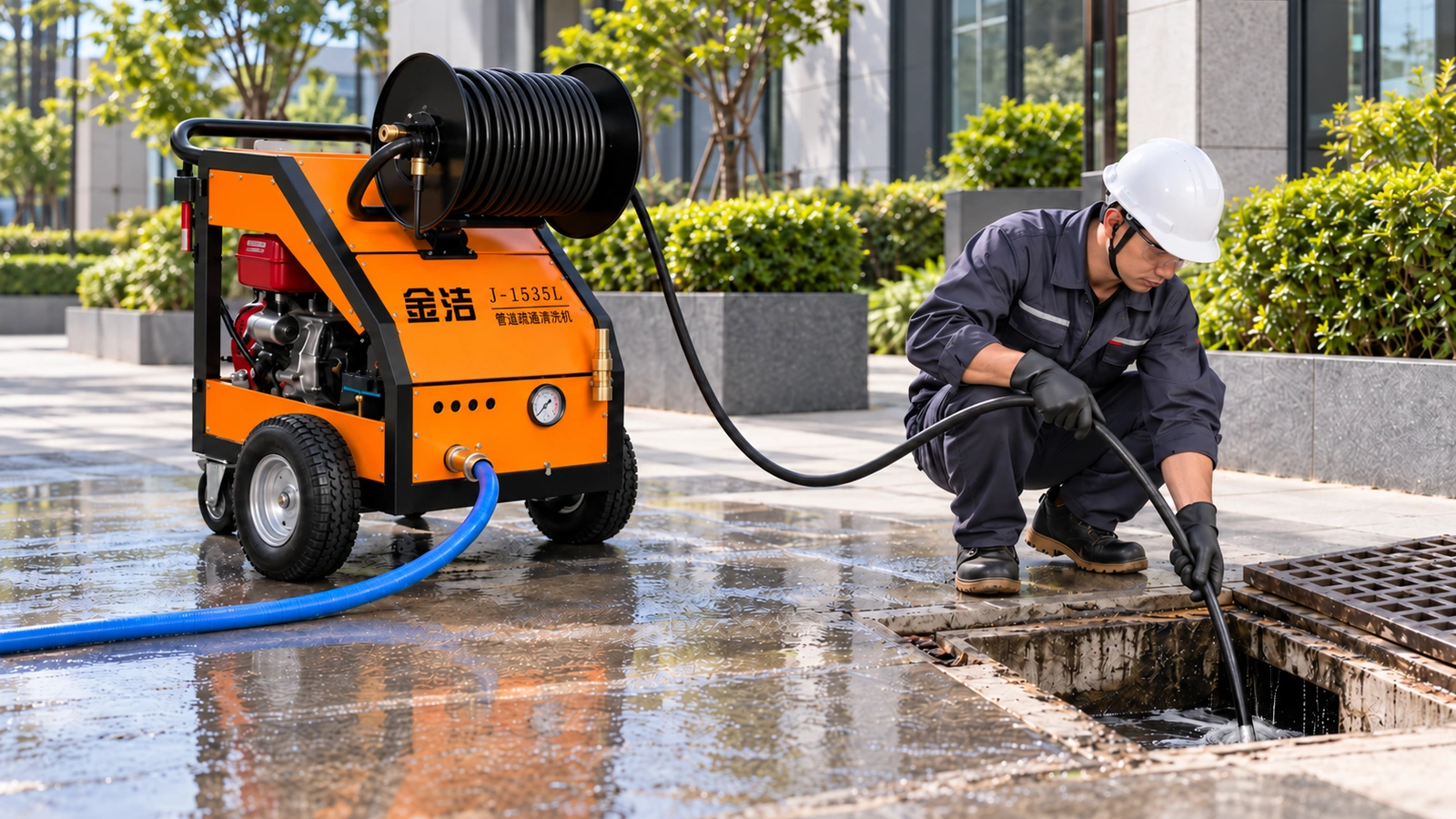
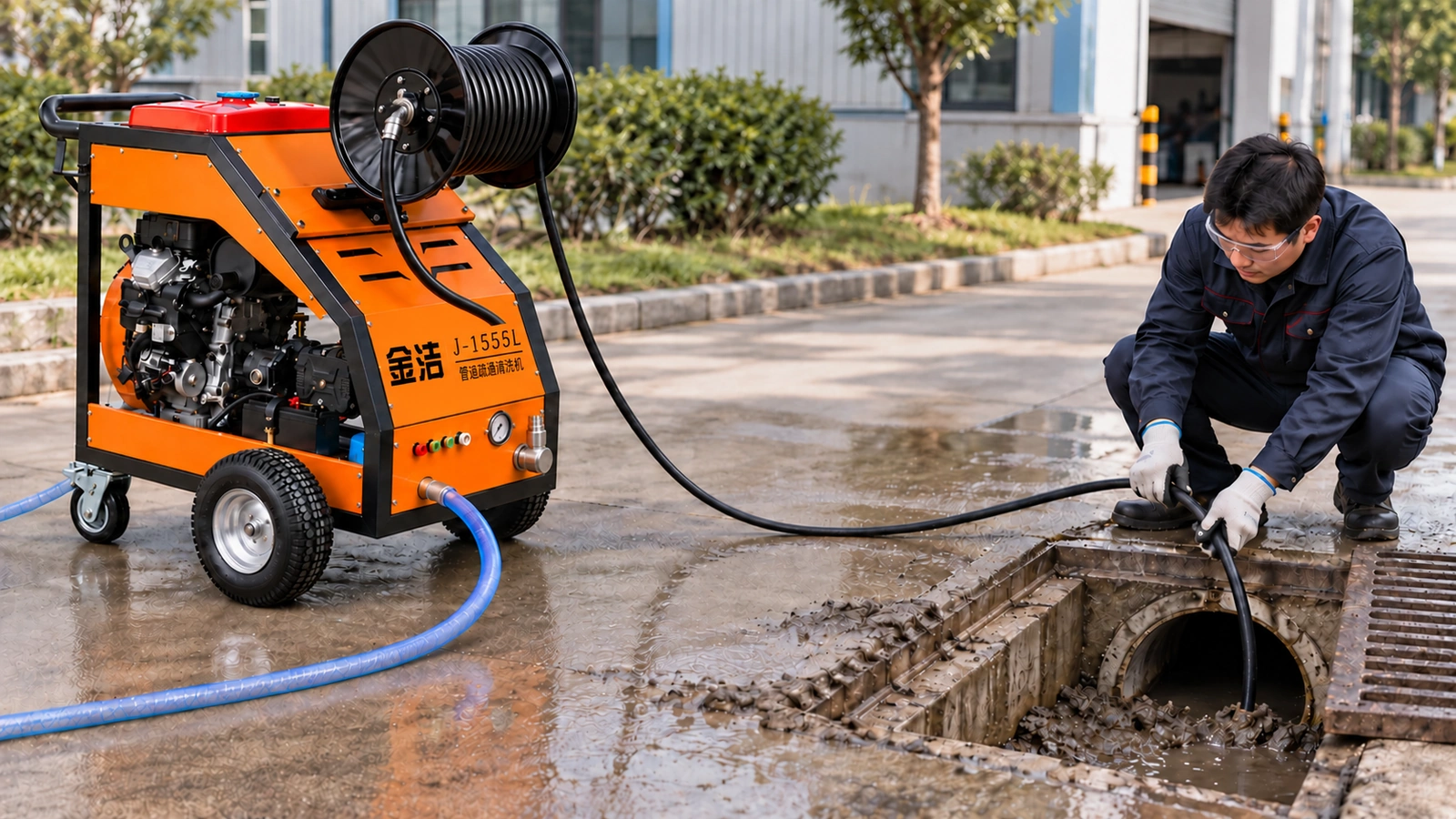
Typical operating reference for access points and drainage branches in open outdoor property areas. Identify deposits and the downstream route before choosing a nozzle and hose-feeding method. The illustration explains the outdoor drainage task and is not verified customer delivery.
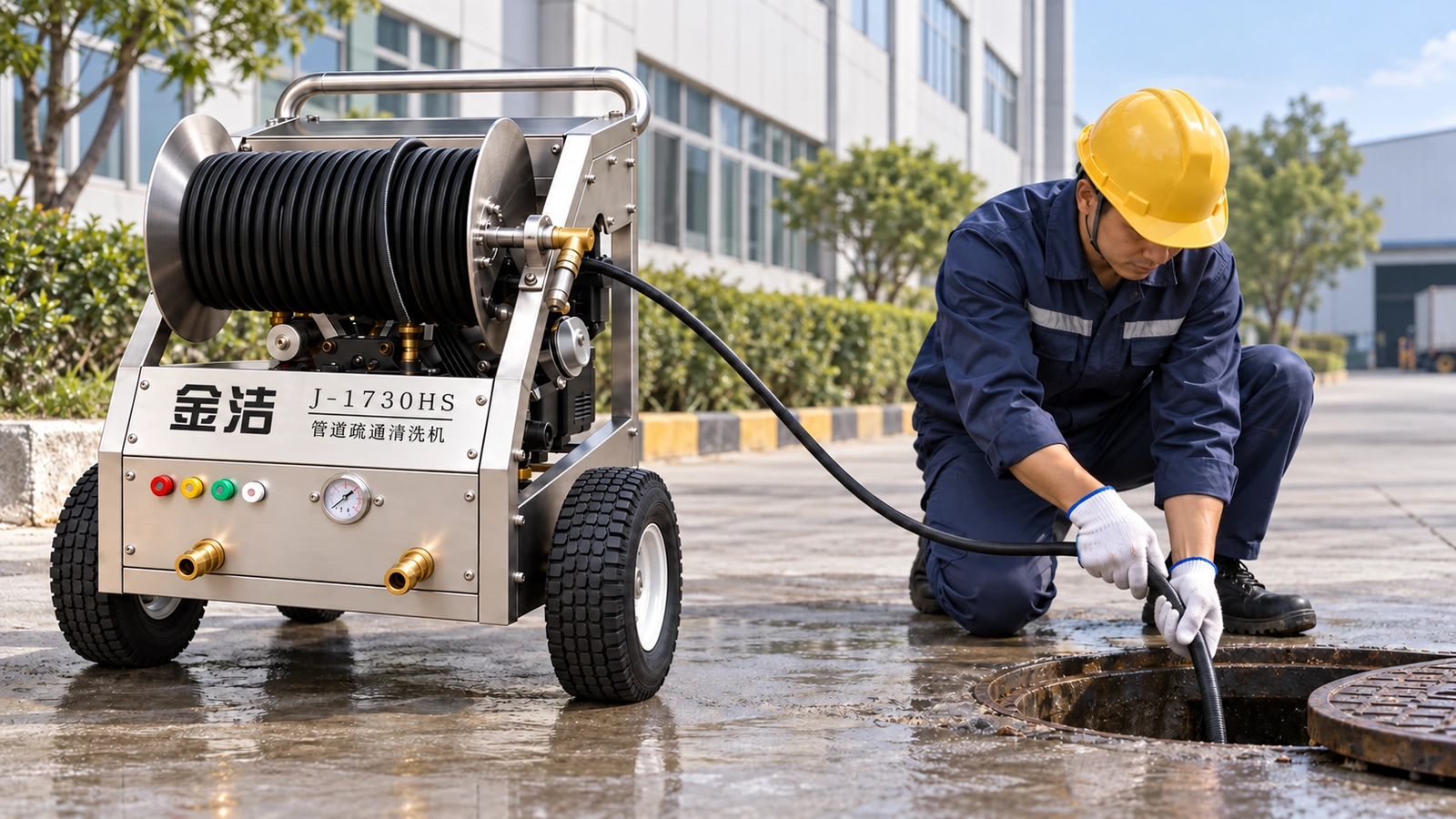
The J-1730HS reel supports organised deployment, retrieval and storage, with water flow and a suitable nozzle selected for the pipe route.
01 · The customer’s cleaning problem
Outdoor property access points are dispersed, requiring organised hose handling and moves. Loosened deposits still need a downstream route and collection; pressure alone misses nozzle, route and supply requirements.
02 · Why this Jinjie machine?
The J-1730HS reel supports organised deployment, retrieval and storage, with water flow and a suitable nozzle selected for the pipe route. GX390 gasoline power belongs at suitable open outdoor positions; 304 material statements remain limited to confirmed components.
03 · Cleaning results, workflow and customer value
Checking the pipe, blockage and water arrangements before sectional access-point work can reduce blind trial work and unnecessary hose handling. Planning separation, hose checks and wastewater collection supports a more orderly suitable task, without guaranteeing reach, one-pass clearance or fixed savings.
This model lists a GX390 engine, an AR plunger pump and a 304 stainless-steel reel. The 304 statement applies only to the reel; it does not establish whole-machine material, certification, service life or failure rate.
- This section does not recommend the petrol unit for underground garages, indoor locations, exhaust-trapping semi-enclosed areas or unverified hazardous zones. A longer hose does not replace site assessment.
- No man-entry task is proposed; jetting does not authorise confined-space entry. Hard obstructions, roots and collapse may require other removal or repair methods. Confirm the actual configuration against the machine, manual and order.
Problems, equipment and customer value
| Site problem | Equipment feature and selection basis | Working method | Potential value |
|---|---|---|---|
| Scattered access points and repeated hose handling | The current page lists a 304 stainless-steel reel | Plan hose deployment, recovery and storage by access point | Include hose management in the maintenance route without inferring service life |
| Loosened sediment still needs a discharge route | The page lists 170bar(17MPa) maximum pressure and 30 L/min flow | Check pipe size, bends, blockage and wastewater collection before staged work | Reduce selection errors caused by considering pressure alone |
| Some outdoor points have no fixed power outlet | The page lists a GX390 petrol engine | Keep the unit in an appropriate open outdoor location and assess fuel and water | Define power conditions rather than treating mobility as universal suitability |
Equipment and configuration boundaries
This model lists a GX390 engine, an AR plunger pump and a 304 stainless-steel reel. The 304 statement applies only to the reel; it does not establish whole-machine material, certification, service life or failure rate.
Confirm standard and optional items from the configuration list. A front-one/rear-six nozzle, other jetting heads and flow dividers are not included merely because a hose appears in an illustration. Compare reel material and handling frequency with J-1730H; assess suitable electric equipment where power is available without inferring hazardous-area approval.
Site assessment and working method
Provide pipe diameter, material, length, bends, access-point locations, blockage type, downstream collection, water supply, work windows and pedestrian/vehicle routes.
Trained personnel should inspect the equipment and hose according to the manual, isolate the access point and plan work from a suitable opening. Stop and reassess backflow, unusual resistance, leakage or suspected collapse.
Limits and safety
This section does not recommend the petrol unit for underground garages, indoor locations, exhaust-trapping semi-enclosed areas or unverified hazardous zones. A longer hose does not replace site assessment.
No man-entry task is proposed; jetting does not authorise confined-space entry. Hard obstructions, roots and collapse may require other removal or repair methods. Confirm the actual configuration against the machine, manual and order.
Questions before selecting equipment
Does this illustration justify petrol operation in an underground garage?
No. This section concerns open outdoor access points. Indoor and underground tasks require separate equipment and process assessment.
Does a 304 reel mean the whole machine is 304 stainless steel?
No. The statement applies to the reel only; check other components against the actual configuration.
Do 170bar(17MPa) and 30 L/min guarantee a jetting distance?
No. Maximum pressure and flow alone do not determine reach or results; assess the pipe, nozzle, deposits, supply and drainage.
Provide the site conditions
Provide pipe diameter, material, length, bends, access-point locations, blockage type, downstream collection, water supply, work windows and pedestrian/vehicle routes.
Rental is subject to actual availability and project assessment; no model, stock or price is promised.