
Selected model: Jinjie J-XS1500
Typical application · Equipment selectionDry debris on level garage lanes: collect first and separate washing tasks
Jinjie J-XS1500
Collecting ordinary dry debris by lane can reduce repeated manual gathering and grit dragged during later washing. Coordinated routes, unloading and handover can organise shifts and help protect compatible surfaces; assess actual output and cost against debris, obstacles and maintenance.
01 · What makes this task difficult?
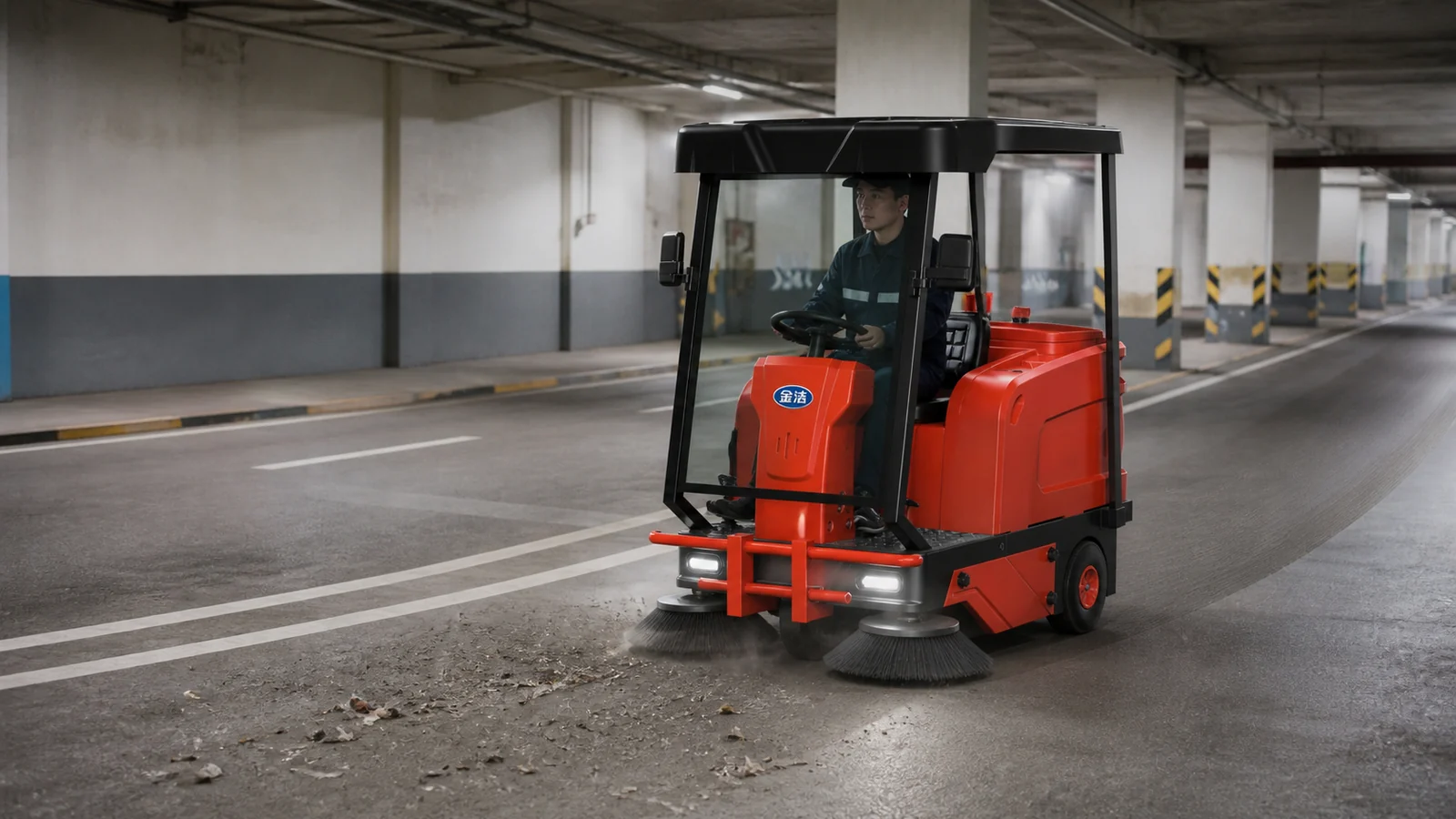
Leaves, paper and ordinary grit on parking lanes interrupt manual gathering around vehicles, columns and parking gaps. Customers need organised collection along accessible routes, not a promise that a sweeper will remove standing water, oily sludge or bonded tyre marks.
Soil, material and routes affect work
Trial material and method, then work sectionally and inspect results
Cleaning conflicts with occupancy or traffic
Plan windows, waste destination and handover inspection
Site conditions must match configuration
Do not borrow other models’ figures or treat options as standard
02 · Why consider this Jinjie machine?
Assess J-XS1500’s canopy ride-on construction and battery power for ordinary dry-debris routes, checking garage height, columns, turns, traffic and unloading. Main and side brushes gather suitable debris while an operator drives, observes and maintains the machine. A canopy does not establish enclosure, explosion protection or dust certification; ventilation and traffic control remain necessary.
This model’s real functions and suitable tools
Trial material and method, then work sectionally and inspect results
Reduce unnecessary repeated work
Sections, supplies and human support
Plan windows, waste destination and handover inspection
Organise labour and working time
This model’s instructions, consumables and supply
Do not borrow other models’ figures or treat options as standard
Manage damage, mismatch and rework risks
Jinjie J-XS1500 · Assess J-XS1500’s canopy ride-on construction and battery power for ordinary dry-debris routes, checking garage height, columns, turns, traffic and unloading. Main and side brushes gather suitable debris while an operator drives, observes and maintains the machine. A canopy does not establish enclosure, explosion protection or dust certification; ventilation and traffic control remain necessary.
03 · A better cleaning workflow and customer value
Collecting ordinary dry debris by lane can reduce repeated manual gathering and grit dragged during later washing. Coordinated routes, unloading and handover can organise shifts and help protect compatible surfaces; assess actual output and cost against debris, obstacles and maintenance.
Reduce unnecessary repeated work
Soil, material and routes affect work · Trial material and method, then work sectionally and inspect results
Organise labour and working time
Cleaning conflicts with occupancy or traffic · Plan windows, waste destination and handover inspection
Manage damage, mismatch and rework risks
Site conditions must match configuration · Do not borrow other models’ figures or treat options as standard
Match tools, the material and the working route before comparing labour, time, consumables and maintenance costs. The potential value depends on suitable conditions and correct operation; no fixed saving or damage-free result is promised.
This guidance covers ordinary dry debris on assessed level lanes only. Exclude standing water, oily sludge, hot chips, combustible dust and hazardous zones. Separate traffic and check canopy height, turns, ventilation, charging and unloading; no slope capability or fixed runtime is promised.
Working method, evidence and original professional analysis
Task-specific equipment selection
Car-park aisle and parking-area sweeping | J-XS1500 selection and value
Site, material and contamination
Leaves, paper and ordinary grit on parking lanes interrupt manual gathering around vehicles, columns and parking gaps. Customers need organised collection along accessible routes, not a promise that a sweeper will remove standing water, oily sludge or bonded tyre marks.
Equipment basis and model differences
Assess J-XS1500’s canopy ride-on construction and battery power for ordinary dry-debris routes, checking garage height, columns, turns, traffic and unloading. Main and side brushes gather suitable debris while an operator drives, observes and maintains the machine. A canopy does not establish enclosure, explosion protection or dust certification; ventilation and traffic control remain necessary.
Model configuration and selection
Check model-specific configurations against the machine and order before purchase.
| Model | Current basis and limits |
|---|---|
| J-XS1500 | Assess J-XS1500’s canopy ride-on construction and battery power for ordinary dry-debris routes, checking garage height, columns, turns, traffic and unloading. Main and side brushes gather suitable debris while an operator drives, observes and maintains the machine. A canopy does not establish enclosure, explosion protection or dust certification; ventilation and traffic control remain necessary. |
| Site problem | Equipment / conditions | Suggested method | Potential value |
|---|---|---|---|
| Soil, material and routes affect work | This model’s real functions and suitable tools | Trial material and method, then work sectionally and inspect results | Reduce unnecessary repeated work |
| Cleaning conflicts with occupancy or traffic | Sections, supplies and human support | Plan windows, waste destination and handover inspection | Organise labour and working time |
| Site conditions must match configuration | This model’s instructions, consumables and supply | Do not borrow other models’ figures or treat options as standard | Manage damage, mismatch and rework risks |
Working method, accessories and site supply
- Confirm ordinary dry debris, remove oversized items and define traffic separation and closure windows.
- Check garage height, columns and turning space against the canopy body, then trial a representative route.
- An operator drives and observes, following brush and collection instructions; use suitable separate methods for water or oily sludge.
- Inspect collection and remaining debris, unload at an approved point and plan charging and maintenance before reopening.
Limits and safety
This guidance covers ordinary dry debris on assessed level lanes only. Exclude standing water, oily sludge, hot chips, combustible dust and hazardous zones. Separate traffic and check canopy height, turns, ventilation, charging and unloading; no slope capability or fixed runtime is promised.
Questions for this task
Prepare site information
Provide garage routes, height and column clearance, debris photos, traffic windows, gradients, unloading and charging points, and this machine’s configuration.
FAQ
Does a canopy mean full enclosure or hazardous-area protection?
No. Verify the machine and configuration; a canopy or front screen does not establish enclosure, explosion protection or dust certification.
Does this replace garage washing?
No. This task collects ordinary dry debris; use suitable separate washing or recovery for oily sludge, water and bonded soil.
Are fixed labour savings guaranteed?
No. Trial routes, debris, access and unloading, then record actual time and staff input.
What site information is needed for selection?
Provide garage routes, height and column clearance, debris photos, traffic windows, gradients, unloading and charging points, and this machine’s configuration.
Select equipment for the actual site
Provide garage routes, height and column clearance, debris photos, traffic windows, gradients, unloading and charging points, and this machine’s configuration.
Jinjie J-XS1500 · Selection enquiryCompare application plansModels and original application images
Compare each model against its own configuration and the actual route, material and site services.
Jinjie J-XS1500
Current model
Assess J-XS1500’s canopy ride-on construction and battery power for ordinary dry-debris routes, checking garage height, columns, turns, traffic and unloading. Main and side brushes gather suitable debris while an operator drives, observes and maintains the ma…