Supermarkets and shops
- Typical site
- Supermarkets and shelving aisles
- Why it fits
- Check entrances and turns around shelving. Assess walk-behind handling for zoned shop cleaning.

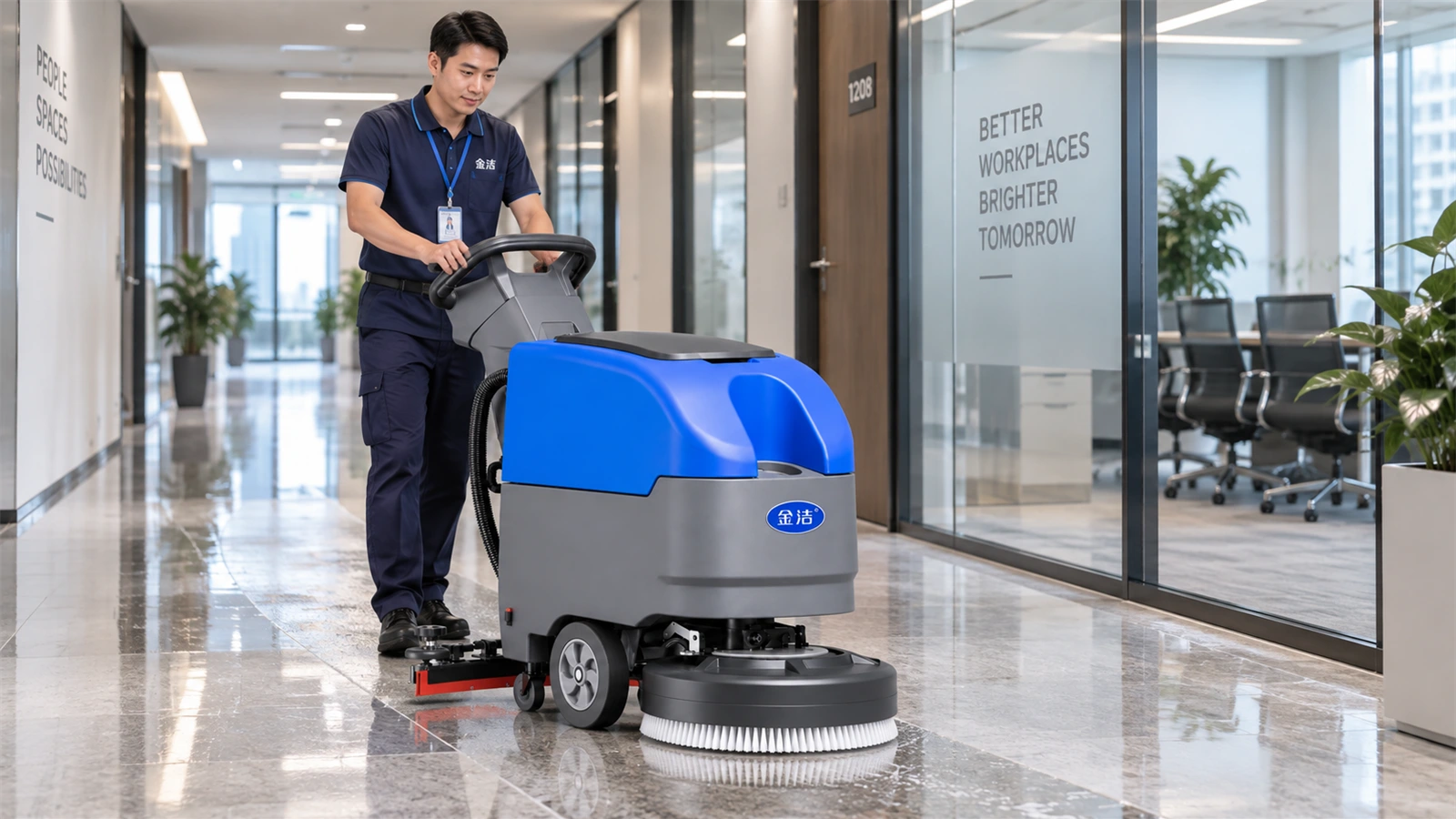
The Jinjie J-D3C combines floor scrubbing and wastewater recovery for zoned cleaning in offices, shops and floor corridors. Check the surface, turning space, water access and operator arrangements together.

Plan scrubbing and pickup around shelving and display areas, with aisle-width and pedestrian-window checks before work.

Assess hard-floor office corridors with route-based scrubbing/pickup outside busy pedestrian periods.

Assess daily cleaning of lift lobbies and shared floor corridors, checking turns, floor material and residual water.
J-D3C for routine cleaning of smaller hard-floor areas: assess access, scrubbing and water recovery together.
Assess J-D3C where frequent routine cleaning combines with limited aisle and turning space. Check the narrowest route, lift entrances and turns alongside the daily cleaning area.
For frequent cleaning of offices, shops and floor corridors, J-D3C combines scrubbing and water pickup in one pass to replace suitable repeated mopping tasks.
Assess J-D3C on smaller zoned routes where doors, lifts and turns constrain larger machines. Confirm actual dimensions and manoeuvring clearance.
J-D3C combines scrubbing with wastewater recovery to address the water left by repeated mopping. Check residual water and safe reopening on the actual floor.
Start with the floors to be cleaned each day and the available time. Wanshenglong considers the J-D3C scrubbing and recovery configuration alongside surfaces, access, water handling and staffing, helping buyers and operators assess the same cleaning task.
Review the key configuration, then the full specifications.
Specifications grouped by cleaning performance, power and charging, and machine configuration.
| Cleaning performance | |||
|---|---|---|---|
| Cleaning width | 460mm | Squeegee width | 720mm |
| Solution tank | 45L | Recovery tank | 50L |
| Runtime | 2–3 hours | Theoretical cleaning efficiency | 2300㎡/h |
| Theoretical operating speed | 5 km/h | ||
| Power and charging | |||
| Working voltage | 48V | Power configuration | 48V / 20Ah |
| Battery brand | Standard Tianneng lead-acid battery | Brush motor | 400W |
| Vacuum motor | 300W | Charger | Smart charger |
| Charging time | Lead-acid: approximately 8 hours | ||
| Machine configuration | |||
| Dimensions | 1200×700×1050mm | Weight | 75kg |
| Operation | Walk-behind | Noise level | 68dB(A) |
Theoretical efficiency uses cleaning width × 5 km/h for comparison; it is not actual productivity. Standard battery: 48V / 20Ah lead-acid; runtime: 2–3 hours; charging: approximately 8 hours.
Injection-moulded engineering PE; resistant to acid and alkali corrosion
Steel frame, multi-layer galvanised electrophoretic coating and stainless fasteners
Integrated pressure adjustment for different floor conditions
Solenoid-controlled water flow
Rubber guide wheels for improved impact protection
Manual lift and motor soft start
Use J-D3C's working width, tanks, battery and dimensions to assess access, the daily task, filling/draining and operator handling rather than comparing figures alone.
Assess routine cleaning of smaller areas with restricted aisles.
Site checks: narrowest entrance, lift and turning space.Plan fewer interruptions for filling and draining on suitable smaller cleaning tasks.
Site checks: water points / wastewater disposal.Assess movement within floors, shops and shared corridors.
Site checks: charging location and daily frequency.Confirm entry, turning and parking space before purchase.
Site checks: doors, lifts, storage and ramps.Assess area, aisles, pushing effort and work duration before deciding between a compact walk-behind, powered-travel or ride-on machine.
| Item | J-D3C | J-D3 L | J-D5SL | J-D6SL | J-D7SL |
|---|---|---|---|---|---|
| When to assess this model | Smaller areas, restricted aisles and frequent routine cleaning | Compare configuration and handling within the compact walk-behind category | Larger areas with a need to reduce pushing effort | Compare ride-on options as continuous task area increases | Ride-on; compare the actual configuration and route rather than ranking productivity by model number |
| Work method | Walk-behind | Walk-behind | Powered travel | Ride-on | Ride-on |
| Conditions to compare | Minimum aisle width, turning space and daily area | Configuration, dimensions and actual access | Pushing effort, task duration and medium-area routes | Whether the route permits ride-on access | Working width, tanks and continuous routes |
Assess J-D3C's compact walk-behind layout where smaller areas require frequent cleaning and routes or turns restrict larger equipment. Confirm actual clearance by trial.
Compare J-D5SL when the area or duration increases and powered travel is needed to reduce pushing effort.
Compare ride-on models such as J-D6SL/J-D7SL for more open routes and larger continuous tasks where access and turning conditions allow them.
Consider offices, shops and corridors requiring repeated cleaning of small zones. Assess the actual daily cleaning area, available time, surface, access and water points rather than total building area. For long routes, compare operator effort with a self-propelled machine on the same task.
For tile, inspect the glaze, joints and slip-resistant texture; for stone, confirm the material, finish and cleaner compatibility; for epoxy, check coating condition and the flooring supplier’s curing requirements. Use compatible brushes or pads and a suitable low-foam cleaner with J-D3C. Trial a small area and assess marking, soil removal and recovery before setting the routine. Harder brushes or stronger chemicals are not substitutes for compatibility.
The 460 mm cleaning width describes brush coverage and the 720 mm squeegee width describes recovery coverage. Check the 1200 × 700 × 1050 mm machine envelope, squeegee edges and operator space at doors and turns.
The 45 L solution tank and 50 L recovery tank help you plan refilling and emptying. Water setting, soiling and the route affect frequency. Identify suitable filling and disposal points to avoid unnecessary trips between floors.
Current information states 2–3 hours with a 48 V/20 Ah lead-acid battery configuration and approximately 8 hours charging. Battery condition, load and operation affect actual duration. Allow time for water handling and cleanup, use the matching charger, and follow the delivered instructions for charging conditions.
Trial a representative route with straights, doors, turns and edges. Record completed area, cleaning and recovery quality, and total time including water handling, yielding and finishing. The listed theoretical 2300 m²/h is a comparison reference; use site records and required cleaning frequency to plan daily output.
Keep the cleaning task constant and compare coverage, tanks, envelope, water handling and operation. The J-D3C and J-D3L are walk-behind options; the J-D5SL has self-propelled assistance. Assess pushing effort on longer routes. Self-propelled assistance is not autonomous navigation, and each delivery configuration remains separate.
Stop safely and isolate power as instructed. Check the recovery tank, lid seal, suction hose, squeegee wear, trapped debris and floor contact. Joints and turns also matter. Replace wear parts according to condition, not a universal lifespan; do not dismantle energized components and contact service if needed.
Provide photographs, actual cleaning area, surface and soil, narrow points, turns, working window, water points and staffing. Shenzhen Wanshenglong Cleaning Products Co., Ltd. can discuss Jinjie selection, trials, training and parts. On-site work, maintenance scope, charges and scheduling depend on location and agreement; verify suitability with a trial where model-specific case evidence is unavailable.
Tell us what needs cleaning, how often and what slows the team down. We can use your site details to work through the right machine and configuration together.